SDG 16.3.2
SDG 16.3.2 Policy- and lawmakers outreach and education
NCUE faculty members actively assist policymakers and lawmakers by providing outreach activities and courses relating to sustainable development concepts such as economics, law, technology, migration, displacement, and climate change. Faculty members in relevant professional fields help implement government agency project and serve as advisory or guidance committee members for government agencies. Through these activities, they help policymakers and lawmakers recognize and understand these sustainable development concepts and identify feasible strategies and specific actions toward achieving the United Nations’ 2030 Sustainable Development Goals (SDGs).
1. Government Department Projects (2023–2025)
In 2023, 21 NCUE faculty members carried out 22 government department projects. In 2024, 26 faculty members carried out 28 projects. In 2025, 40 faculty members carried out 40 projects. The details are as follows:
(1) Two faculty members assisted with two projects under the "Economy" theme:
(a) Assistant Professor Xian-Ji Kuang of the Department of Finance is carrying out an NSTC project from August 1, 2025, to July 31, 2026, titled "The Role of Good and Bad Jumps in VIX Option Pricing". Since the CBOE launched VIX options in 2006, they have become the second most heavily traded contract after S&P 500 index options. The project aims to build a more accurate VIX option pricing model based on a new framework incorporating good and bad jump, providing financial market participants with a reliable hedging model in today's highly volatile financial markets (Figure 1).

(b) Professor Yi-Shun Wang of the Department of Information Management is carrying out an NSTC project from August 1, 2025, to July 31, 2026 titled "Development and Validation of a Theory of Internet and E-Commerce Entrepreneurship Education: Building a Model of Internet Entrepreneurial Success that Integrates Internet Entrepreneurial Self-Efficacy, the Feasibility of Internet Business Ideas, E-Commerce Entrepreneurial Learning and Creative Personality Traits". 1. The project examines and validates a model for assessing the feasibility of internet business ideas. This will help business education researchers and practitioners judge whether students’ or individuals’ e-commerce business idea are feasible and viable in the market, thereby improving and promoting the development of e-commerce entrepreneurship. 2. The project also examines and validates a model for measuring internet entrepreneurial self-efficacy. This will help business education researchers and practitioners assess students' or individuals’ internet entrepreneurial capability and confidence and understand how to improve students’ internet entrepreneurial self-efficacy. 3. The project’s model of internet entrepreneurship education and success will help business education researchers and practitioners understand how e-commerce education can improve students' chances of succeeding as internet entrepreneurs. This will strengthen the global competitiveness of young people in Taiwan in e-commence innovation and entrepreneurship and promote the development of country's internet and digital economy (Figure 2).

(2) Two faculty members are contributing to two projects under the "Law" theme:
(a) Professor Mei-Chun Lin of the Department of Public Affairs and Civic Education is carrying out an NSTC project from August 1, 2025, to July 31, 2026, titled "Re-examining the Systems of Non-Performance of Obligations and Warranty Liability in Civil Law: On the 2022 Amendment to the German Law of Obligations". The project examines the legal questions raised by transactions in goods and services in the digital economy, analyzes the applicability and limitations of the Civil Code and the Consumer Protection Act apply, and draws on EU directives and the reform of German obligations law to propose amendments for Taiwan. At the social level, the project aims to clarify liability rules for digital goods and services, reduce consumer disputes, raise consumer confidence, protect vulnerable consumers, and support fair trading. At the economic level, a clear legal framework can attract investment and innovation and lower legal risk and compliance costs. At the academic level, the project can fill a gap in domestic research on the 2022 German reform, promote academic exchange, provide a comparative law basis for legislative amendments. Overall, the project seeks to address gaps in domestic research and may contribute to advances in the legal system and to social, economic and academic development (Figure 3).

(b) Professor Wen-Ching Chang of the Department of Accounting is carrying out an NSTC project from August 1, 2025, to June 30, 2026, titled "Research on the Impact of Audit Litigation on Auditor Reputation." The purpose of this research is to explore whether auditors involved in audit litigation suffer reputational damage and consequently lose other clients. This study makes several contributions to academic research on auditing. First, Anantharaman et al. (2016) and Chy et al. (2021) call for future research to explore more about the relationship between legal environment and auditor behavior, and the evidence in this study can respond to their call. Second, previous research focusing on accounting firms provides little empirical evidence on whether audit litigation damage reputational capital (Allen et al. 2005, Lennox 1999), and the evidence is inconsistent. This study can add archival empirical evidence on whether audit litigation damages auditors’ reputation. Finally, evidence on the reputational effects of audit litigation at the individual auditor level remains scarce, and this study can fill this gap in the literature (Figure 4).

(3) 27 faculty members assisted with 27 projects under the "Technology" theme:
(a) Professor Der-Rong Din of the Department of Computer Science and Information Engineering is carrying out an NSTC project from August 1, 2025, to July 31, 2026, titled "The Multi-Layer Filterless Optical Network Planning Problem with Point-to-Multipoint Transceivers". The work exploits the transmission characteristics of point-to-multipoint transceivers combined with filterless optical networks to design new transmission mechanisms. The algorithms make the best use of the resources an optical network provides and are expected to raise transmission performance while lowering the cost of building the network (Figure 5).

(b) Professor Chao-Chin Wu of the Department of Computer Science and Information Engineering is carrying out an NSTC project from August 1, 2025, to July 31, 2026, titled "A Study on Lightweight Deep Neural Network Architecture Search Methods for Highly Heterogeneous System Environments". The project optimizes deep learning models in heterogeneous resource environments, focusing on lightweight architectures and on raising the contribution of weak nodes. Using the distributed computing framework Ray, it combines population-based training (PBT) with natural evolution strategies (NES). PBT speeds up convergence while NES provides the global search that avoids local optima, improving the accuracy and stability of optimization. LoRA reduces computation and memory requirements and, combined with layer-by-layer loading and tensor parallelism, addresses the memory shortage of weak nodes. An adaptive scheduling strategy assigns tasks according to node performance, improving resource use and the contribution of weak nodes. The aim is efficient training of lightweight models as a workable solution for deep learning in resource-constrained environments (Figure 6).

(c) Professor Chia-Jyi Liu of the Department of Physics is carrying out the NSTC project from August 1, 2025, to July 31, 2026, titled "High-Performance Synthesis of Novel Thermoelectric Thick Films and Bulk Organic-Inorganic Composite Materials and Manufacturing of Thermoelectric Generators (2/3).” Reducing energy consumption during the synthesis of thermoelectric materials can help promote their widespread use in energy harvesting. Although the conversion efficiency of thermoelectric generators (TEGs) is currently lower than that of solar panels, minimizing the energy consumption in manufacturing thermoelectric materials may make the net electricity generation of TEGs comparable to that of solar panels. Additionally, thermoelectric modules offer high reliability and a long service life. Recently developed high-performance thermoelectric materials with zT > 2 promise even greater conversion efficiency (Figure 7).

(d) Professor Mine-Yine Liu of the Department of Chemistry is carrying out an NSTC project from August 1, 2025, to July 31, 2026, titled "Studying the Antioxidant Capacity of Acute-Phase High-Density Lipoprotein by Capillary Electrophoresis and Liquid Chromatography-Mass Spectrometry". It is still unclear how the antioxidant function of high-density lipoprotein (HDL) is affected by changes in its chemical composition and structure. In chronic inflammatory disease, HDL may shift to an acute-phase form that promotes the oxidation of low-density lipoprotein. The project compares how well normal and acute-phase HDL protect LDL against oxidation, using capillary electrophoresis and liquid chromatography-mass spectrometry. This study is expected in to help clarify the structure and function of acute-phase HDL and improve methods for detecting and treating related diseases (Figure 8).

(e) Professor Chia-Hsuan Wu of the Department of Intelligent Vehicle Engineering is carrying out an NSTC project from August 1, 2025, to July 31, 2026, titled "Development of a High-Efficiency Bidirectional Wireless Power Transfer System with Battery Voltage Balancing". The project aims to build a 900 W bidirectional wireless power transfer system with battery voltage balancing, based on a conventional series-series topology combined with a multi-stage converter and four battery packs. In charging mode, a balanced-charging control strategy bypasses packs at higher voltage to slow their charging and balance charging the packs. In power supply mode, the batteries feed power back to the DC bus. Selective harmonic elimination and balanced-discharge control are used to balance discharging among the batteries while reducing reactive power during AC power transfer. Academically, the project combines selective harmonic elimination with battery balancing in a wireless power transfer system to achieve bidirectional wireless power transfer, battery balancing and improved power transfer efficiency. In terms of industrial applications, wireless charging systems are increasingly used in electric vehicles. The proposed system has commercial development potential because it does not require a separate battery balancing circuit (Figure 9).

(f) Professor Jui-Yu Chou of the Department of Biology is carrying out an NSTC project from August 1, 2025, to July 31, 2026, titled "Dissecting Host-Microbe Interaction Mechanisms in Physarum polycephalum: An In-Depth Exploration of Symbiosis and Evolution". The project explores symbiotic relationship between microbes and their hosts in depth. It is expected to provide important breakthroughs in research on microbial evolution and soil ecology and promote innovation in theories and methods in related fields. The findings may be applied in environmental protection, biotechnology and medicine, particularly in discovering new bioactive compounds and disease-resistant microbes with commercial potential. Economically, the related technologies can support the development of biological resources and the commercialization of innovative products, bringing new economic benefits and strengthening Taiwan's competitiveness in biotechnology (Figure 10).

(g) Assistant Professor Yung-Chien Chou of the Department of Mechatronics Engineering is carrying out an NSTC project from August 1, 2025, to July 31, 2026, titled "Development of an AI-Driven Intelligent Service Robot System". The project aims to develop an AI-driven intelligent service robot system that integrates speech emotion recognition, natural language processing (NLP), facial expression recognition and speech synthesis. Multimodal fusion is used to improve the robot’s emotion sensing and natural interaction in different settings. The system will address inadequate emotions recognition and difficulties in smooth interaction in service robots. The robot will have adaptive emotions learning capabilities, dynamically updating its model during interaction, tailoring responses to user characteristics, simulating human emotional fluctuations and improving its ability to adjust its behavior across different settings. These capabilities will enable more intelligent and human-like interaction. Academically, the project advances multimodal emotion recognition and human-robot interaction technologies and help build highly adaptive intelligent systems. Economically, the findings are expected to support the development of the smart service industry, strengthen competitiveness in AI and robotics, promote industrial upgrading and the wider adoption of smart technologies, and contribute to achieving national AI development goals (Figure 11).

(h) Associate Professor Jin-Fa Chang of the Department of Electronic Engineering is carrying out an NSTC project from August 1, 2025, to July 31, 2026, titled "Research on Broadband Heterogeneously Integrated Transceiver Front-End Modules and Key Sub-Circuits for Sub-7 GHz WiFi 7 and 28 GHz 5G NR Communications". The project proposes a heterogeneously integrated broadband wireless transceiver system and front-end module for 5G New Radio and WiFi 7, with new low-power, high-performance sub-circuits and system architectures. These include ultra-wideband low-noise, low-power amplifiers, amplifiers with high variable-gain, power amplifiers, high-linearity switches, phase shifters and baluns. Compared with circuit designs reported in recent literature, the proposed sub-circuits offer lower cost and improved perform. The project plans to publish papers on the innovative sub-circuits and systems and submit patent applications. It also aims to transfer some of the resulting technologies4 to IC companies (Figure 12).

(i) Professor Chih-Wei Chang of the Department of Chemistry is carrying out an NSTC project from August 1, 2025, to July 31, 2026, titled "Photoluminescence Mechanisms and Fluorescence Quenching Behavior of High-Purity Carbon Quantum Dots". By preparing high-purity carbon quantum dots, the project aims to examine their photophysics and fluorescence quenching mechanisms in greater depth. The findings are expected to improve understanding of how carbon dots emit light and draw attention to the need to purify them. The project also aims to study how chemical modification affects their optical properties so that these properties can be better controlled. An in-house continuous-flow reactor is expected to provide a method for scaling up carbon quantum dot production (Figure 13).

(j) Professor Ing-Chau Chang of the Department of Computer Science and Information Engineering is carrying out an NSTC project from August 1, 2025, to July 31, 2026, titled "A Self-Attention Meta Reinforcement Learning Multi-Task Offloading Strategy for the Internet of Vehicles". Using vehicular edge computing (VEC), the project integrates vehicular networks with edge computing and designs an adaptive multi-task offloading model, Self-Attention Meta Reinforcement Learning (SAMRL), that minimizes computing latency and resource consumption and maximizes the efficiency of the Internet of Vehicles. Tasks are offloaded and allocated to different nodes to meet the varied service requirements of intelligent transport systems (ITS), and the model adapts as conditions change. The network simulations and the implementation and training of the meta reinforcement learning system will also help train specialists in network edge computing and meta reinforcement learning (Figure 14).

(k) Assistant Professor Chi-Hua Hsu of the Department of Mechatronics Engineering is carrying out an NSTC project from August 1, 2025, to July 31, 2026, titled "Static and Dynamic Analysis of Cracked Smart Composite Materials in Hygrothermal Environments". Magneto-electro-elastic composites are used in sensors, energy harvesters and other precision devices because their magnetic, electric and mechanical fields are coupled. Their high sensitivity and brittleness make them prone to performance deviation when temperature and humidity change, and crack initiation and growth shorten component life. The project builds numerical models of cracked magneto-electro-elastic structures and analyzes their static and dynamic behavior under different hygrothermal conditions, crack boundary conditions and crack geometries. The findings are expected to provide an important theoretical basis for the structural design and life assessment of smart composite structures (Figure 15).

(l) Assistant Professor Jiunn-Shiou Fang of the Master's Degree Program in Artificial Intelligence Technology Application is carrying out an NSTC project from August 1, 2025, to July 31, 2026, titled "Neural Network Based Adaptive Learning Algorithm Design for Sliding Mode Controllers, Saturation Function Parameters and Chattering Suppression". The project proposes a neural network-based adaptive learning algorithm for sliding mode controller design that learns an appropriate value for the saturation function parameter within the designed bounds and guarantees that the sliding trajectory converges within a sufficiently small boundary, so that high-frequency chattering in the control input is suppressed and the ideal sliding mode behavior is approached. The results can be published in academic papers (Figure 16).

(m) Associate Professor Li-Wei Tseng of the Department of Mechatronics Engineering is carrying out an NSTC project from August 1, 2025, to July 31, 2026, titled "Microstructure and Superelastic Properties of Lightweight Magnesium Shape Memory Alloys". The new MgSc shape memory alloy is superelastic and shows the shape memory effect at room temperature, and weighs about one third as much as conventional NiTi alloy. It can replace NiTi in industrial uses such as mobile phone antennas, spectacle frames, couplings, medical devices, fasteners and vibration dampers, and in aerospace applications such as internal frames for space habitats, damping devices for spacecraft systems and wing actuators, where its low weight reduces the energy a spacecraft or rocket must expend. The results will serve as a reference for future academic work and for industrial processing of MgSc shape memory alloys (Figure 17).

(n) Professor Shyuh-Yaur Tzeng of the Department of Mathematics is carrying out an NSTC project from August 1, 2025, to July 31, 2026, titled "Patterns and Waves in Equilibrium Models". In recent work, Professor Tseng and his collaborators studied the possibility of multiple travelling waves for nonlocal reaction-diffusion equations on infinite channels. They proved the existence of different types of travelling front solutions and estimated the speed of each. They also showed that a fast wave can catch up with a slow one so that the two merge into a new wave, giving three distinct wave profiles, with the newly generated wave faster than the slow one. Building on this work, the project aims to make progress by refining the methods and carrying out certain estimates in the first year. One focus is comparing and estimating the speeds of non-planar and planar travelling pulses. To the investigator’s knowledge, no definite answer to this class of problems is yet known (Figure 18).

(o) Professor Hon-Man Lee of the Department of Chemistry is carrying out an NSTC project from August 1, 2025, to July 31, 2026, titled "Integrated Nuclear Magnetic Resonance Research Project of the Department of Chemistry, National Changhua University of Education". The project introduces a new nuclear magnetic resonance (NMR) spectrometer to strengthen the department's teaching and research, particularly in molecular structure determination, high-sensitivity analysis and new materials development. Older instruments cannot adequately support current research needs, so the new equipment will improve the department's competitiveness in research and teaching and strengthen students’ experimental kills, laying a solid foundation for careers in industry or further study. At the social level, the project will promote the wider adoption and use of high-technology instruments and support cooperation with companies in chemistry, biomedicine and environmental science, helping improve industrial technology and accelerate the transfer of research results. Economically, greater research efficiency will support the development of innovative products and the local high-technology industry, increasing output value and competitiveness. Academically, the project will strengthen the department's position in international academic exchange, improve research quality and encourage cross-disciplinary collaboration. It will also help address current research bottlenecks and lay a solid foundation for future academic development (Figure 19).

(p) Assistant Professor Chien-Shing Li of the Department of Mechatronics Engineering is carrying out an NSTC project from February 1, 2025, to January 31, 2026, titled "Development of Highly Efficient Integrated Film and Transpiration Cooling Technology for Gas Turbines". Modern gas turbines are widely used in high-value industries such as aircraft engines and power plants. The global market has grown to about US$26 billion and is expected to exceed US$30 billion by 2026. The project develops key cooling technology and related designs to raise turbine cooling performance and efficiency, combining film and transpiration cooling in a systematic program of fluid and heat transfer simulation, prototype design and manufacture, experimental validation and optimization. It is expected to strengthen Taiwan's capacity to design efficient cooling systems for modern turbines independently and to train a new generation of specialists in advanced turbine technology (Figure 20).

(q) Professor Shih-Yuin Lin of the Department of Physics is carrying out an NSTC project from February 1, 2025, to January 31, 2026, titled "Interaction of relativistic Single-Electron Wavepackets in EM Vacuum: Quantum Information and Quantum Radiation (3/3)". The results will enrich quantum field theory in curved spacetime, relativistic quantum information and quantum electrodynamics. They will be compared with electron microscope and accelerator experiments and used to predict the outcome of strong-field laser experiments testing the Unruh effect. The work may also extend to quantum computing that uses free electrons as qubit carriers (Figure 21).

(r) Associate Professor Shih-Lin Lin of the Graduate Institute of Vehicle Engineering is carrying out an NSTC project from August 1, 2025, to July 31, 2026, titled "Deep Learning-Based Multimodal Non-Line-of-Sight Object Detection and Tracking Using Millimeter-Wave Radar, LiDAR and Cameras". The project builds a non-line-of-sight detection and tracking system based on multimodal sensor fusion to make autonomous driving and intelligent transport safer and more efficient. It is expected to reduce traffic accidents and protect pedestrians, support smarter cities and better traffic flow, stimulate the high-precision sensing and intelligent transport industries, and deepen research on multimodal fusion and non-line-of-sight technology (Figure 22).

(s) Professor Yow-Jon Lin of the Graduate Institute of Photonics is carrying out an NSTC project from August 1, 2025, to July 31, 2026, titled "Characterization of Sol-Gel-Prepared p-Type Gallium Oxide Films and the Fabrication and Optoelectronic Properties of Their Schottky Diodes". Research on p-type conduction in the wide-bandgap semiconductor gallium oxide is both urgent and innovative for academic work and for national development, and the project will strengthen Taiwan's research capacity and international competitiveness. Researchers taking part will be trained in observing the physical and chemical properties of gallium oxide, preparing the material, fabricating Schottky diodes and measuring their rectifying and photoresponse characteristics (Figure 23).

(t) Assistant Professor Chieh Lin of the Department of Physics is carrying out an NSTC project from January 1, 2025, to July 31, 2027, titled "Searching for New Physics Beyond the Standard Model through Rare Decays of Neutral Kaons: The KOTO Experiment at the Japanese Accelerator". The project asks why the universe contains far more matter than antimatter and what dark matter is. By participating in the KOTO experiment at the hadron accelerator in Japan, researchers study rare weak-interaction decays of subatomic particles to test the Standard Model. The experiment is a joint effort by Taiwan, the United States, Japan and Korea, and NCUE is responsible for data analysis and hardware development. The project aims to help resolve questions that have challenged physicists for decades (Figure 24).

(u) Professor Der-Yuh Lin of the Department of Electronic Engineering is carrying out an NSTC project from August 1, 2025, to July 31, 2026, titled "Growth of Copper Iodide (CuI) and Silver Iodide (AgI) Films and Their Optoelectronic and Thermoelectric Properties". The project grows AgI and CuI films by several methods and analyzes their optoelectronic properties using SEM, TEM, XRD, Raman, photoconductivity and modulation spectroscopy. Both films have wide optoelectronic and thermoelectric applications, can serve as transparent electrodes in light-emitting devices and can be made into p-n heterojunction diodes, which allows the formation mechanism of heterojunctions to be studied and offers commercial potential (Figure 25).

(v) Professor Yi-Cheng Lin of the Department of Mechatronics Engineering is carrying out an NSTC project from August 1, 2025, to July 31, 2026, titled "Achieving a 325 °C Low-Temperature Selenization Process for Sb₂(S,Se)₃ Absorber Layers: Mechanistic Analysis at Different Hydrogen Concentrations". In response to the growth of wearable devices and AI, the project develops flexible solar cells with an Sb₂(S,Se)₃ absorber layer made by a low-temperature process. In place of the conventional 425 °C selenization, it proposes a hydrogen-assisted low-temperature selenization and sulfurization process (HAS) and, by adjusting the H₂ concentration, the S/Se ratio and the annealing parameters, reaches 8% power conversion efficiency at 350 °C. Using a mixed Se and SeS₂ powder technique, it examines how hydrogen concentration affects film structure and defects and finally achieves selenization at 325 °C (Figure 26).

(w) Professor Chun-Yu Lin of the Department of Mechatronics Engineering is carrying out an NSTC project from August 1, 2025, to July 31, 2026, titled "Development and Application of a Vortex-Beam Interferometric Surface Profiler". The project proposes a surface profiling system that combines polarized vortex beams with spatial phase modulation by optical vortices, using a Michelson interferometer and the distinctive phase properties of vortex light. A vortex beam passing through the interferometer produces an interference pattern with a central dark fringe. Analyzing the change in the angle of that fringe gives the phase difference and hence the variation in surface height. The quasi-common-path design is accurate and stable and needs no expensive light source or electronic modulator, which lowers cost and helps miniaturization. For wafer measurement, a spiral scanning method checks surface flatness and overcomes current limits on measurement range, accuracy and speed. The aim is a high-precision, fast, low-cost and energy-efficient measurement system for wafer inspection, optical component manufacture, MEMS and materials science, provide solutions for academic and industrial needs (Figure 27).

(x) Assistant Professor Wei-Chen Lin of the Master's Degree Program in Artificial Intelligence Technology Application is carrying out an NSTC project from June 1, 2025, to May 31, 2026, titled "Applying Deep Learning to Improve Visual Defect Inspection of High-Density Interconnect Printed Circuit Boards". The project develops an automatic deep learning platform for detecting defects in HDI printed circuit boards to improve the efficiency and accuracy of existing inspection techniques and meet the needs of production lines. By combining image processing, convolutional neural networks (CNNs), self-attention and transfer learning, it addresses the weakness of conventional methods in detecting small targets and the high cost of data labeling. Statistical analysis and a visualization interface for defect data further improve production flow, productivity and quality control. The project will also promote industrial upgrading and academic progress through efficient inspection systems, bringing positive impacts to society, the economy and academia (Figure 28).

(y) Assistant Professor Chang-Yue Chiang of the Department of Chemistry is carrying out an NSTC project from August 1, 2025, to July 31, 2026, titled "A Reflective Fiber-Optic Nanogold-Linked Immunosorbent Assay (FONLISA) for the Detection of Silver Ions (Ag⁺)". Heavy metal pollution has become a major challenge to environmental safety worldwide, threatening ecosystems and human health, so fast, sensitive and reliable detection methods are in demand. The project builds a reflective fiber-optic nanogold-linked immunosorbent assay to detect silver ions in industrial wastewater, combining optical fiber technology with the localized surface plasmon resonance (LSPR) of gold nanoparticles for high sensitivity, fast response and ease of use. It provides an innovation detection technique, train researchers in optical sensing and environmental analysis, and strengthen Taiwan's environmental testing and instrument industries. The results will support real-time monitoring of heavy metal pollution in industrial wastewater and improve pollution prevention and control, with positive impacts on society, the economy and environmental safety (Figure 29).

(z) Professor Yih-Chern Horng of the Department of Chemistry is carrying out an NSTC project from August 1, 2025, to July 31, 2026, titled "Catalytic Exploration of Copper(II)-Pyrazole Systems in Nitrile Hydration". The study should establish copper(II)-pyrazole systems as an effective and sustainable alternative to noble metal catalysts for nitrile hydration. By showing that copper(II) catalysts can selectively produce amides or acids, it opens the way to greener catalytic processes in pharmaceutical, agrochemical and industrial chemical production. Copper is cheaper and less toxic than noble metals, which makes the method attractive at scale and addresses a key challenge in green chemistry (Figure 30).

(aa) Professor Liang-Rui Chen of the Department of Electrical Engineering is carrying out an NSTC project from August 1, 2025, to July 31, 2026, titled " Asymmetric Switched- Capacitor Battery Balancing System". The technology retains the advantages of conventional switched-capacitor battery balancing circuits, including minimal EMI/EMC problems, simple control, small board area and low cost. It also solves their main drawback, a balancing current that is too small. This makes switched-capacitor balancing usable with large battery packs and commercially competitive. The technology can be applied directly in battery energy storage systems, which are widely used in electric vehicles, grid-scale storage and uninterruptible power supplies, and will influence development of Taiwan's battery industry (Figure 31).

(4) One faculty member is contributing to one project under the "Immigration and Displacement" theme:
Professor Yi-Han Wang of the Department of Guidance and Counseling is carrying out an NSTC project from August 1, 2025, to July 31, 2027, titled "From 'New Immigrants' to 'New New Immigrants': Narratives of Divorce and Remarriage among Southeast Asian Immigrant Women and Family Relationships and Welfare Needs Following Remarriage to Immigrant Spouses". Chain migration and 'new new immigrant' families already exist in Taiwan. Practitioners observe that the family relationships and welfare needs of these families are distinctive. However, academic research and professional discourse pay them little attention. Some media reports and official documents frame the remarriage of naturalized, divorced Southeast Asian immigrant women as a problem and express concern that 'new new immigrants' may become an emerging social problem in Taiwan. Using intersectionality theory, the study examines three topics. First, it explores the experience of naturalized Southeast Asian immigrant women who divorce and remarry men from their home country or elsewhere. Second, it examines the family relationships and welfare needs of 'new new immigrant' families. Third, it collects and synthesizes data on the first two topics to identify key findings. The researchers will then work with a new immigrant center under an action research framework to develop one or two service programs that respond to those families’ needs (Figure 32).

(5) Four faculty members are contributing to Four projects under the "Climate Change" theme:
(a) Professor Yu-Ling Song of the Department of Geography is carrying out an NSTC project from July 1, 2025, to June 31, 2026, titled " A 'Large Place' Where Mountain Meets Sea: Observation of the Coastal and Foothill Social-Ecological Systems of Changhua County and Co-creation of Policies for Sustainability and Resilience (1/3)". The integrated project divides Changhua into foothill and coastal areas according to their social-ecological systems and addresses the following topics across five sub-projects: land use change, coastal landform change, local communication in coastal communities, lessons from elsewhere, foothill pest and disease control, and long-term meteorological monitoring. The topics match the Changhua County Government's priorities. These include coastal areas where lives and livelihoods have been affected by the green energy transition, and foothill areas affected by pests, air pollution and extreme weather. Improving agricultural production, living environments and health in these areas is an important goal of the country government. In the coastal area, sub-projects one and two collect scientific data on current land use and on conflicts between coastal landform change and residents' lives and livelihoods. Sub-project three gathers material on public communication, conflict and governance difficulties, compares it with the findings of sub-projects one and two, traces the context of conflicts and identifies key stakeholders to collect local knowledge. In the foothill area, sub-projects four and five monitor and address pests, air pollution and extreme weather that affect residents' industries, daily lives, health and safety. Public communication issues are also passed to sub-project three for today. The coastal communication model is used as a reference to assess whether intervention is needed to collect local knowledge. Sub-projects one, two and four provide relevant county government departments with scientific findings and the results of workshops and outreach activities. Sub-project three compiles the public communication issues raised by all sub-projects, collects and analyzes the data, and drafts local knowledge and communication guidelines for each topic. After discussion and revision with the other sub-projects, these guidelines are integrated into local communication strategies for the county government. Working with the county government puts knowledge translation into practice through the Knowledge to Action (KTA) process. This connects academic research with policy, increases the value of academic research for policy applications, supports scientifically grounded policies for sustainability and resilience (Figure 33).

(b) Professor Jien-Yi Tu of the Department of Geography is carrying out an NSTC project from August 1, 2025, to July 31, 2026, titled "The Influence of Changes in the Characteristics of Typhoons Near Taiwan on Rainfall in Taiwan across Different Time Scales". Typhoons are the main weather system bringing rain to Taiwan, and the amount of rain they bring during the typhoon season largely determines whether the water supply is sufficient. The project will help explain the causes of variation in typhoons striking Taiwan and in autumn rainfall across different time scales, and provide a reference for government agencies (Figure 34).

(c) Professor Su-Fen Wang of the Department of Geography is carrying out an NSTC project from August 1, 2025, to July 31, 2026, titled "The Effect of the Spatial Configuration of Photovoltaic Panels on the Environment and Ecology (Sub-project 3) (1/3)". Clean energy is essential to sustainable development, but the energy transition must balance economic benefit against environmental protection. Taking Fangyuan in Changhua as its case, the project examines how photovoltaic installations affect the coastal environment and ecology. It combines remote sensing imagery with deep learning to detect panels automatically with greater speed and accuracy, and quantifies the potential effect of panel layout on land surface temperature and ecosystems. The results are expected to contribute in the following areas: Social impacts: Scientific data will show the actual effects of panels on the environment and ecosystems and provide a reliable reference for siting and layout, helping ensure that green energy development sustainability and ecological conservation goals. The data can make policy more transparent, improve communication with residents, reduce misunderstanding and local conflict, and support ecological restoration in coastal areas to strengthen social and ecological resilience. Economic impacts: The results can make land use planning for the photovoltaic industry more efficient and precise and reduce the conflict-related cost for businesses and government during siting and development. Clear assessment of environmrntal and ecological impacts can also guide invrstor, including the development of response strategies for environmrntal and social reviews, and support the stable development of the renewable energy industry. Protect wetlands, fish ponds and farmland can maintain fishing and farming productivity, prevent inappropriate development from harming residents’ livelihoods, and support sustainable local economic development. Academic contributions: The project uses deep learning to interpret high-resolution satellite imagery automatically and combines it with UAV thermal infrared imagery to develop methods for measuring and assessing land surface temperature. This extends the application of remote sensing technology. By quantifying how panel layout affects land surface temperature and ecosystem connectively, the project provides a replicable and adaptable framework for assessing the environmental impacts of photovoltaic installations. The framework can also serve as a basis for future research in other regions. Other impacts: As green finance and environmental sustainability gain weight internationally, this scientific evidence can guide panel layout and reduce development conflict and environmental impacts. It can also strengthen Taiwan's competitiveness in the international green energy market, attract domestic and foreign investment, and promote the energy transition (Figure 35).

(d) Associate Professor Yi-Chin Chen of the Department of Geography is carrying out an NSTC project from August 1, 2025, to July 31, 2026, titled "Satellite Image Inversion Analysis of the Impact of Natural Processes and Human Development on the Topography and Sediment Grain Size of the Changhua Tidal Flats (Main Project and Sub-project 1) (1/3)". Using multi-temporal satellite imagery, the project develops techniques for monitoring the topography and sediment grain size of the Changhua tidal flats in order to analyze environmental change caused by natural forces (typhoons and monsoons) and by human development (the sea-ox walkway, the Lunweidong photovoltaic panels and similar works), and then assesses the impact on the intertidal ecosystem and the oyster farming industry. Sub-project 1 provides the basic research that underpins the main project on the interaction between the coastal energy landscape and local structural change in Changhua, and establishes key methods for monitoring the coastal ecological environment (Figure 36).

(6) Four faculty members are contributing to four projects under the "Sustainability" theme:
(a) Professor Fan-Yun Pai of the Department of Business Administration is carrying out an NSTC project from August 1, 2025, to July 31, 2027, titled "Sustainable Supply Chain Strategy and Management: Push, Pull and Mooring Forces and Ambidextrous Capability". Environmental sustainability is a pressing issue for industry. Companies, especially small and medium-sized enterprises (SMEs), should take on social and environmental responsibility in their operations and stakeholder relations and make sustainability part of their core strategy. From the perspective of SMEs, the study examines the push, pull and mooring forces behind sustainable supply chain strategy. It also set out concrete paths for developing ambidextrous capability in sustainable supply chain management, encompassing both exploratory and exploitative capabilities. This will help SMEs build sustainable supply chain capabilities, balance innovation with deeper sustainability practice, and strengthen their competitiveness and resilience in global markets (Figure 37).

(b) Professor Chih-Cheng Lo of the Department of Electrical and Mechanical Technology is carrying out an NSTC project from August 1, 2025, to July 31, 2026, titled "Designing Leadership Micro-Learning Modules for the Sustainable Development Goals: Mental Model Transformation and Green Innovation Capability". The project begins by examining how leaders' mental models should be reconstructed in the context of the Sustainable Development Goals (SDGs). It then explores the design of micro-learning modules for sustainable leadership development to strengthen leaders' ambidextrous green innovation capability. The projects uses a six-stage mixed-methods design. In the first year, narrative inquiry and lag sequential analysis examine the content of senior managers' sustainable leadership mental models and produce a measurement scale, filling a gap in the leadership literature. In the second year, the project examines the relationship between leaders' mental models and ambidextrous green innovation capability. It also analyzes the roles of employees' moral attentiveness and organizational ambidexterity in SDG dilemmas and designs the micro-learning modules accordingly. In addition to its academic contributions, the project will develop a sustainable leadership mental model scale and leadership micro-learning modules. These will help leaders use green training to cultivate ambidextrous green innovation capability within their organizations in the context of the SDGs (Figure 38).

(c) Assistant Professor Ping-Cheng Hsieh of the Department of Mechatronics Engineering is carrying out an NSTC project from August 1, 2025, to July 31, 2026, titled "Preform Heating and Energy-Saving Optimization in Plastic Blow Molding". As manufacturing moves toward green intelligent production, intelligence and energy saving have become essential. The preform heating and energy-saving optimization technology developed in this project should support academic research on green intelligent manufacturing and serve as an important reference for industry in developing intelligent machinery technologies. Other expected contributions are as follows:
i. The results can improve the product yield and productivity of plastic blow molding equipment, increase its added value, and generate profits for manufacturers.
ii. While meeting PET bottles performance specifications, the technology can also reduce equipment energy consumption and bottle weight, bringing green production into the manufacturing process of each bottle. It is expected to deliver material and energy savings together with high efficiency and product yield (Figure 39).

(d) Professor Ching-mu Chen of the Department of Geography is carrying out an NSTC project from August 1, 2025, to July 31, 2026, titled "Building a Quantitative Urban Model of Taichung City Using Telecommunications Signaling Data". The project aims to advance urban economics and to introduce a replicable framework for evaluating and planning urban policy. The results will also give Taichung City Government a reliable tool for designing fair and sustainable urban development strategies, narrowing the gap between academic research and policy practice (Figure 40).

2. Government Committee Appointments (2024–2025)
In 2024, Four NCUE faculty members held five appointments on government committees. In 2025, these numbers increased to ten faculty members holding fourteen appointments. These faculty members provide policymakers with recommendations for practical strategies and concrete actions to achieve specific sustainable development goals:
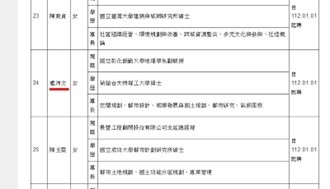
(1) Professor Pei-Wen Lu of the Department of Geography served as a member of the Ministry of the Interior’s National Spatial Planning Review Committee from January 1, 2023, to December 31, 2025. In this role, she helped review the drafting or revision of the national spatial plans, evaluate national defense and major public facility or public utility protects spanning two or more national land functional zones, solicit opinions on the national land white paper, review and improve the national spatial plan, and address other matters related to spatial planning deliberation or coordination (Figure 41).
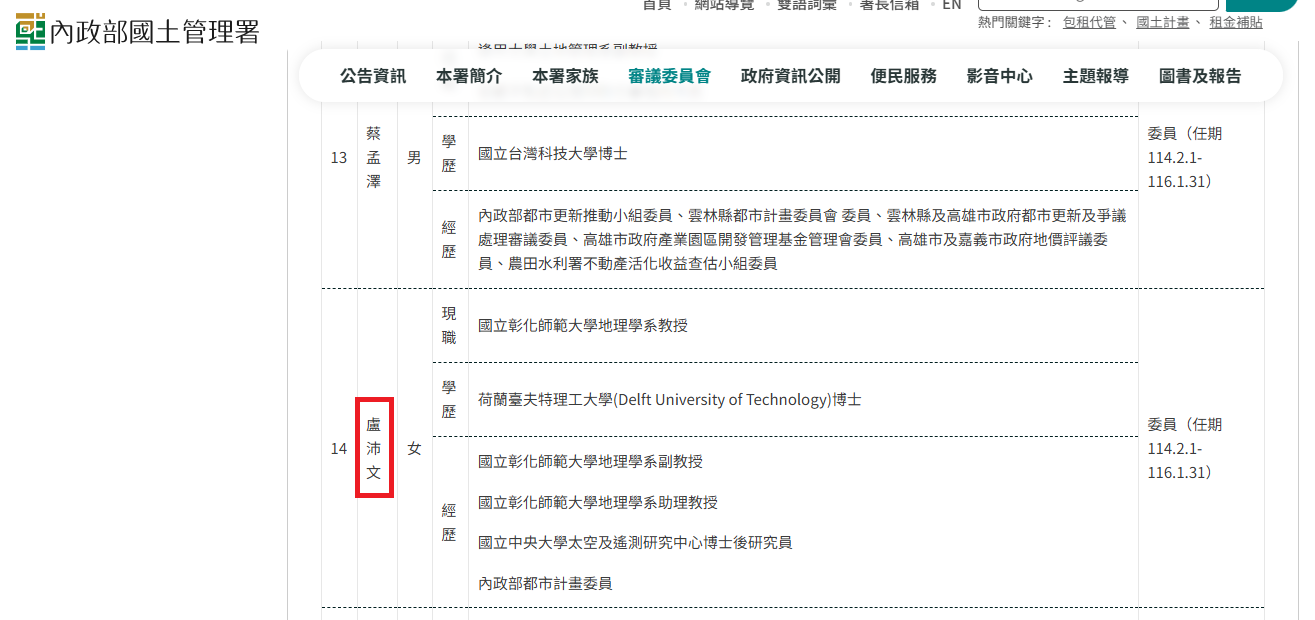
(2) Professor Pei-Wen Lu of the Department of Geography serves as a member of the Ministry of the Interior’s Construction and Planning Development Fund Management Committee from February 1, 2023, to January 31, 2027. In this role, she assists the government in effectively managing the income, expenditures, safekeeping, and utilization of the Construction and Planning Development Fund, contributing to the promotion and development of national construction projects (Figure 42). Website: https://www.nlma.gov.tw/ch/moicommittee/comm9/49
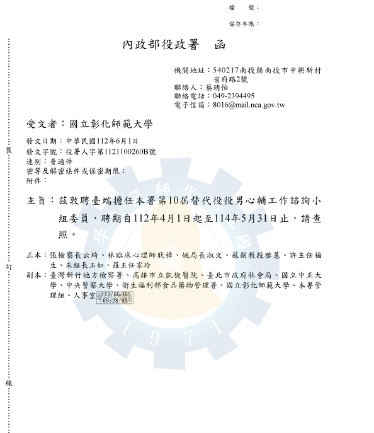
(3) Professor Jia-Ling Luo of the Department of Guidance and Counseling served as a member of the 10th Alternative Service Mental Health Consultation Group of the Ministry of the Interior's National Conscription Agency from April 1, 2023, to May 31, 2025. Professor Lo helped the agency provide psychological counseling and support services for alternative service draftees, offering professional guidance and advice to help them resolve psychological problems and complete their service safely and in good health (Figure 43).
(4) Professor Chien-Hui Lin of the Department of Special Education served as a member of the advisory committee for the gender equity education resource center for senior secondary schools under the K-12 Education Administration, Ministry of Education, for the 2024 academic Year, from August 1, 2024, to July 31, 2025. Professor Lin provided advice on gender equity regulations and on research and development in special education that promotes educational services suited to students’ needs and inclusion (Figure 44).
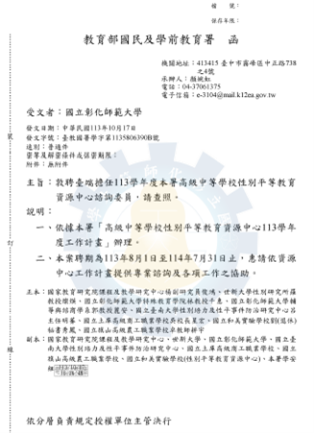
(5) Professor Li-An Kuo of the Department of Guidance and Counseling served as a member of the advisory committee for the gender equity education resource center for senior secondary schools under the K-12 Education Administration, Ministry of Education, for the 2024 academic Year, from August 1, 2024, to July 31, 2025. Professor Kuo provided advice on gender equity regulations and on research and development in special education that promotes educational services suited to students’ needs and inclusion (Figure 45).
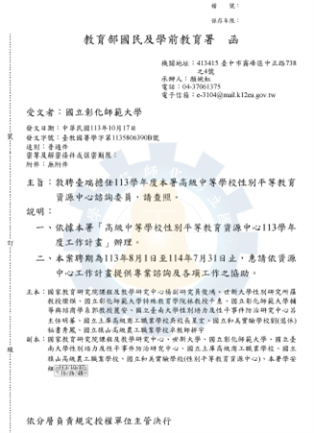
(6) Professor Chung-Chi Lin of the Department of Biology serves as Executive Director of the National Red Imported Fire Ant Control Center. He is responsible for professional technical support and for planning and supervising the implementation of emergency control programs. Established in November 2004, the center provides nationwide fire ant reporting and response, develops monitoring methods and control strategies suited to Taiwan's ecological environment, and works with communities and civic groups on outreach and the training of educators who can train others. These efforts help the government contain the spread of fire ants quickly and avoid heavy losses (Figure 46). Website: https://fireant.aphia.gov.tw/RedFireant/AboutUs
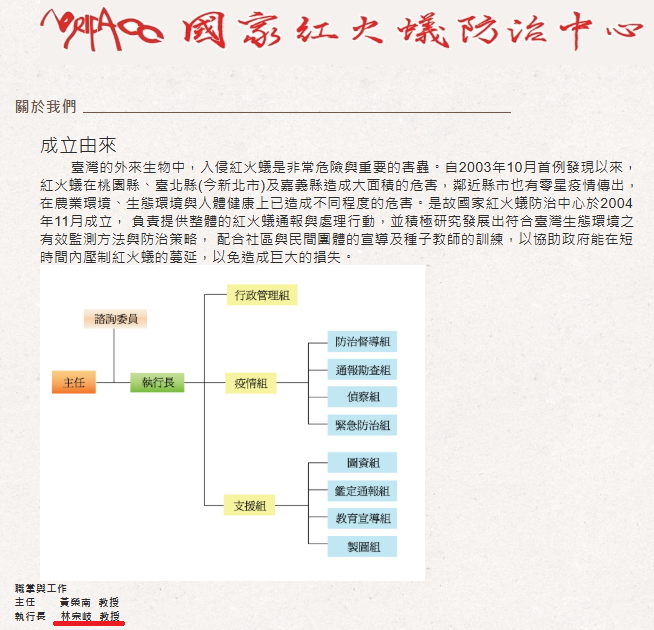
(7) Emeritus Professor Tair-Jye Chou of the Department of Special Education served as a member of the Identification and Educational Guidance Committee for Students with Disabilities in Senior Secondary and Special Education Schools under the K-12 Education Administration, Ministry of Education, during its sixth term, from August 1, 2023, to July 31, 2025. Professor Chou reviewed identification and placement decisions, counseling and support services for students with special educational needs, and the annual work plans of the committee and its sub-groups (Figure 47).
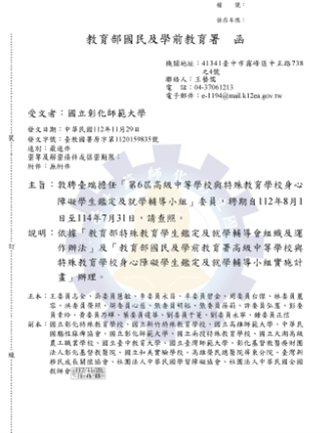
(8) Professor Meng-Chi Chan from the Department of Special Education served as a member of the Ministry of Education's evaluation group for special education classes in the senior secondary schools under its jurisdiction from January 1, 2025, to December 31, 2025. Professor Chan evaluated special education work in those classes (Figure 48).
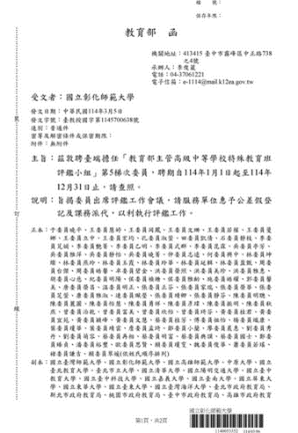
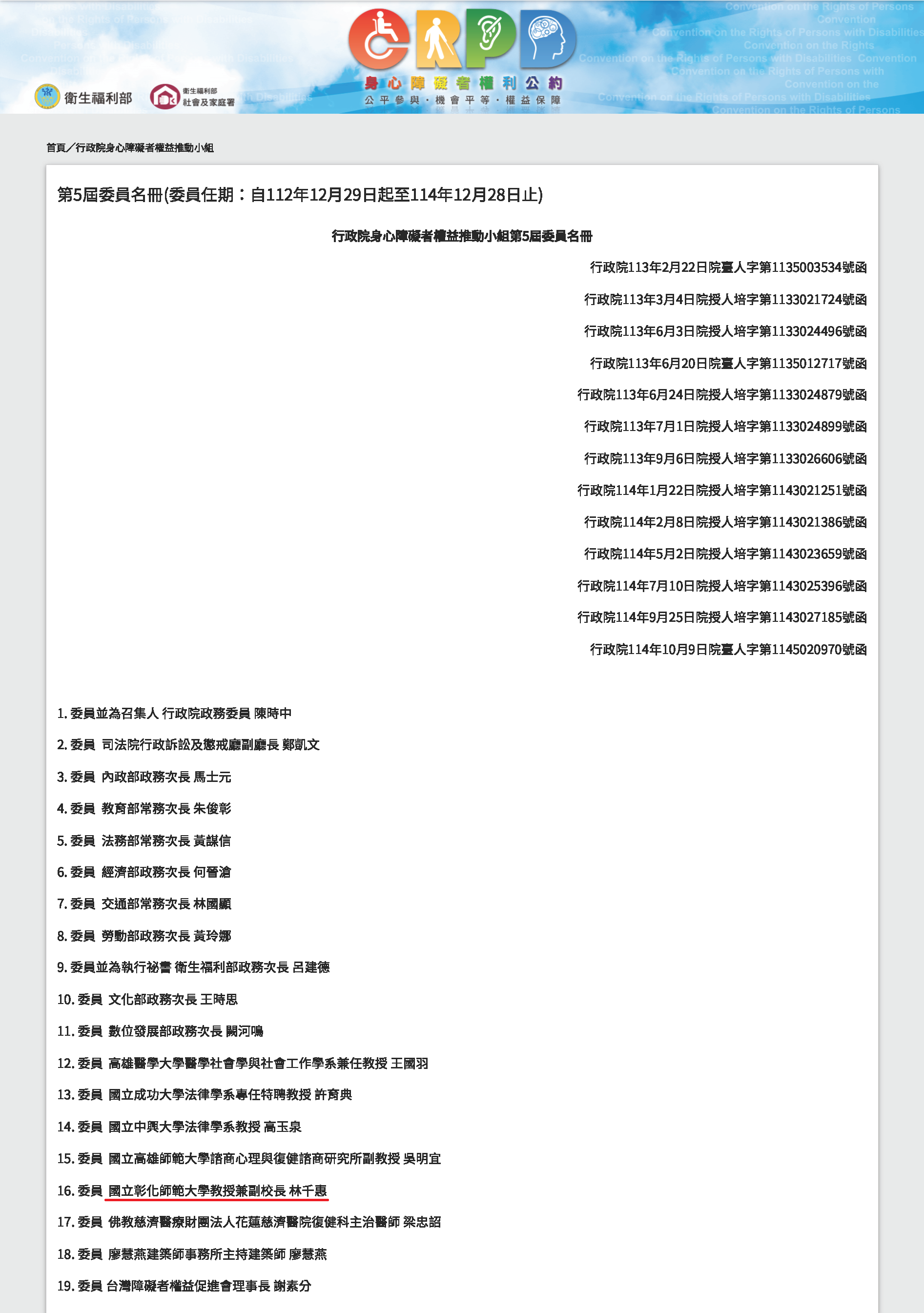
(9) Professor Chien-Hui Lin of the Department of Special Education served as a member of the Executive Yuan's Task Force for Promoting the Rights of Persons with Disabilities from December 29, 2023, to December 28, 2025. Professor Lin helped government agencies ensure that people with disabilities have equal rights and opportunities in daily life (Figure 49).
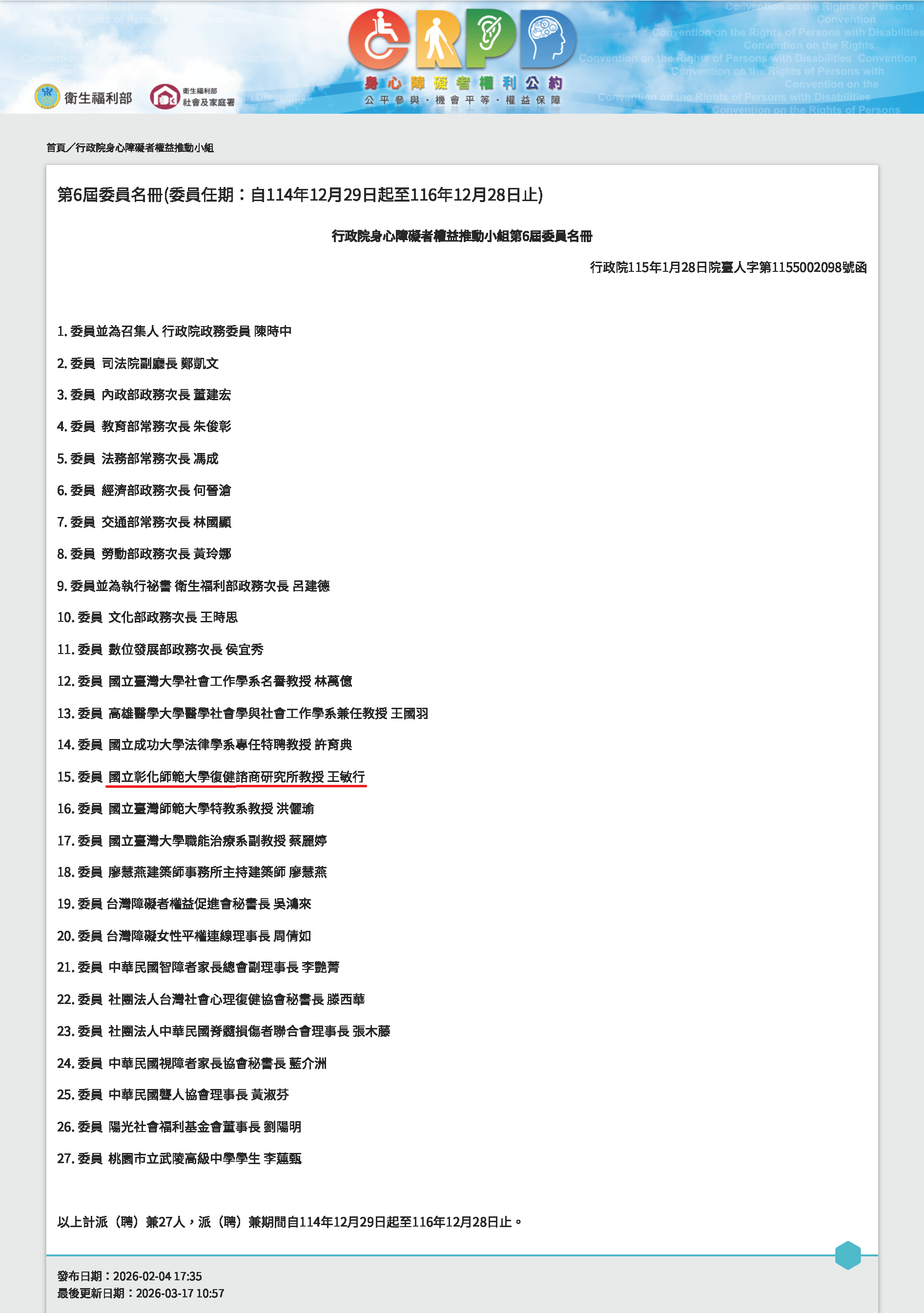
(10) Professor Min-Hung Wang of the Department of Special Education serves as a member of the Executive Yuan's Task Force for Promoting the Rights of Persons with Disabilities from December 29, 2025, to December 28, 2027. Professor wang helped government agencies ensure that people with disabilities have equal rights and opportunities in daily life (Figure 50).
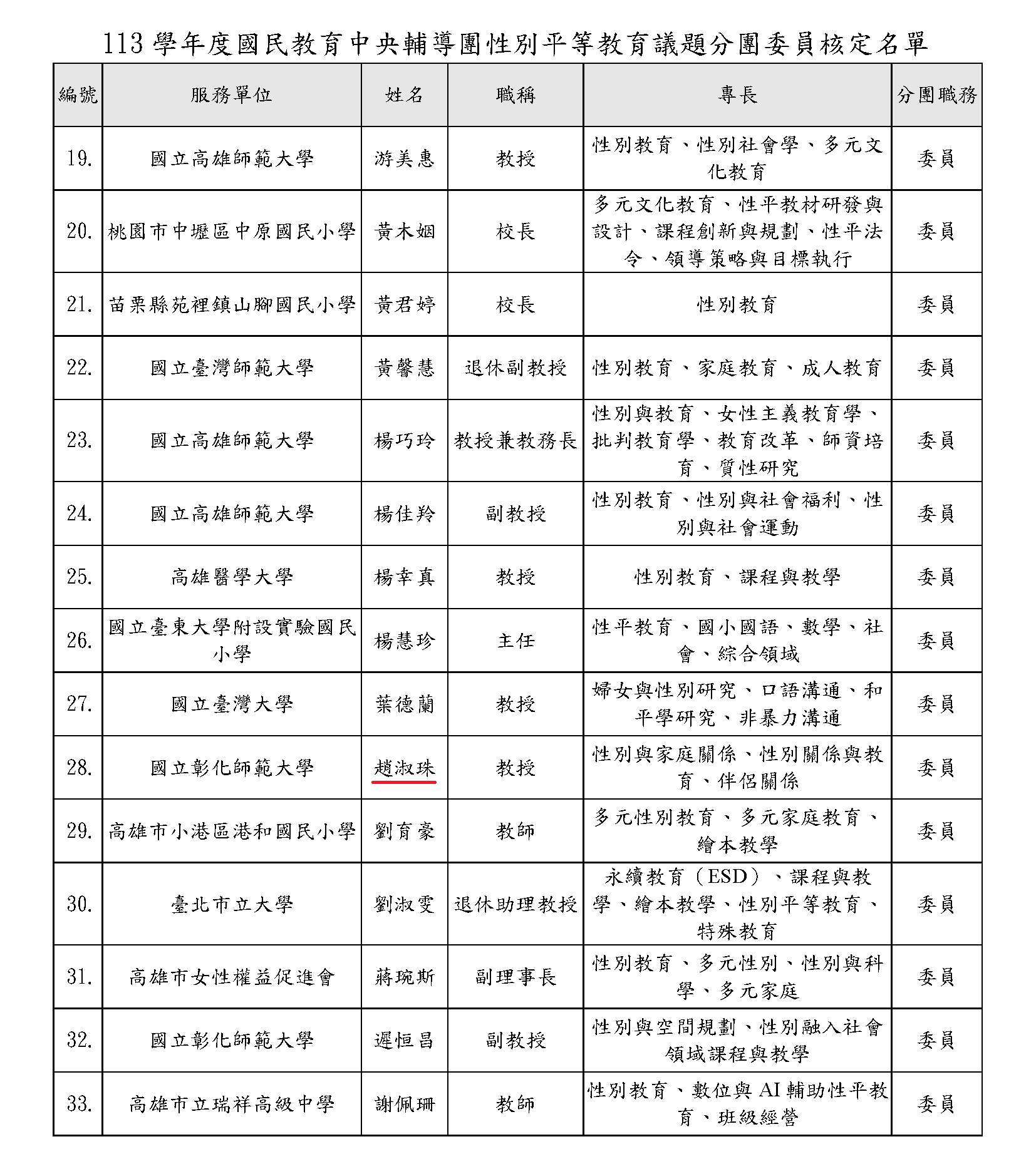
(11) Professor Shu-Chu Chao of the Department of Guidance and Counseling served as a member of the Gender Equity Education Sub-group of the Central Advisory Group for Compulsory Education under the K-12 Education Administration, Ministry of Education for the 2024 Academic Year, from August 1, 2024, to July 31, 2025. Professor Chao helped counties and cities set up gender equity education advisory teams and promoted and supervised the implementation of gender equity curricula and teaching in schools. She also planned training, professional development and certification for gender equity education personnel and integrated professional resources for gender equity education. In addition, she provided consultation on gender equity curricula and teaching, planned research on these areas, and evaluated their effectiveness (Figure 51).
(12) Associate Professor Heng-Chang Chi of the Department of Geography served as a member of the Gender Equity Education Sub-group of the Central Advisory Group for Compulsory Education under the K-12 Education Administration, Ministry of Education for the 2024 academic year, from August 1, 2024, to July 31, 2025. Associate Professor Chi helped counties and cities set up gender equity education advisory teams and promoted and supervised the implementation of gender equity curricula and teaching in schools. He also planned training, professional development and certification for gender equity education personnel and integrated professional resources for gender equity education. In addition, she provided consultation on gender equity curricula and teaching, planned research on these areas, and evaluated their effectiveness (Figure 52).
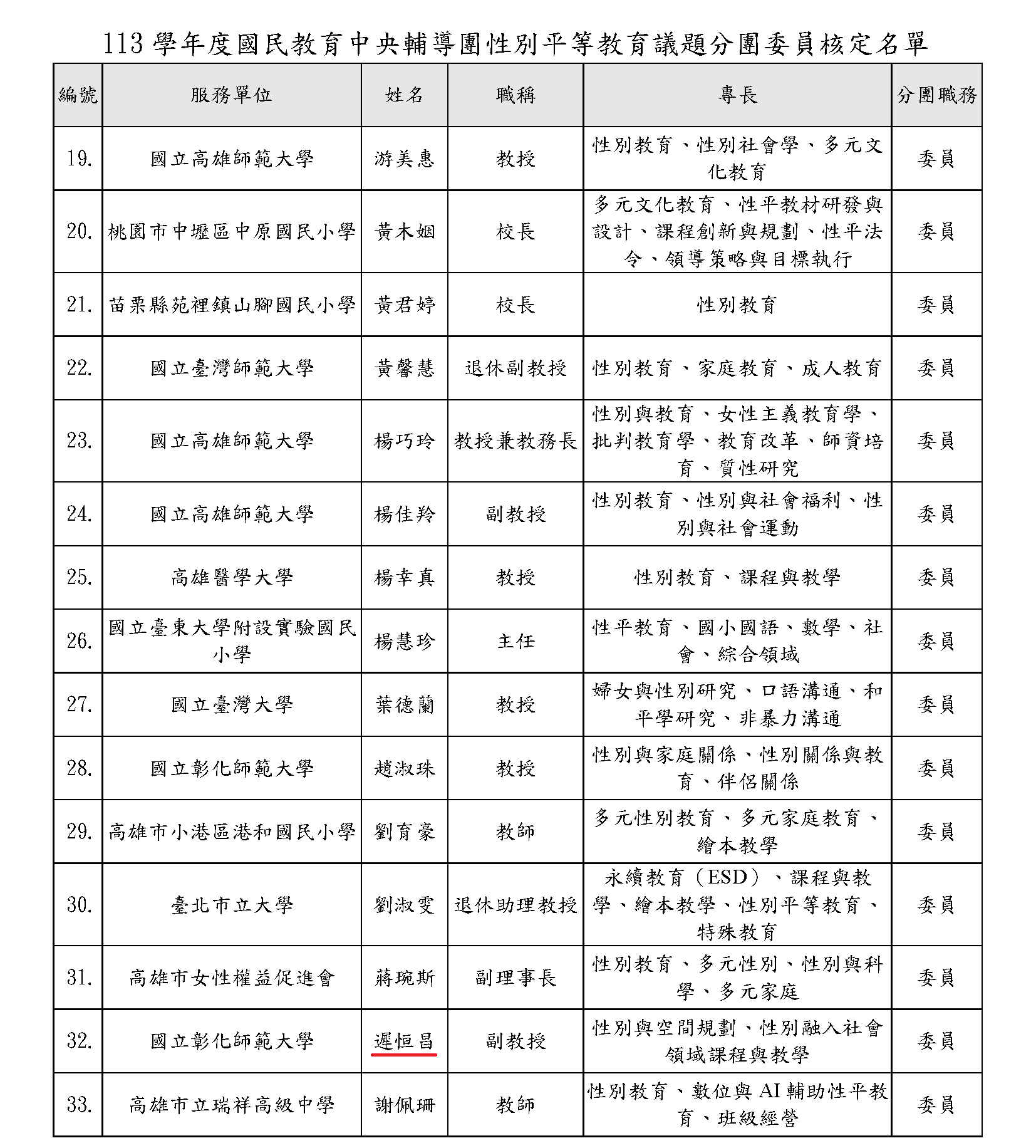
(13) Professor Shu-Chu Chao of the Department of Guidance and Counseling served as a member of the Gender Equity Education Sub-group of the Central Advisory Group for Compulsory Education under the K-12 Education Administration, Ministry of Education for the 2025 academic year, from August 1, 2025, to July 31, 2026. Professor Chao helped counties and cities set up gender equity education advisory teams and promoted and supervised the implementation of gender equity curricula and teaching in schools. She also planned training, professional development and certification for gender equity education personnel and integrated professional resources for gender equity education. In addition, she provided consultation on gender equity curricula and teaching, planned research on these areas, and evaluated their effectiveness (Figure 53).
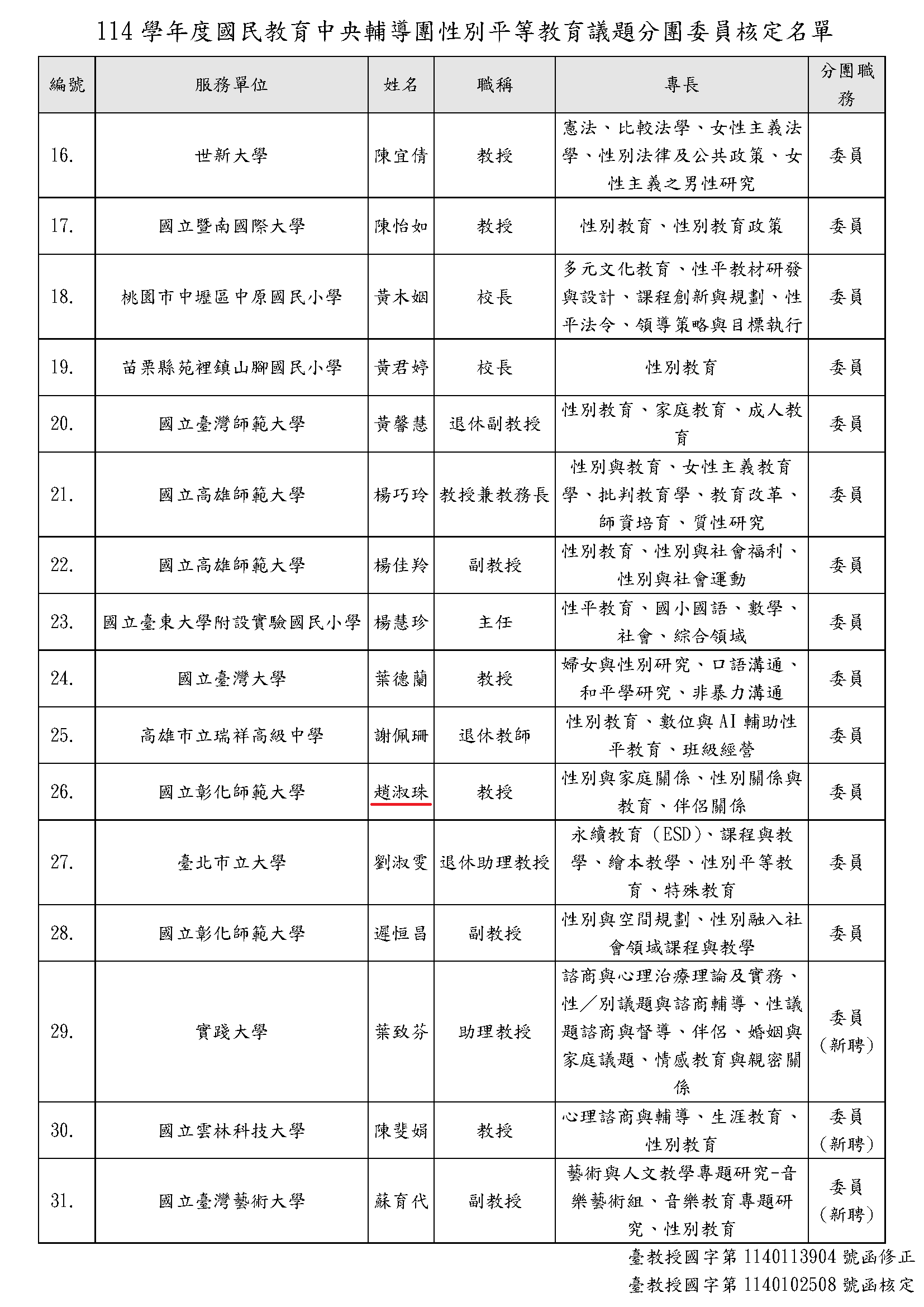
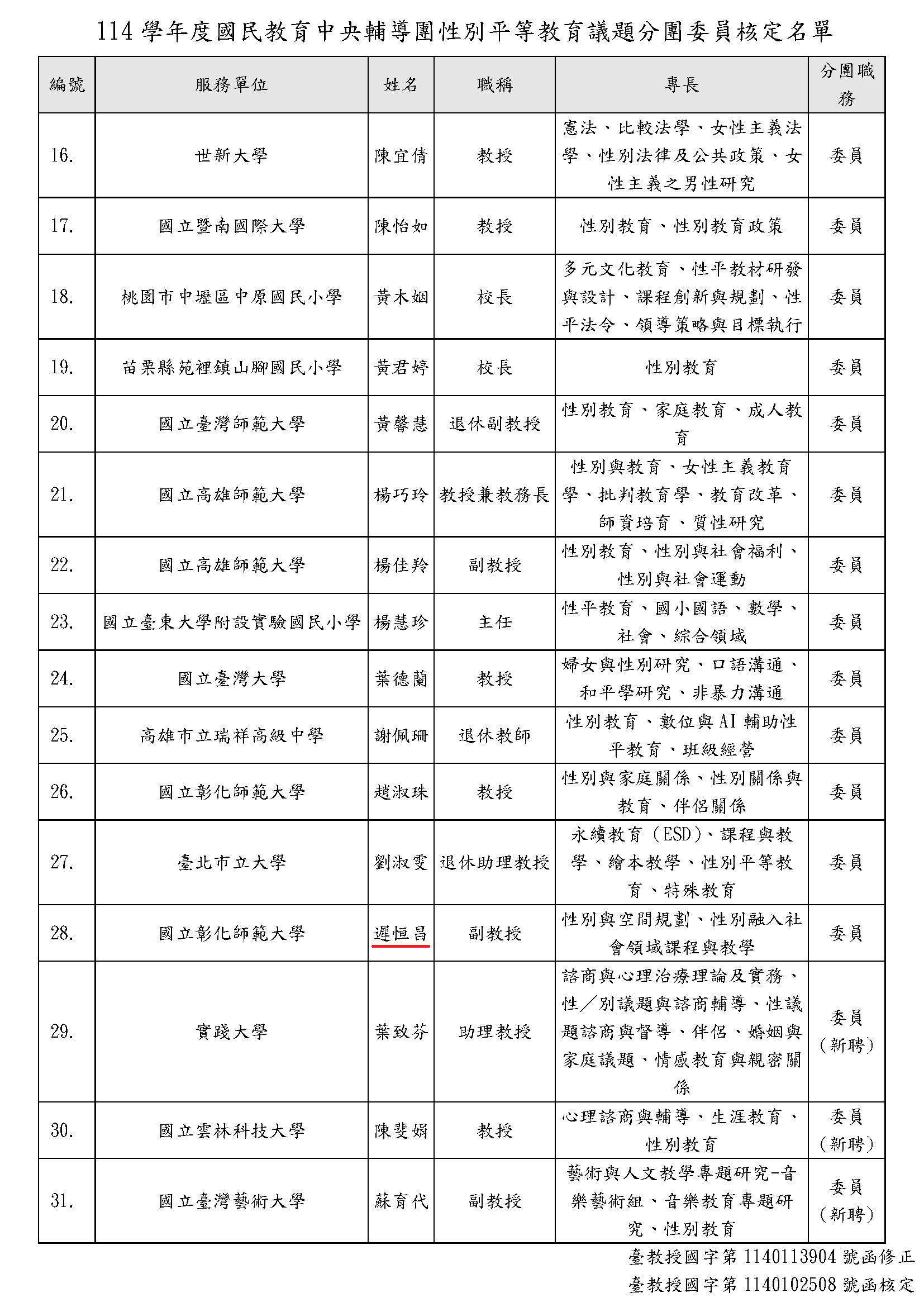
(14) Associate Professor Heng-Chang Chi of the Department of Geography serves as a member of the Gender Equity Education Sub-group of the Central Advisory Group for Compulsory Education under the K-12 Education Administration, Ministry of Education for the 2025 academic year, from August 1, 2025, to July 31, 2026. Associate Professor Chi helped counties and cities set up gender equity education advisory teams and promoted and supervised the implementation of gender equity curricula and teaching in schools. He also planned training, professional development and certification for gender equity education personnel and integrated professional resources for gender equity education. In addition, she provided consultation on gender equity curricula and teaching, planned research on these areas, and evaluated their effectiveness (Figure 54).