
SDG 2.2.1
SDG 2.2.1 Campus food waste tracking
1. NCUE measures and controls the food waste produced by its two campus cafeterias.
NCUE measures and manages the daily food waste of both cafeterias. With the student and staff population steady and campus activity increasing, daily food waste was held at 0.020 metric tons, level with 2024 and the lowest figure recorded since 2021. Average daily food waste is shown in Table 1.
| Year | Average daily food waste | Reduction vs. previous year |
|---|---|---|
| 2025 | 0.020 metric tons | 0 metric tons |
| 2024 | 0.020 metric tons | 0.001 metric tons |
| 2023 | 0.021 metric tons | 0.001 metric tons |
| 2022 | 0.022 metric tons | 0.003 metric tons |
| 2021 | 0.025 metric tons | — |
Note: taking 2025 as an example, average daily food waste = annual food waste ÷ total working days per year (5 days × 52 weeks); 5.2 metric tons ÷ 260 days = 5,200 kg ÷ 260 days = 20 kg/day = 0.020 metric tons.
2. NCUE applies a food-waste reduction policy to avoid wasting food:
(1) The food-waste reduction policy is as follows:
- (a) Nutrition education campaigns encourage students to take only what they will eat, to avoid fussy eating and to leave nothing on the plate.
- (b) Vendors are asked to prepare ingredients according to the expected number of diners.
- (c) Food-waste levels are reviewed and menus adjusted accordingly.
(2) NCUE sorts and manages the food waste produced each day by its two cafeterias. Food-waste bins are installed in both cafeterias, dedicated cleaning staff collect the waste daily, and a contracted vendor removes it on a fixed schedule for resource recovery. All of this waste is counted in the figures reported above. The measures and strategies for reducing food waste are as follows:
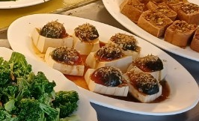
(a) To use ingredients efficiently, NCUE prepares meals to a standardized production process and has reduced portion sizes, so that students and staff finish each serving and no food is wasted (Figure 1).
(b) NCUE has established rules for ingredient purchasing and management, applying standard operating procedures to procurement, handling and inventory control so that stock levels and freshness are tracked precisely and ingredients are used efficiently. Ingredients approaching their use-by date are made into “light meal boxes” or “coin-price bento boxes”, which uses up the stock while giving students and staff cheap, nutritious food and easing their financial burden.