
SDG 16.2.1
SDG 16.2.1 Elected representation
1. University Council Governance
Article 15 of Taiwan’s University Act stipulates that each university shall establish a university council to deliberate on and decide significant university matters. The university council shall comprise the university president, vice-president(s), faculty representatives, heads of academic and administrative units, representatives of research personnel, staff representatives, student representatives, and representatives of other relevant personnel.
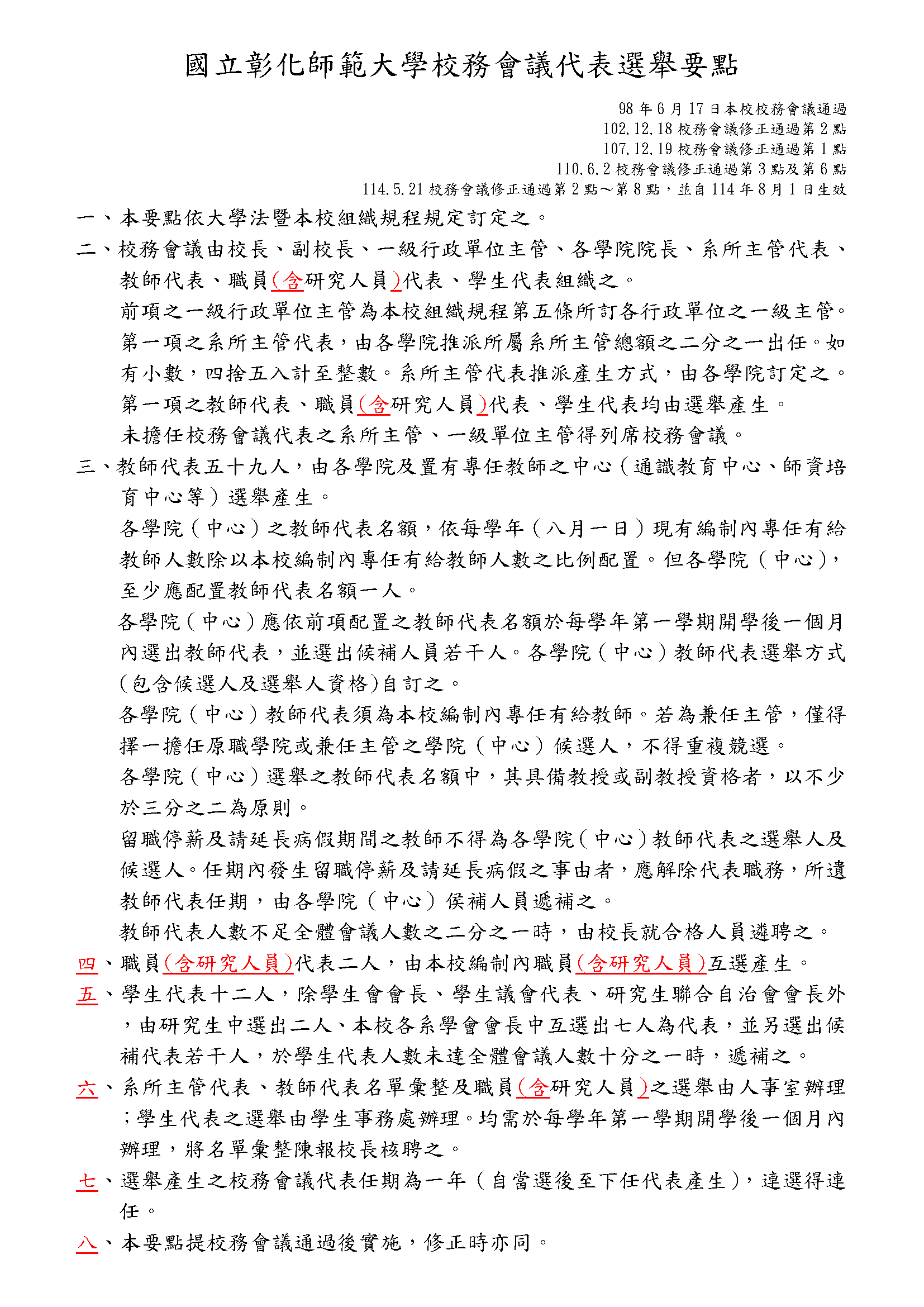
In accordance with the University Act, the National Changhua University of Education (NCUE) has established the university council as its highest governing body. In addition to the heads of administrative units, the council includes faculty representatives, student representatives (both undergraduate and graduate), faculty representatives, and staff (non-faculty employees) representatives. All council members have equal rights to propose and vote. (Figure 1)
(1) NCUE’s University Council comprises eight categories of members: the president, vice-president(s), the heads of first-level administrative units, the deans of the colleges, representatives of department and graduate institute heads, faculty representatives, staff representatives (including research personnel), and student representatives.
(2) The faculty representatives, staff representatives (including research personnel), and student representatives shall be elected in the following ways:
(a) There shall be 59 faculty representatives. According to Article 15 of the University Act, the teacher representatives shall constitute at least one-half of the University Council. They shall be elected by the colleges and centers with full-time faculty members, such as the Center for General Education and the Center for Teacher Education.
(b) There should be two staff representatives (including research personnel). They should be elected by and from among NCUE's quota-based staff (including research personnel).
(c) There shall be 12 student representatives. According to Article 15 of the University Act, the student representatives shall constitute at least one-tenth of the total membership of the University Council. The student representatives include the president of the Student Council, a representative of the Student Congress, and the president of the Graduate Student Council. In addition, two representatives shall be elected from among the graduate students, the presidents of the departmental student associations shall elect seven representatives from among themselves.
(3) The university council shall deliberate on the following matters:
(a) University development plans and budgets.
(b) Organizational regulations and other important rules and regulations.
(c) The establishment, changes, and discontinuation of colleges, departments, graduate institutes, and affiliated institutions.
(d) Academic affairs, student affairs, general affairs, academic research, and other important internal matters.
(e) Deliberation on directives for teaching evaluation.
(f) Matters resolved by committees or task force established by the University Council.
(g) Proposals submitted at council meetings or proposed by the president.
(4) The number of members in each category of NCUE’s university council in 2025 is as follows:
2. Labor-Management Meeting
To protect the rights and interests of employees with legally recognized labor status, NCUE has established a Labor-Management Meeting in accordance with the Labor Standards Act and the Regulations for Implementing Labor-Management Meeting.
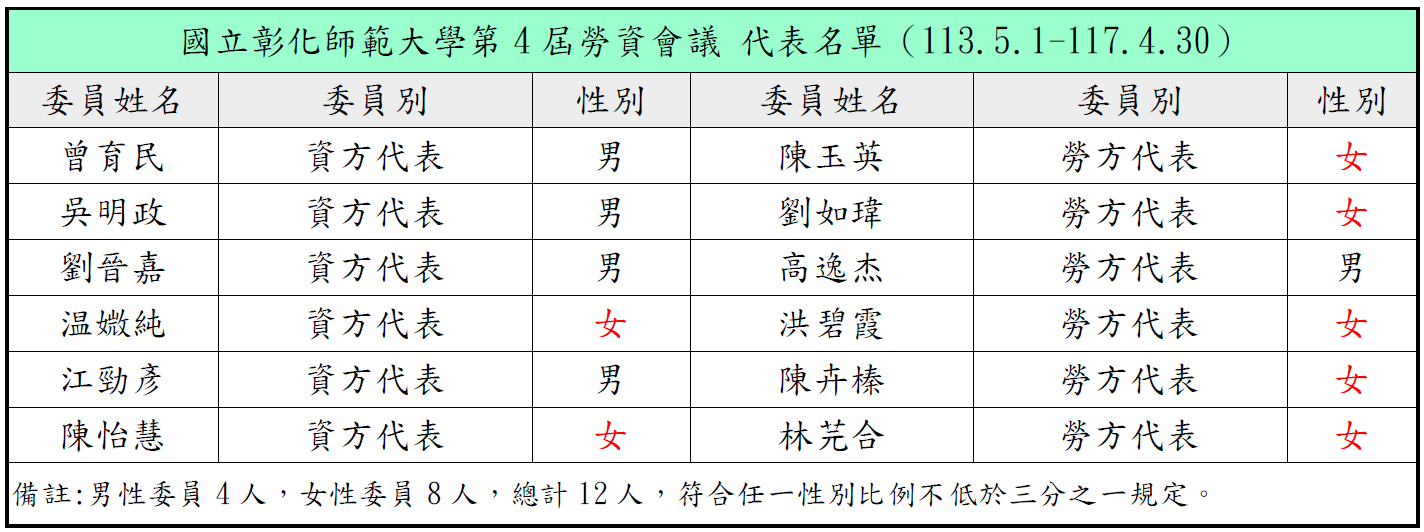
(1) Meeting Composition: The Labor-Management Meeting consists of 12 members: six management representatives selected by the university and six labor representatives nominated by the workers. The list of representatives from both sides is submitted by official letter to the Labor Affairs Department of Changhua County Government for reference. (Figure 2)
(2) Meeting Schedule: The university convenes the Labor-Management Meeting every three months to deliberate on and decide the following matters:
(a) Coordination of labor-management relations and promotion of cooperation between both parties.
(b) Issues concerning labor conditions.
(c) Planning of employee welfare.
(d) Measures to improve work efficiency.
(e) Matters concerning the selection and removal from office of Labor-Management Meeting representatives.
(f) Matters concerning the operation of the Labor-Management Meeting.
(g) Other matters for discussion.