
SDG 16.2.7
SDG 16.2.7 Publish financial data
NCUE regularly announces its important financial data:
1. University Endowment Fund Management Committee
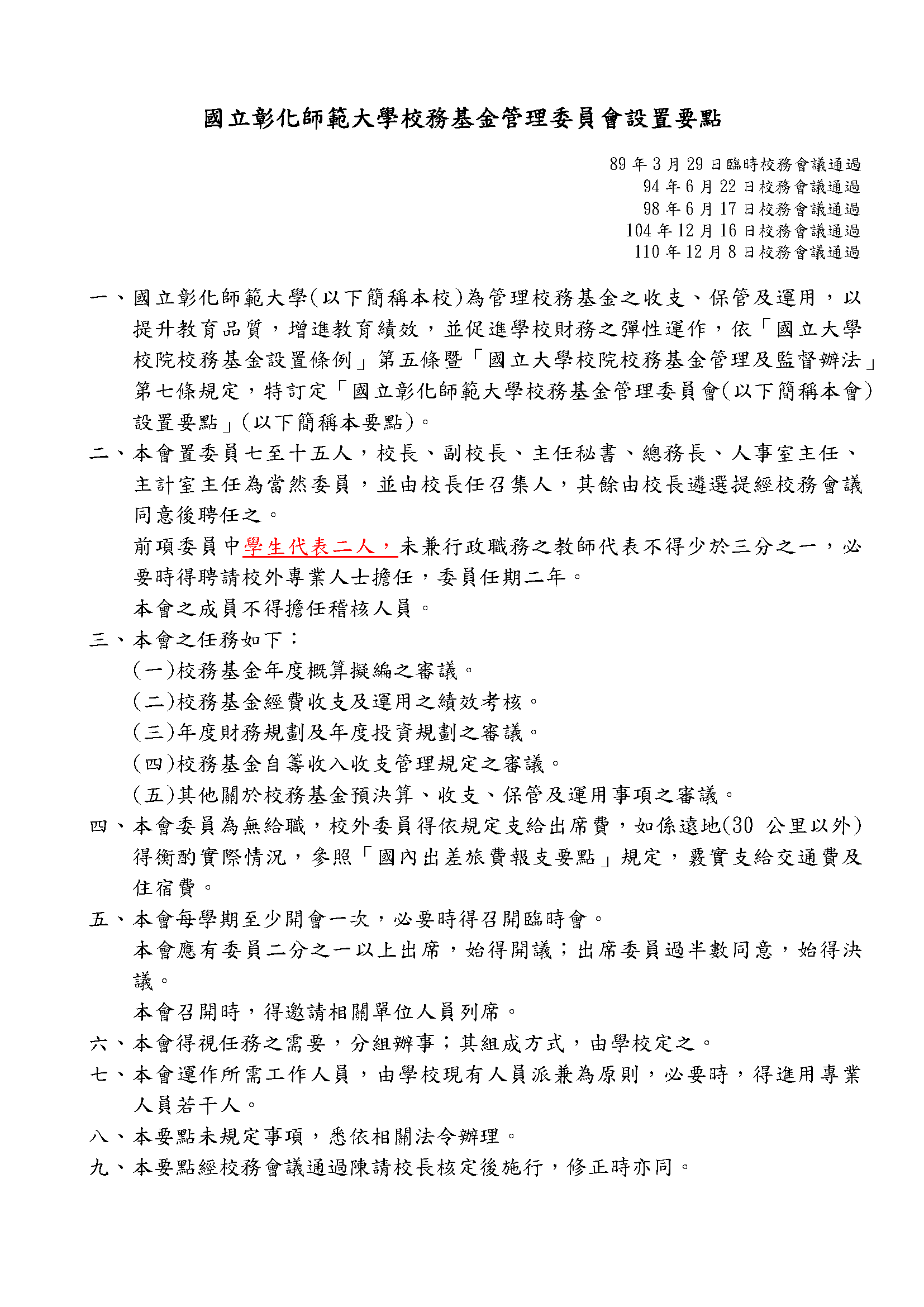
NCUE manages the income, expenditure, custody, and utilization of its University Endowment Fund to enhance educational quality, improve educational performance, and promote flexible financial operation. NCUE has established the "Guidelines for the Establishment of the National Changhua University of Education University Endowment Fund Management Committee" in accordance with Article 5 of the Act Governing the Establishment Endowment Fund at National University " and Article 7 of the Regulations for the Management and Supervision of National University Endowment Funds." (Figure 1) The Committee consists of seven to fifteen members, with the President, Vice President, Chief Secretary, Dean of General Affairs, Director of Personnel Office, and Director of Accounting Office serving as ex-officio members, and the President serving as the convener. The remaining members are selected by the President and appointed upon approval by the University Council. Members of this Committee may not serve as audit personnel. The Committee includes two student representatives, and faculty representatives without administrative duties must constitute at least one-third of the membership. External professionals may be appointed when necessary. The term of office is two years. The duties include:
(1) Review of the annual budget estimates for the University Endowment Fund.
(2) Performance evaluation of the income, expenditure, and utilization of University Endowment Fund resources.
(3) Review of annual financial planning and annual investment planning.
(4) Review of regulations governing the revenue and expenditure management of the University Endowment Fund’s self-generated income.
(5) Review of other matters related to the budget and final accounts, income and expenditure, custody, and utilization of the University Endowment Fund.
2. Internal Audit Guidelines and Duties
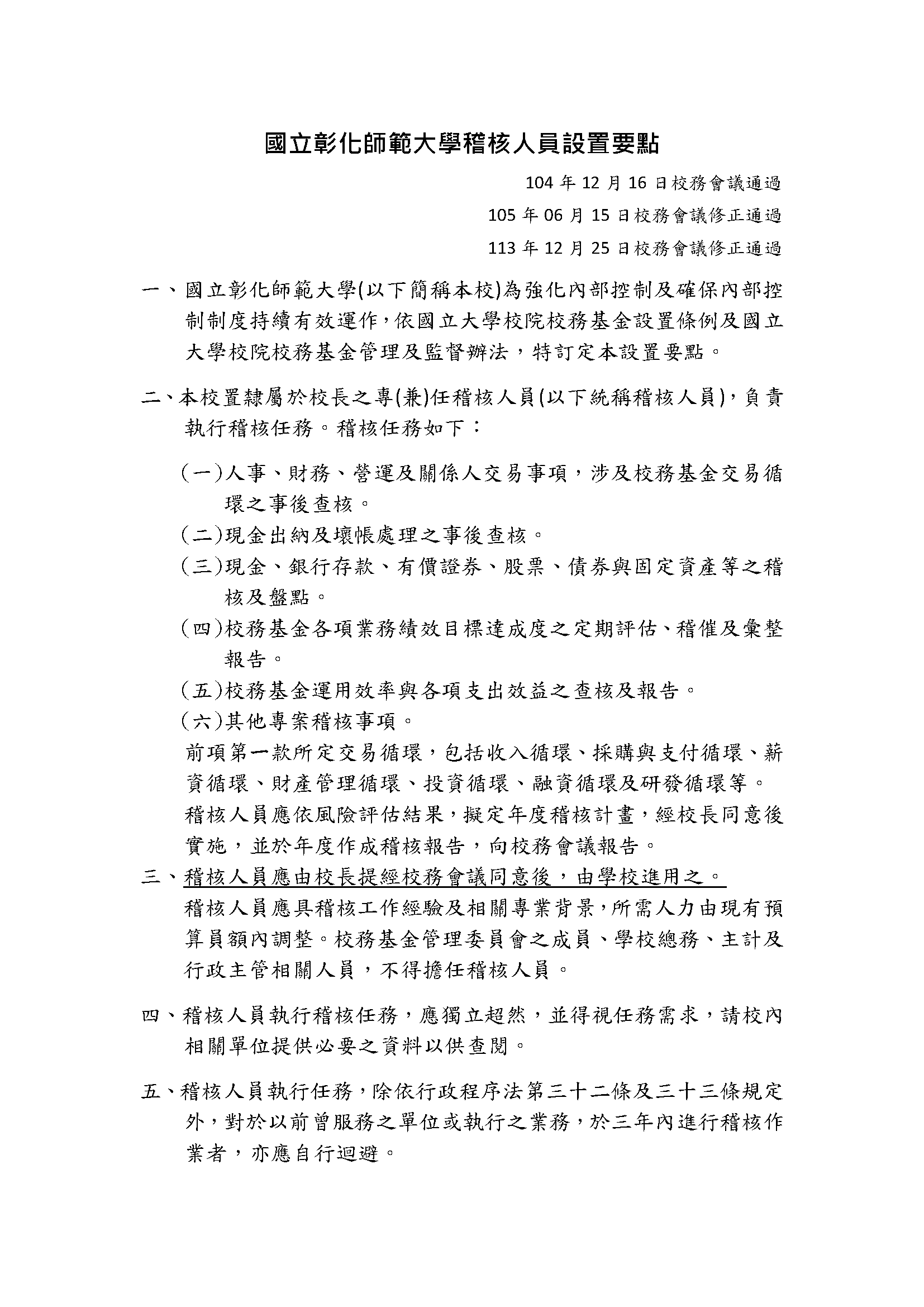
To strengthen internal control and ensure the continuous effective operation of the internal control system, NCUE has established the "Guidelines for the Appointment of Audit Personnel at National Changhua University of Education" in accordance with the Act Governing the Establishment Endowment Fund at National University and the Regulations for the Management and Supervision of National University Endowment Funds. (Figure 2) NCUE appoints audit personnel on a full-time or concurrent basis (hereinafter collectively referred to as audit personnel) who report directly to the President and are responsible for executing audit duties. Annual meetings are held. The audit duties include:
(1) Post auditing of personnel matters, financial affairs, operations, and related-party transactions, and matters affecting the transaction cycle of the University Endowment Fund.
(2) Post auditing of cash handling and bad debt processing.
(3) Auditing and inventory-taking of cash, bank deposits, securities, stocks, bonds, and fixed assets.
(4) Regular evaluation, follow-up, and consolidated reporting on the achievement of performance targets for various University Endowment Fund operations.
(5) Auditing and reporting on the efficiency of the University Endowment Fund utilization and the effectiveness of various expenditures.
(6) Other special audit matters.
3. Annual Budget Preparation and Approval
The university prepares annual budgets according to its development priorities and administration goals, considering the school’s actual needs and the financial capacity of the University Endowment Fund. It submits the budgets to the Ministry of Education and the Directorate-General of Budget, Accounting, and Statistics of the Executive Yuan for review. The budgets approved by the Legislative Yuan become statutory budgets and are announced on the university’s website.
4. Year-End Final Accounts and Audit Reporting
At the end of each year, NCUE compiles records of budget execution and closes its accounts before preparing a final accounts report. The report is submitted to the Ministry of Education and the Directorate-General of Budget, Accounting, and Statistics of the Executive Yuan, and is then published on the university’s website. Following review by the National Audit Office, the audited final accounts are also published.
5. Regular Information Disclosure and Monthly Reports
As required by regulations, NCUE publishes its monthly reports, income and expenditure analyses, and changes in available funds in the information disclosure area of its website. The home page of the NCUE Accounting Office also has a financial information disclosure area to provide information on the University Endowment Fund's annual budgets, revenue, expenditures, and budget execution as reflected in the final accounts.
6. Details of Attached Information and Supporting Websites
Details of the attached information, including supporting evidence, are available on the websites below: https://ncueinfo.ncue.edu.tw/02%E8%B2%A1%E5%8B%99%E8%B3%87%E8%A8%8A%E5%88%86%E6%9E%90
(1) NCUE's Information Disclosure Section:
(a) Financial Information Analysis: This includes an analysis of the university’s income and expenditure over the past 3 years, changes in available funds (execution status reports), financial planning reports, published budgets, final accounts, and the performance report of the University Endowment Fund.
(b) Tuition, Fees and Financial Aid Information: This includes the fee structure per student, the average teaching cost per student for the university and each college, the ratio of tuition fees to the average teaching cost, and estimated educational expenses during enrollment (including tuition and fees, accommodation, and living costs). It also provides information on financial aid options from the government, the university, and private institutions, such as scholarships and grants, student loans, and work opportunities. Published information also includes application amounts and the numbers and percentage of currently enrolled students applying for student loans, scholarships and grants, and tuition and fee reductions or waivers.
(2) The financial information page of the NCUE Accounting Office: This section includes publicly available data such as financial reports, published budget statements, final account statements, monthly reports, and information on subsidies and donations provided to private organizations and individuals. Website: https://accountingweb.ncue.edu.tw/