SDG 10.6.9
SDG 10.6.9 Disability access scheme
1. Job accommodation plans for people with disabilities
According to the job accommodation plans of the Workforce Development Agency, Ministry of Labor, (https://jobacmd.wda.gov.tw/DJOB_WEB/), NCUE helps people with disabilities, middle-aged, and elderly people overcome work obstacles and improve their work efficiency so as to implement the goal of employment services. On behalf of the hearing-impaired and visually impaired faculty members, NCUE applied to the Changhua County Government and implemented the “Job Accommodation for People with Disabilities” plan, and a total amount of NTD$181,140 was allocated to NCUE. The subsidized services and used amounts are as follows:
(1) Transcription services: 120 hours in total, with NTD$500 /hour compensation subsidized, totaling NTD$60,000.
(2) Assistance from helpers in the workplace: 210 hours in total, with NTD$190 /hour compensation subsidized, totaling NTD$39,900.
(3) Transportation expenses: NTD$6,000 in total.
(4) Vision assistance services: 396 hours in total, with NTD$190 /hour compensation subsidized, totaling NTD$75,240.
In addition to assisting the aforementioned colleague in job design with the application process, NCUE also helps handle subsequent matters including service personnel hour management, attendance sign-in and sign-out, and expense reimbursement procedures.
2. Service plans to help students in the Resource Classroom
According to the Implementation Key Points on Recruiting and Counseling Students with Disabilities in Colleges and Universities Subsidized by the Ministry of Education (as shown in Figure 1), NCUE applies to the Ministry of Education every year for the subsidies of the work plan for recruiting and counseling students with disabilities in colleges and universities, and provides various forms of counseling and service work for students with disabilities. In 2025, the Ministry of Education subsidized more than NTD$3,374,936 to help students with disabilities who have disability identification certificates adapt to university life, expand interpersonal relationships, and improve their learning ability in various subjects. NCUE helps them successfully complete their studies, as well as improve their emotional, learning, social, and professional adaptation. The support services provided are as follows (please refer to https://ncue7232105.wixsite.com/ncue/blank-4), and the participation count for various support services are shown in Table 1.
| Support service category | Number of participants |
|---|---|
| Schoolwork assistance service | 2571 |
| Life assistance service | 339 |
| Career and schooling system transition service | 83 |
| Consulting and counseling | 651 |
(1) Schoolwork support services
(a) Individual remedial teaching (difficult subjects): The Resource Classroom aims to help students with disabilities with difficult subjects, such as psychology and educational tests, English, and statistics, and arranges individual tutors for students to help them with their progress.
(b) Examination service measures (explaining highlighted contents, reviews of specific questions, etc.): The Resource Classroom has designed a ‘Special Examination Service Form’ to meet the needs of teachers and students and provide appropriate assistance according to the different types and degrees of students’ disabilities.
(c) Work-study students and volunteers assist with learning (text-to-speech, audio recording, translation upon clicking, note taking, etc.): The Resource Classroom arranges regular shifts of work-study students and volunteers to assist students with disabilities with text-to-speech, audio recording, note taking, and translation upon clicking. At the same time, specific work-study students are arranged to assist students with disabilities with searching for information, etc.
(d) Textbook conversion. The Resource Classroom helps with converting textbooks into braille or enlarged fonts, and convert written materials into electronic files.
(e) Provide assistive equipment for borrowing.
(f) The Resource Classroom helps students with applying for special education award scholarships (provided by the Academic Affairs Office), and to applying for scholarships from off-campus organizations.
(2) Life support services
(a) Orientation and mobility training: In order to help students with severe or total blindness familiarize themselves with the campus environment as soon as possible, Taiwan Foundation for the Blind is usually invited to assist with orientation and mobility training.
(b) Organize extracurricular activities and fellowship: To help students in special education get acquainted with, understand, and support each other, the Resource Classroom organizes activities such as dinners, off-campus visits, and alumni experience sharing in public office examinations or teacher enrolment examinations for students at the beginning and end of each semester.
(c) Hold student forums: In order to understand students’ learning efficiency in the classroom and effectively assist with it, the Resource Classroom regularly holds symposiums between counselors and students to enable them to exchange views and provide timely assistance.
(d) Psychological counseling (individual counseling, growth group): In view of the personal troubles faced by students with disabilities, the Resource Classroom helps students refer to the Student Psychological Consulting and Counseling Center of NCUE for individual consultation and participation in growth groups.
(e) Arrange accommodation and transportation on campus.
(f) Improve accessible environment on campus.
(3) Support services for schooling system transition counseling
(a) Student transition notification services: NCUE offers comprehensive and ongoing transition counseling and services, incorporating individualized special education plans to assist students in achieving their transition goals, which may include independent living, social adaptation, participation, further education, or employment.
(b) Graduate transition notification and tracking services: The resource room is committed to provide transition services for students with disabilities after graduation, tailoring our support to meet each student's individual needs by linking them to resources related to further education, transfer to other institutions, employment, vocational training, and homecare.
3. Disability-related Conferences and Programs Organized by NCUE
(1) When Special Education Meets Artificial Intelligence — 2025 Special Education Conference
NCUE’s Department of Special Education held the 2025 Special Education Conference on June 21, 2025, focusing on the theme “When Special Education Meets Artificial Intelligence” to examine innovative applications of AI technology in special education. NCUE opened the conference to the public to share educational resources, drawing experts, scholars, and frontline elementary and secondary school teachers from education institutions nationwide.
Speakers discussed applications of generative AI in education and led hands-on sessions demonstrating digital tools such as NotebookLM and speech-to-text software, directly helping external special-education practitioners strengthen their digital teaching skills. The conference also featured several practice-based papers on inclusive education and AI applications. By holding this open academic conference, NCUE shared its special-education resources and expertise with primary and secondary school teachers nationwide, providing a channel for continuing professional learning and illustrating its role in advancing the digital transformation of special education. Figure 2 shows the campus news coverage of the event, and Figure 3 shows photographs from the event.
Campus News: https://www.ncue.edu.tw/p/406-1000-31011,r93.php?Lang=zh-tw
(2) Practical and Academic Research Outcomes in Rehabilitation Counseling and Applied Behavior Analysis (ABA)
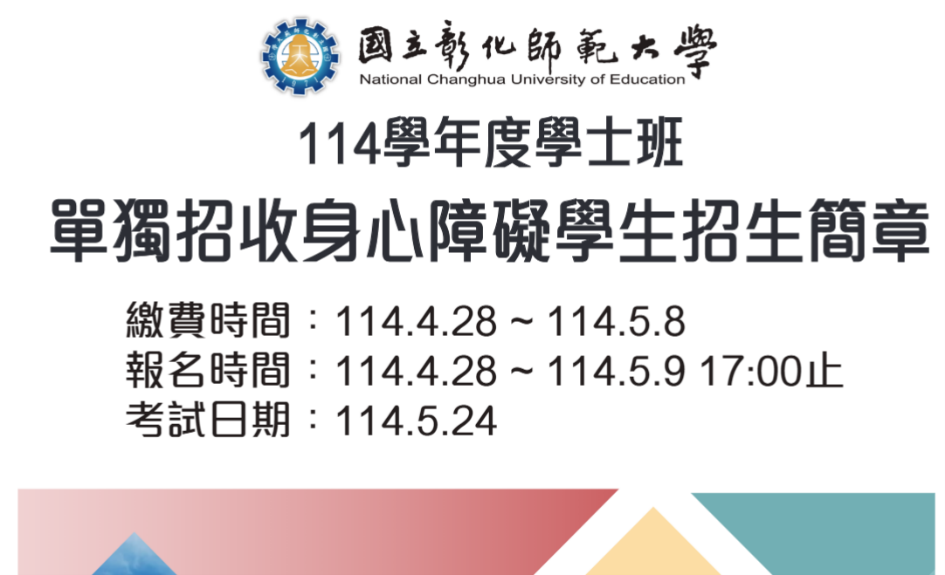
In NCUE’s Graduate Institute of Rehabilitation Counseling, Professor Hua Feng has supervised students on several research projects in recent years (Figure 4), focusing on the practical and clinical application of applied behavior analysis (ABA) and positive behavior support to improve the behavior of people with disabilities. These include graduate student Pei-Zhen Lin’s study “Effects of Behavioral Skills Training on Social Distancing Behavior of Autistic Adults,” graduate student Shang-Ci Yang’s study “Effects of a Positive Behavior Support Plan on Reducing Self-Injurious Behavior of Adults with Visual and Multiple Disabilities,” graduate student Guan-Hua Chen’s study “Effects of Multiple Exemplar Training on Precursors to Theory of Mind in Children with Autism Spectrum Disorder,” and graduate student Hui-Yi Chen’s study “Challenges, Responses, and Ethical Issues in Behavioral Consultation Services.” These research outputs extend academic knowledge into practice in special education, rehabilitation care, and community mental health, providing behavior support and clinical consultation for people with autism, emotional and behavioral disorders, and multiple disabilities, and improving the physical and mental health and well-being of these populations.