
SDG 10.4.1
SDG 10.4.1 Proportion of students with disabilities
Number of students
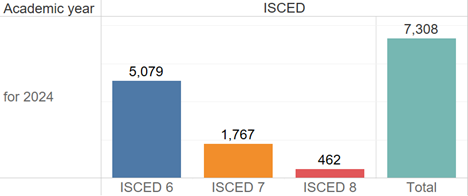
Figure 1 shows the FTE number of students enrolled in NCUE. The total number of FTE students in 2025 was 7,383 including 5,139 Bachelor’s students, 1,792 Master’s students, and 452 Doctoral students.
Number of students with disability
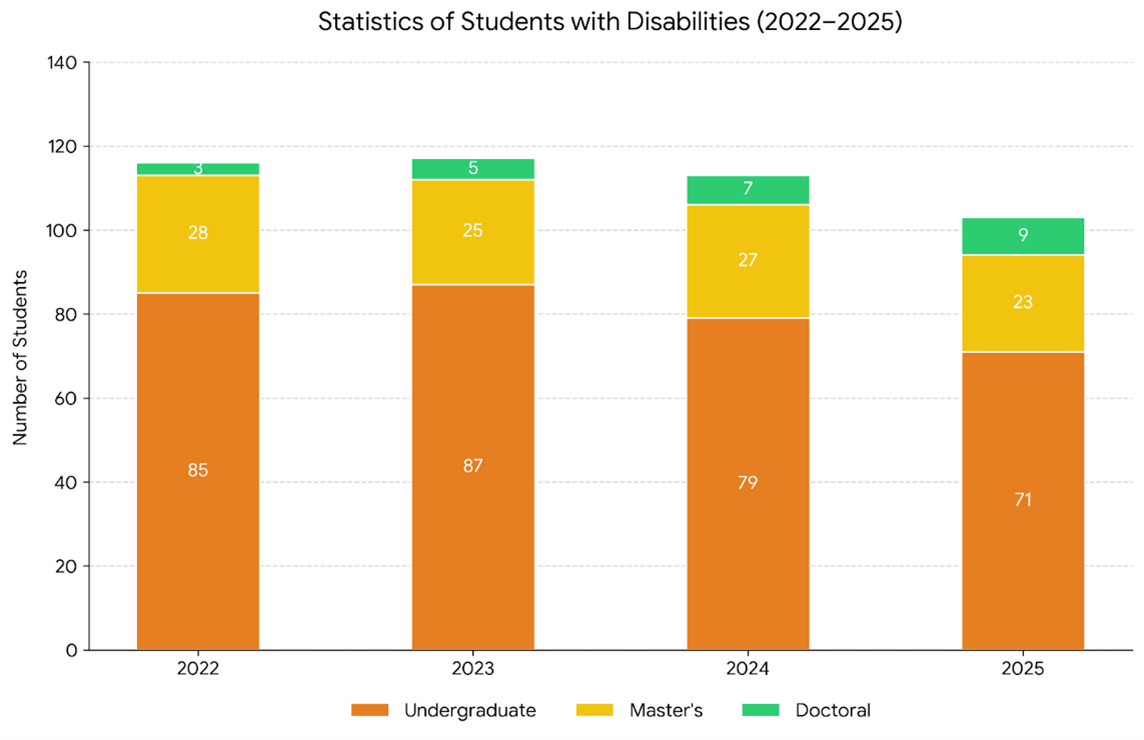
In 2025, there were 103 students with disabilities enrolled in NCUE, and the proportion of students with disabilities 103/7,383=1.40%. The statistics for students with disabilities in various academic programs are as presented in Table 1, and the four-year trend in the number of students with disabilities is shown in Figure 2.
| Educational system | Extremely severe | Severe | Moderate | Mild | Other (determined by the Committee Responsible for the Identification and Placement of Gifted and Disabled Students) | Total |
|---|---|---|---|---|---|---|
| Doctoral programme | 1 | 0 | 2 | 6 | 0 | 9 |
| Master's programme | 0 | 0 | 7 | 16 | 0 | 23 |
| Bachelor's programme | 0 | 9 | 4 | 58 | 0 | 71 |
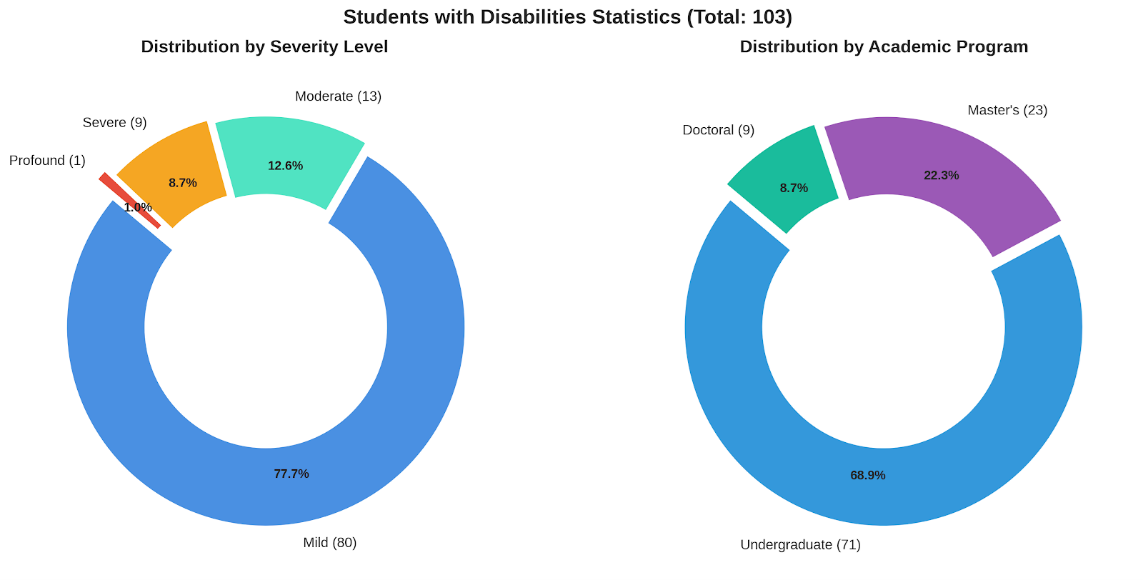
| Total | 1 | 9 | 13 | 80 | 0 | 103 |
Building a Comprehensive Support Network for Students with Disabilities: Creating a 100% Universally Designed, Barrier-free Campus
NCUE has implemented a "comprehensive support system" that spans multiple diverse admission channels prior to enrollment, high-coverage academic and psychological support during enrollment, and seamless career transition support after graduation, creating a dignified, safe, and barrier-free globally inclusive learning environment for students of all backgrounds.
1. Demographic Statistics of an Inclusive Campus Population
In 2025, the total FTE number of day-division students at NCUE was 7,383, of whom 103 students with disabilities were incorporated into a substantive network of academic care and counseling support, accounting for 1.40% of the university's total FTE student number (the breakdown by degree of disability is shown in Figure 3). The distribution of students with disabilities at NCUE is not limited to the undergraduate level but extends comprehensively to advanced academic research programs at the master's and doctoral levels. This demonstrates that NCUE has successfully broken down institutional barriers preventing students with disabilities from pursuing advanced degrees, substantively realizing academic equity across all levels of education.
2. Institutionalized Barrier Removal: University-level Diverse Admission Strategies for Disadvantaged Groups
To address the institutional inequality faced by minority and disadvantaged groups within the traditional higher education admission system, NCUE promotes diverse admission channels and tracks their effectiveness over the long term, actively expanding the recruitment of disadvantaged groups:
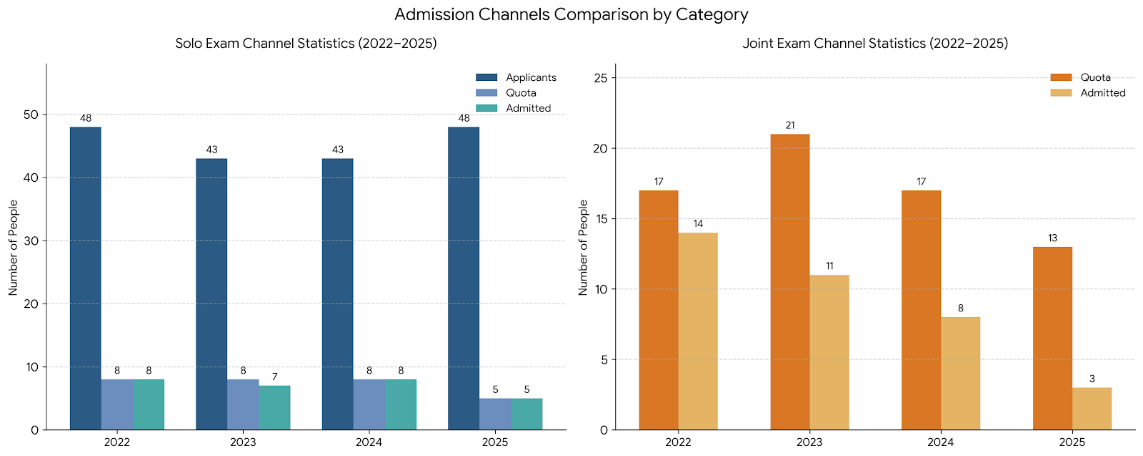
(1) Independent admission channels to build accessible pathways to higher education: NCUE is one of the few national universities in Taiwan that continues to operate an independent admission channel specifically for students with disabilities. In 2025, NCUE admitted 8 students through the "National Joint University and College Admission System for Students with Disabilities," and a further 8 students through the "NCUE Independent Admission Exam for Students with Disabilities (Bachelor's Program)," precisely supporting the adaptive transition of students with special educational needs into higher education (the results of the past four years are shown in Figure 4).
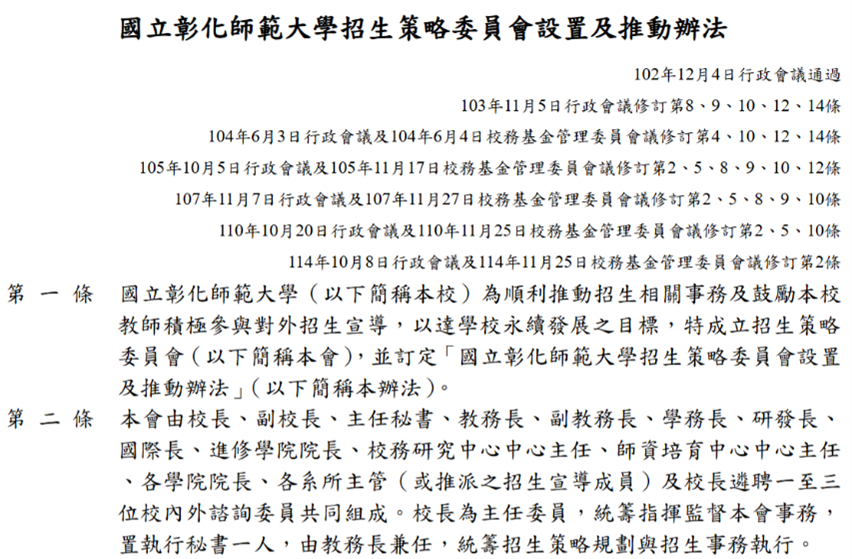
(2) Recruitment incentive program for disadvantaged student groups: In accordance with NCUE's Measures of Establishing the Recruitment Strategy Committee and the Implementation (shown in Figure 5), for each additional-quota student from a special group (including students with disabilities, Indigenous students, and international students) recruited and successfully registered by a department, the university provides an additional operating subsidy of NT$5,000.
3. Comprehensive Learning Resource Support System
NCUE's Center for Special Education operates a dedicated "Resource Classroom."(showed as Figure 6) In 2025, the Resource Classroom successfully secured NT$3,374,936 in dedicated subsidy funding from the Ministry of Education, building a high-coverage support network across four dimensions—academics, daily life, psychological wellbeing, and career transition—substantively increasing the retention rate of students with special needs and preventing academic interruption caused by disability.
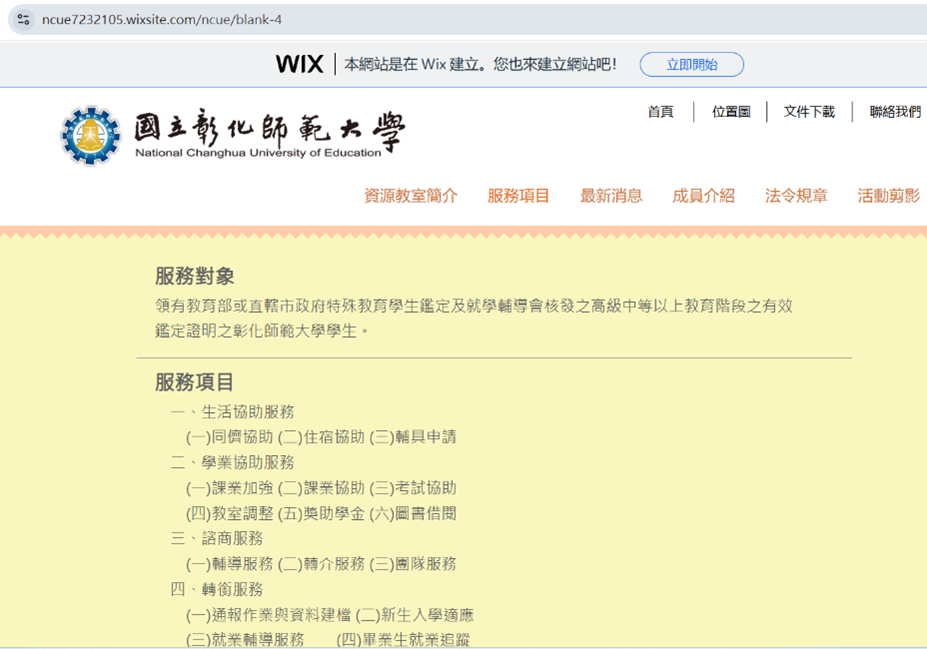
(1) On-site Service Provision and Participation Coverage at the Resource Classroom
In 2025, the Resource Classroom provided an extremely high density of on-site support services to students with disabilities across the university. The specific service items and core support categories (shown in Tables 2 and 3 below) demonstrate NCUE's precise commitment to safeguarding students' daily learning rights and digital accessibility.
| Statistics of various services provided in the Resource Classroom | Students served (person-times) |
|---|---|
| Data query | 387 |
| Use of assistive equipment | 9 |
| Printing coursework | 650 |
| Self-study | 1399 |
| Exam service | 115 |
| Data transfer | 12 |
| Academic counseling | 337 |
| Life counseling | 339 |
| Transition counseling | 15 |
| General counseling | 16 |
| Types of services provided by the Resource Classroom | Number of students served |
|---|---|
| Schoolwork counseling | 141 |
| Examination service | 115 |
| Study companion service | 898 |
| Borrowing assistive equipment | 38 |
| Textbook conversion | 29 |
(2) Comprehensive Systemic Support for Academic Life, Daily Living, and Career Transition
In 2025, NCUE's various support services collectively served as many as 3,644 person-times (as shown in Table 4). Rather than offering purely passive relief, NCUE has implemented a high-standard "Career Empowerment and Transition Program for Students with Disabilities," organizing multiple career aptitude tests, entrepreneurship lectures for students with disabilities, alumni sharing sessions on careers in state-owned enterprises, and university-wide inclusive education activities (as shown in Table 5), substantively enhancing the social mobility and civic awareness of students with special needs.
| Support service category | Number of participants |
|---|---|
| Schoolwork assistance service | 2571 |
| Life assistance service | 339 |
| Career and schooling system transition service | 83 |
| Consulting and counseling | 651 |
| Name of Support Service Activity | Number of Participants |
|---|---|
| Visit by Sihu Senior High School: Introduction to Special Education Resource Services in Higher Education | 26 |
| Student Forum, Shida Campus | 17 |
| Student Forum, Jinde Campus | 31 |
| Career Lecture: "Coping Alone: From Overwhelming Stress to Inner Peace" | 16 |
| Career and Workplace Image Workshop (I) | 18 |
| Career and Workplace Image Workshop (II) | 18 |
| The 7th National Intercollegiate Resource Room Sports Competition and Inter-University Exchange Event | 14 |
| Special Education Advocacy Week Activity: "Love in Understanding and Acceptance" | 182 |
| General Education Lecture: "If Opportunity Were a Bus and You Pretended Not to See It Leave, Here's What You Could Do" | 41 |
| Consultation Meeting on Reassessment of Assistive Devices and Internship-related Special Education Needs for Students with Disabilities | 7 |
| Off-campus Visits and Experiential Learning Activities | 17 |
| End-of-Semester Gathering and Farewell Party | 28 |
| Freshman Parents' Forum, Shida Campus | 9 |
| Freshman Parents' Forum, Jinde Campus | 17 |
| Student Forum, Jinde Campus | 28 |
| Student Forum, Shida Campus | 17 |
| Transportation Subsidy Review Meeting | 8 |
| One-on-One Career Orientation Counseling | 6 |
| One-on-One Career Exploration Test Interpretation: CPAS Career Aptitude Diagnostic Test | 23 |
| University Anniversary Special Education Advocacy Activity: "Love in Understanding and Acceptance" | 121 |
| General Education Lecture: "Different Traits, Different Feelings: Discussing Interpersonal Interaction and Gender Sensitivity through #MeToo" | 32 |
| Career Self-empowerment Lecture: "Sometimes the Smallest Things Can Hurt" | 8 |
| Year-end Blessing Activity: Resource Classroom Support Service Satisfaction Survey | 43 |
| Career Lecture: "Fighting Adversity: The Journey from Exam Hall to Workplace" | 21 |
| End-of-Semester Gathering and Transition Activity | 19 |
| Off-campus Visits and Experiential Learning Activities | 15 |
4. Work-study Rights and Wage Protections for Students with Disabilities
NCUE places great importance on the equal participation rights and financial support of students with disabilities, establishing a comprehensive and supportive on-campus work-study protection mechanism to ensure that students with disabilities gain practical experience and reasonable financial security in a barrier-free environment:
(1) Guaranteed Work-study Positions and Dedicated Funding
All administrative and academic units on campus give priority to offering on-campus work-study opportunities to students with disabilities, with budgeted funds allocated specifically for work-study wages, ensuring a stable source of work-study income for economically disadvantaged and special-needs students.
(2) Suitable Placement and Reasonable Accommodation
Before matching students with work-study positions through the Resource Classroom, a thorough assessment is conducted of each student's physical and mental condition and needs, with accommodations made to job duties (such as flexible scheduling and adjustments to work processes), and assistive devices or barrier-free work environments provided to protect students from differential treatment.
(3) Doubling the Basic Wage for Students with Disabilities
NCUE has planned to revise its "Guidelines for the Protection of Labor Rights and Scholarship/Assistantship Rights of Student Teaching/Research Assistants," "Guidelines for the Implementation of Work-Study Subsidies," and "Regulations for the Management of Full-time and Part-time Research Personnel in Industry-Academia Collaboration Projects" to double the wages of students with disabilities. The disbursement of work-study subsidies for students with disabilities strictly adheres to national labor regulations, ensuring that the hourly wage never falls below the statutory minimum wage. In cases of special circumstances, additional wage adjustments may be made to uphold the principle of dignified labor.
5. 100% Accessibility: A Universally Designed Environment and a Safe Campus
NCUE has comprehensively implemented the principles of "universal design" and "environmental accessibility" across both its physical and digital campus environments. Cumulative expenditure on accessibility facility improvements over the years has reached NT$158,867,700. NCUE's 23 main teaching and public buildings have achieved a 100% rate for the installation of accessible facilities, compliance with digital accessibility standards, and passage of regulatory inspections. NCUE's physical space support for students with disabilities and economically disadvantaged students follows a continuum of accessible design "from campus mobility to secure living":
(1) Campus Perimeter Access and Basic Guidance Facilities
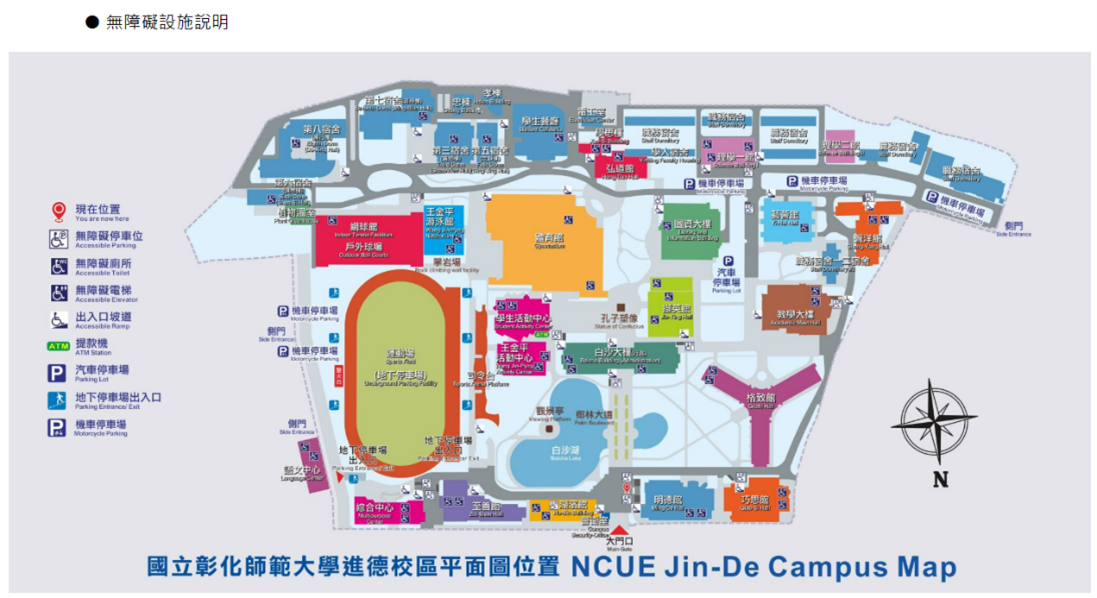
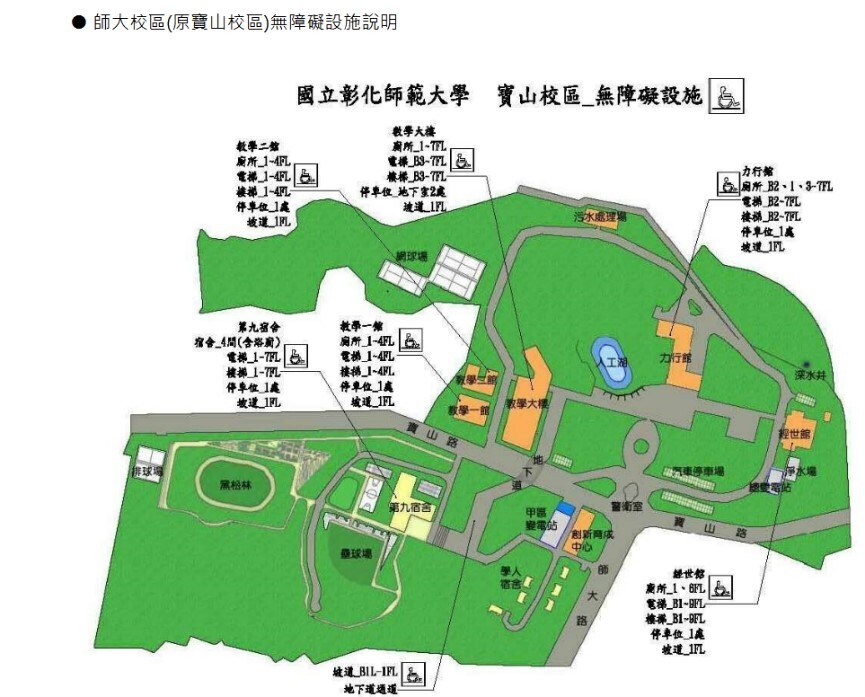
The campus is equipped with 19 renovated accessible ramps and 26 accessible guidance facilities (including tactile paving and bilingual audio guidance), combined with orientation and mobility training conducted in partnership with the Taiwan Foundation for the Blind, ensuring that blind individuals and wheelchair users can enter the campus independently and safely (Figure 7-8).
(2) Vertical Mobility and Sensory Optimization in Teaching Buildings
The university's 23 core teaching and administrative buildings have achieved a 100% installation rate for vertical mobility facilities (23 accessible elevators) and sanitary facilities (61 accessible restrooms), as shown in Table 6. Each year, more than 500 conventional light fixtures are replaced with energy-efficient LED lighting, combined with zoned motion-sensor lighting control in public areas, substantially improving nighttime walking safety.
(3) Housing Equity and Financial Support
Across the university's 7 dormitory buildings, a total of 31 dedicated accessible rooms have been installed, featuring low switches, widened doorways, threshold-free showers, and non-slip grab bars. Students with disabilities, low-income students, Indigenous students, and other special groups are given 100% priority for guaranteed dormitory accommodation, and students from low-income households additionally receive institutionalized financial support in the form of a full waiver of accommodation fees.
| Accessible Facility | Quantity | Installation Rate |
|---|---|---|
| Accessible elevator | 23 | 100% |
| Accessible toilet | 61 | 100% |
| Renovated accessible ramp | 19 | 100% |
| Accessible stair handrails | 36 | 100% |
| Guide facility | 26 | 100% |
6. Housing Equity and Anti-discrimination Accommodation Protections on Campus
NCUE firmly believes that comprehensive housing protections and a psychologically safe environment are key to reducing dropout rates among disadvantaged students and realizing social justice. NCUE has established a Gender Equity Education Committee and a Student Grievance Review Committee, explicitly and strictly prohibiting under university regulations "discrimination and unequal treatment arising from economic background, disability, gender, or ethnicity," thereby safeguarding the dignity and safety of all students within dormitories and across campus.
Across the university's 7 dormitory buildings (with a total capacity of 3,312 students) (as shown in Table 7), a robust "Guaranteed Accommodation and Financial Assistance Policy" is implemented, providing dedicated accessible rooms and financial protection for students with disabilities and other socially disadvantaged students, with priority and unconditional accommodation rights guaranteed annually for students with disabilities.
| Dormitory | Number of rooms | Number of rooms allocated to students with disabilities |
|---|---|---|
| 3rd dormitory | 77 | 3 |
| 5th dormitory | 90 | 4 |
| 6th dormitory | 63 | 1 |
| 7th dormitory | 140 | 3 |
| 8th dormitory | 179 | 6 |
| 9th dormitory | 151 | 6 |
| 10th dormitory | 193 | 8 |
In 2025, NCUE successfully translated regulatory compliance into an institutionalized commitment within university governance across its various initiatives under SDG 10: Reduced Inequalities. Whether through the nearly NT$160 million invested in accessible hardware and software, the extensive lifecycle coverage of Resource Classroom services, or the full waiver of accommodation fees for low-income students, these efforts substantively demonstrate NCUE's determination to advance educational equity.