
SDG 10.6.8
SDG 10.6.8 Disability support services
In order to help students with disabilities adapt to school life, NCUE provides support services in terms of schoolwork, life, and schooling system transition counseling.
1. Schoolwork support services
(1) Individual remedial teaching (difficult subjects): The Resource Classroom aims to help students with disabilities with difficult subjects, such as psychology and educational tests, English, and statistics. NCUE arranges individual tutors for students to help them with their progress.
(2) Examination service measures (explaining highlighted contents, reviews of specific questions, etc.): The Resource Classroom has designed a ‘Special Examination Service Form’ to meet the needs of teachers and students and provide appropriate assistance according to the different types and degrees of students’ disabilities.
(3) Work-study students and volunteers assist with learning (text-to-speech, audio recording, explaining highlighted contents, note taking, etc.): The Resource Classroom arranges regular shifts of work-study students and volunteers to assist students with disabilities with text-to-speech, audio recording, note taking, and explaining highlighted contents. At the same time, specific work-study students are arranged to assist students with disabilities with searching for information, etc.
(4) Textbook conversion: The Resource Classroom helps with converting textbooks into braille or enlarged fonts, and convert written materials into electronic files.
(5) Provide assistive equipment for borrowing.
(6) Application for special education award scholarships (provided by the Academic Affairs Office), and application for scholarships from off-campus units.
2. Life support services
(1) Orientation and Mobility training: To help a severely blind student with disabilities become familiar with the campus environment as early as possible, NCUE applied for assistance from the Taiwan Foundation for the Blind to conduct orientation and mobility training.
(2) Organize extracurricular activities and fellowship: To help students in special education become acquainted with, understand, and support each other, the Resource Classroom organizes activities such as dinners, off-campus visits, and alumni experience sharing in public office examinations or teacher enrolment examinations for students at the beginning and end of each semester.
(3) Hold student forums: In order to understand students’ learning efficiency in the classroom and effectively assist with it, the Resource Classroom regularly holds symposiums between counseling teachers and students to enable them to exchange views and to provide timely assistance.
(4) Psychological counseling (individual counseling, growth group): In view of the personal troubles faced by students with disabilities, the Resource Classroom helps students refer to the Student Psychological Consulting and Counseling Center of NCUE for individual consultation and participation in growth groups.
(5) Arrange accommodation and transportation on campus.
(6) Improve accessible environment on campus.
3. Support services concerning transition counseling
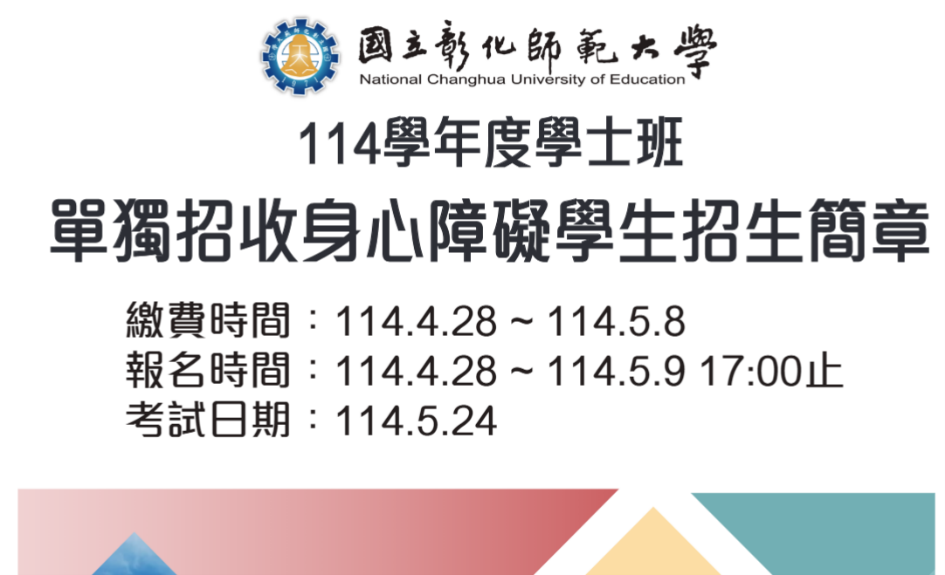
The participating individuals for various services offered at NCUE’s resource room are detailed in Table 1, and the participation in support services are detailed in Table 2. For additional information, (please refer to the resource room activities webpage at https://ncue7232105.wixsite.com/ncue/blank-7; snippets from these activities are as shown in Figures 1-4):
(1) Student transition notification services: The Resource Classroom also offer students comprehensive and ongoing transition counseling and services, incorporating individualized special education plans to assist students in achieving their transition goals, which may include independent living, social adaptation, participation, further education, or employment.
(2) Graduate transition notification and tracking services: The Resource Classroom is committed to provide transition services for students with disabilities after graduation, tailoring our support to meet each student's individual needs by linking them to resources related to further education, transfer to other institutions, employment, vocational training, and homecare.
| Support service category | Number of participants |
|---|---|
| Schoolwork assistance service | 2571 |
| Life assistance service | 339 |
| Career and schooling system transition service | 83 |
| Consulting and counseling | 651 |
| Name of Support Service Activity | Number of Participants |
|---|---|
| 2024-2 Visit by Sihu Senior High School: Introduction to Special Education Resource Services at Universities and Colleges | 26 |
| 2024-2 Student Forum at the Shida Campus | 17 |
| 2024-2 Student Forum at the Jinde Campus | 31 |
| 2024-2 Career Lecture: Adjusting on My Own—From Overwhelming Stress to Inner Peace | 16 |
| 2024-2 Career and Workplace Image Workshop (I) | 18 |
| 2024-2 Career and Workplace Image Workshop (II) | 18 |
| 7th National University and College Resource Classroom Sports Competition and Inter-School Exchange Activity | 14 |
| 2024-2 "Love in Understanding and Acceptance" Special Education Week Awareness Activity | 182 |
| 2024-2 General Education Lecture – "If This Bus Called Opportunity Passes by and You Pretend Not to Notice, Here's What You Can Do" | 41 |
| 2024-2 Consultation Meeting on the Reassessment of Assistive Devices and Special Education Needs for Internship for Students with Disabilities | 7 |
| 2024-2 Off-Campus Visit and Experience Activity | 17 |
| 2024-2 End-of-Semester Dinner and Farewell Activity | 28 |
| 2025-1 Parent Forum for New Students at the Shida Campus | 9 |
| 2025-1 Parent Forum for New Students at the Jinde Campus | 17 |
| 2025-1 Student Forum at the Jinde Campus | 28 |
| 2025-1 Student Forum at the Shida Campus | 17 |
| 2025-1 Transportation Subsidy Review Meeting | 8 |
| 2024-1 One-on-One Career Orientation Consultation | 6 |
| 2025-1 One-on-One Career Exploration Test Interpretation – CPAS Career Aptitude Diagnostic Test | 23 |
| 2025-1 "Love in Understanding and Acceptance" Anniversary Special Education Awareness Activity | 121 |
| 2025-1 General Education Lecture – "Different Traits, Different Feelings": Interpersonal Interaction and Gender Sensitivity from the Perspective of #MeToo | 32 |
| 2025-1 Career Self-Empowerment Lecture – "Sometimes Even a Little Can Hurt" | 8 |
| 2025-1 Year-End Blessing Activity – Resource Classroom Support Service Satisfaction Survey | 43 |
| 2025-1 "Fighting Adversity: The Journey from Exam Hall to Workplace" (Career Lecture) | 21 |
| 2025-1 End-of-Semester Dinner and Transition Activity | 19 |
| 2025-1 Off-Campus Visit and Experience Activity | 15 |
4. Activities related to the counseling services provided by the Resource Classroom
Activities related to the counseling services provided by the Resource Classroom are announced to all students with disabilities on a Facebook group, and students are encouraged to participate actively, as shown in Figure 5.
5. Commissioned and Subsidized Projects from the Ministry of Education
The Special Education Center of NCUE undertakes commissioned and subsidized projects from the Ministry of Education. In addition to providing internal support for students with disabilities at our university in learning assistance, life assistance, school adaptation, and transition services, it also provides external special education consultation services for schools and community members in the guidance area, organizes special education professional development workshops, conducts on-site visits for higher education special education, performs special education assessment for higher education institutions, and publishes special education publications.
(1) Regarding the counseling of students with disabilities on campus, in 2025, a total of 80 students with disabilities at NCUE received related support services, including 2571 instances of academic learning assistance services, 339 instances of life assistance services, 83 instances of career and transition services, and 651 instances of counseling and guidance services.
(2) For community members, students, teachers at various educational levels, and related guidance personnel, the center provides consultation hotline services to resolve issues related to teacher instruction, parental education, and student guidance practices. It also conducts on-site visits to schools in the guidance area to understand the implementation of special education work in schools.