SDG 15.2.6
SDG 15.2.6 Sustainable management of land for tourism (educational outreach)
NCUE has implemented a project through its Department of Biology entitled “Monitoring and Control of Yellow Crazy Ants at Gaomei Wetland.” A brief introduction is provided below.
Monitoring and Control of Yellow Crazy Ants at Gaomei Wetland
Gaomei Wetland is home to rich terrestrial crab ecological resources. However, in recent years, the invasive alien species yellow crazy ant (Anoplolepis gracilipes) has been found to have invaded terrestrial crab habitats, posing a threat to the survival of terrestrial crab populations.
Control operations targeting yellow crazy ants in the terrestrial crab hotspot areas of Gaomei Wetland were initiated in early 2018 and concluded in 2019. Subsequently, the population density of yellow crazy ants remained relatively low until 2023, when an increasing trend was observed. As a result, control operations were resumed in 2024.
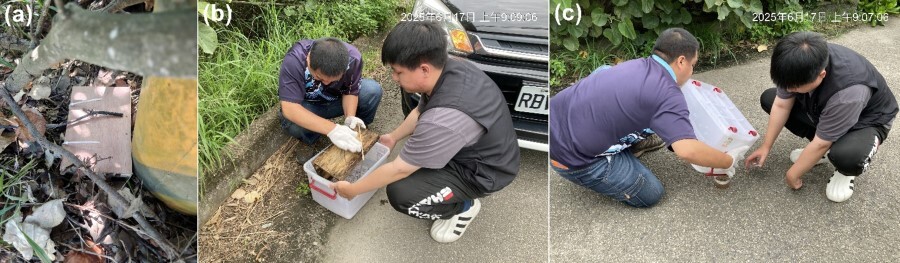
In the current year, monitoring of the distribution and population density of yellow crazy ants in terrestrial crab hotspots was continued in April, June, August, and October. In addition, liquid bait was applied once a month from April through September. Artificial bait stations were also deployed to physically remove yellow crazy ant nests.
The distribution range of yellow crazy ants was consistent with that observed in previous years, with the population primarily concentrated between the southern starting point of the survey area and the pavilion, corresponding to sampling points 1–24. The survey results showed that yellow crazy ants were detected at 7, 14, 14, and 9 sampling points in April, June, August, and October, respectively. Among the sampling points, 17 were classified as Level 1 (low severity), 20 as Level 2 (moderate severity), 6 as Level 3 (moderately high severity), and 1 as Level 4 (high severity).
Compared with the data from the previous year, both the distribution range and population density of yellow crazy ants showed a declining trend this year. Unlike the previous year, the population did not increase substantially after summer, particularly in October.
During the four monthly monitoring periods, the artificial bait stations captured a total of 579 queen ants, 117 queen pupae, and 35,249 worker ants. The monitoring results indicate that the integrated control approach of continuous liquid bait application combined with artificial bait stations was more effective in suppressing the yellow crazy ant population within the survey area.
Given the significant effectiveness of the current control measures, it is recommended that the monthly application of liquid bait be continued next year, together with the use of bait stations for physical removal. The related activities are shown in Figure 1.