
SDG 6.5.5
SDG 6.5.5 Cooperation on water security
1. NCUE works with government agencies at all levels and related organizations to promote water security and water resource protection. Through multiple projects and free activities, NCUE focuses on the management and sustainable development of coastal and freshwater resources, strengthens water safety education, and works to improve local water use and protect ecosystems.
(1) Local and Regional Cooperation: Industry and Environment Sustainability Project
(a) Coastal Water Resource Protection and Industry Support
NCUE uses the University Social Responsibility (USR) Project “Resilient Changbin: Sustainability of Changhua’s Coastal Environment and Industries under Climate Change” (Figure 1) as a cross-disciplinary cooperation platform. The project brings together university research and education, local schools, communities, environmental education partners, and the aquaculture industry to carry out water quality monitoring, manila clam habitat surveys, and aquaculture environment management along the Changhua coast. In 2025, it held volunteer training, marine citizen science activities, outdoor surveys, and aquaculture probiotics workshops to build local capacity for monitoring and managing aquatic environments. It also turned water quality, dissolved oxygen, sediment, and ecological survey data into information for local environmental education and industry management, creating a cooperation model that links university research, local participation, and industry application.
(b) Youth Water Education Promotion:
NCUE's Department of Geography collaborated with Taichung Municipal Fengdong Junior High School to organize the "Taichung City 2025 Junior High School Talented Student Camp" and jointly promote the course "Stories of Water and Settlements: Exploring Human-Land Relationships through Hydrological Science." Through collaboration between NCUE and local educational institutions, the program deepened water resource and water safety education.
The course integrated hydrogeography, water resources engineering, and disaster prevention education. Students explored river terraces, floodplains, canal systems, and important water resources facilities such as Shigang Dam and Tucheng Levee, while analyzing their impacts on settlement development, water resource utilization, flood control governance, and environmental sustainability (see Figures 2-3). Through on-site field trips and case analysis, students gained an understanding of the importance of government-led water resources construction, water resource management, and flood control governance. This project promoted collaborative efforts between NCUE and local educational institutions to advance water safety knowledge and raise younger generations' awareness of sustainable water resource management and water safety issues. Activity highlights webpage: https://www.facebook.com/photo/?fbid=1289851339620289&set=pcb.1289851632953593
(c) Taipower Youth Career Experience Visit Program
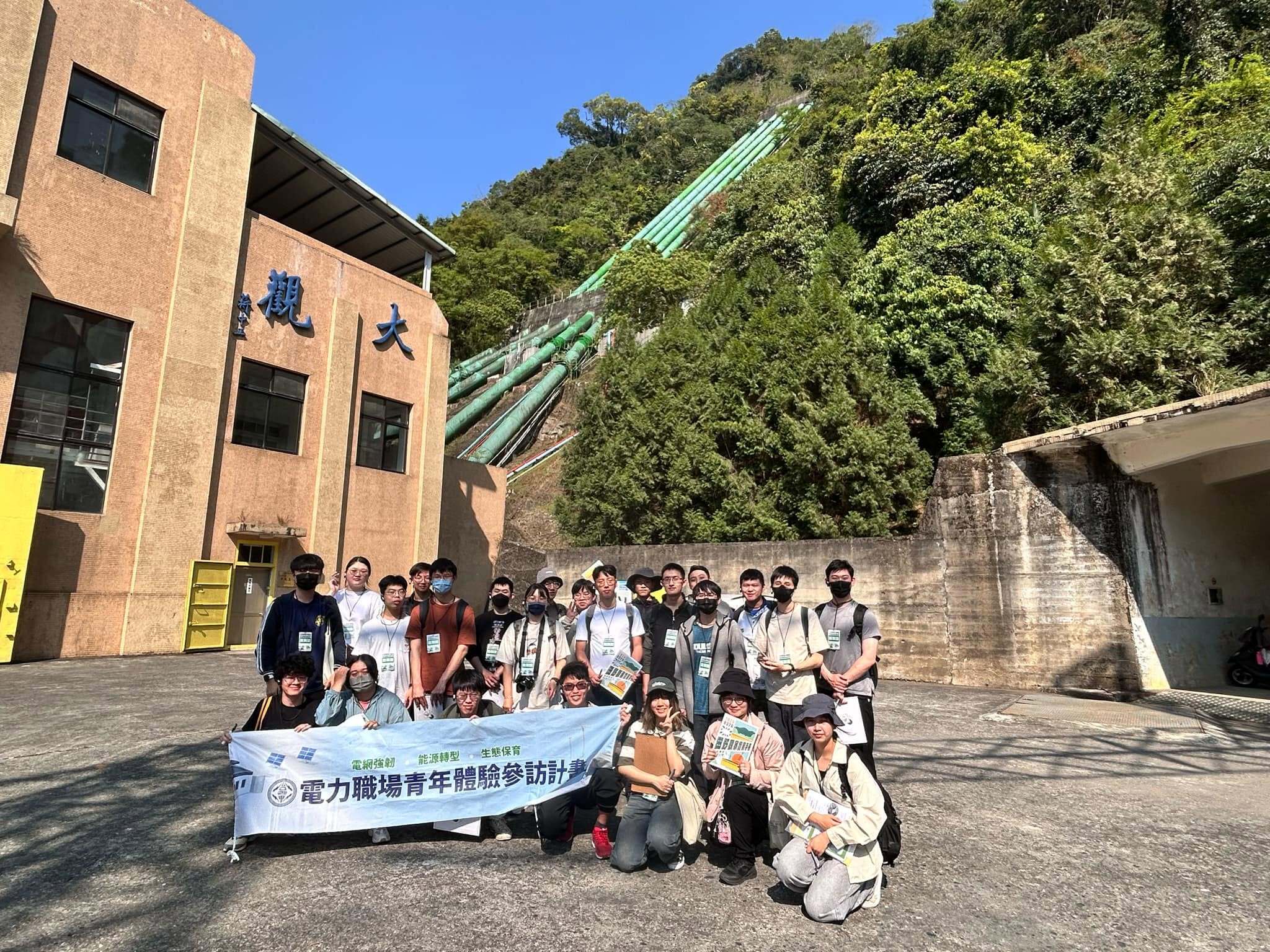
On March 26, 2025, NCUE's Department of Geography led teacher-training students to participate in the "Taipower Youth Career Experience Visit Program," organized by Taiwan Power Company, and visit the Daguan Power Plant for a field observation of hydroelectric power generation. Through collaboration with the state-owned enterprise, the visit promoted education in water resource management, hydroelectric power generation, and sustainable development (as shown in Figure 4).
During the activity, Taipower professionals introduced the hydroelectric power generation system, water resource dispatch, reservoir management, and energy transition strategies at the Daguan Power Plant.They also explained the operation of sediment-retention dams, measures to prevent reservoir siltation, and important measures balancing power generation with environmental conservation. Through on-site observation and exchange, students gained an in-depth understanding of the practical operations of water resource management, hydroelectric power generation, and water safety governance. The collaboration between NCUE and government agencies created great outcomes in jointly promoting sustainable water resource utilization and water safety education.
(d) Water Safety Cooperation Training and Social Practice
NCUE's swimming pool adopts a Public-Private Partnership (PPP) model. New Image Enterprise Co., Ltd. leased to operate and establish "Shinshang Swimming Academy." This collaboration not only implements sustainable operation of the campus facility but also extends resources to local, regional, and national government units, building a multi-leveled water safety collaboration network.
In response to the Ministry of Education's policy of promoting "Student Water Sports Safety Education" and enhancing "Students' Water Self-Rescue Abilities," NCUE actively serves as a regional core for water safety education. Through public-private partnership, and in collaboration with central government agencies and local education bureaus, NCUE jointly promotes standardized and professional water safety training. Practical outcomes span national law enforcement agencies, grassroots local education, and regional talent cultivation; specific 2025 cooperative achievements (continuing 2024 results) are shown in Table 1 below.
| No. | Cooperative Unit | Course Name | Participants |
|---|---|---|---|
| 1 | Special Police Fourth Headquarters, NPA, MOI | Police Special Examination Swimming Course Training | 615 |
| 2 | 24 Elementary Schools in Changhua County | Water Self-rescue Ability Course | 17,000 |
| 3 | Elementary to High School Students | Xinxiang Swimming Team | 100 |
(2) Central Government Cooperation: Water Culture Construction and Policy Support
(a) Tamsui River Water Culture Research – Water Environment Change and Disaster Adaptation Project
NCUE’s Graduate Institute of History carries out the “Tamsui River Water Culture Research – Water Environment Change and Disaster Adaptation Project” (Figure 5) for the Water Resources Planning Branch, Water Resources Agency, Ministry of Economic Affairs. To help protect water resources and the environment, the project covers the following work items:
i. Inventory, Compilation, and Impact Analysis of Historical Spatial Data/Maps Related to Water Environment Changes.
ii. Tracing the Historical Context of River Channel Changes and Watershed Governance
iii. Water Culture Nurtured by River Channels, Disasters, and Folk Beliefs
iv. Research and Analysis of Water Culture for Adaptation to Climate Change
v. Administrative Coordination, Work Briefings, and Report Compilation
The research is conducted using four methodologies: collection and study of existing research findings and historical records, inventory and pre-processing of historical spatial data/maps, on-site investigation (fieldwork and oral history), and cross-disciplinary research discussions, along with tasks such as presentations and report compilation, to achieve the research objective regarding water environment change and disaster adaptation. For related information, please refer to webpages:
i. https://www.wra.gov.tw/wrap/cp.aspx?n=39953
ii. https://web.wra.gov.tw/wralib/WraLib/wSite/books_96414
(b) Monitoring of the Farming and Fishery Social Ecosystem in the Wetlands
NCUE’s Department of Geography carries out the National Science and Technology Council project “Monitoring of the Farming and Fishery Social Ecosystem in the Wetlands of the Western Coast of Taiwan.” The department has set up long-term observation stations at Fangyuan, Hanbao, and Wanggong Wetlands to survey water quality, ecology, topography, and local residents’ perceptions. It has integrated social, cultural, and ecological change to provide scientific data for sustainable government governance.
Taiwan Long-term Social-ecological Research Changhua Station LTSER Changhua related webpages (Figure 6):
i. https://www.facebook.com/profile.php?id=100083565782372#
ii. https://ltsertwchanghua.org/
(3) Water Resource Professional Course Promotion:
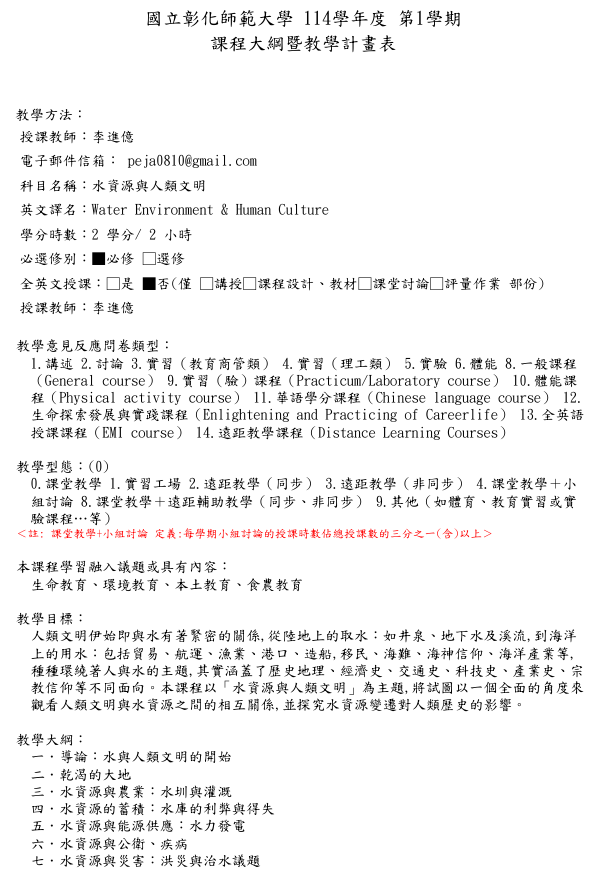
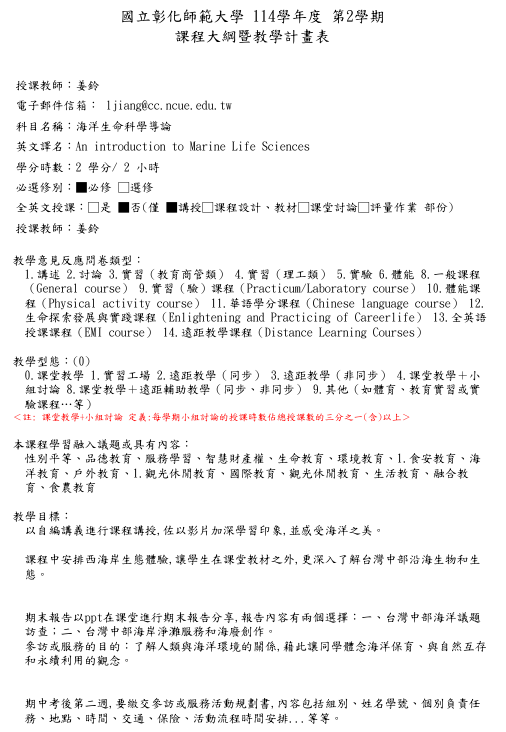
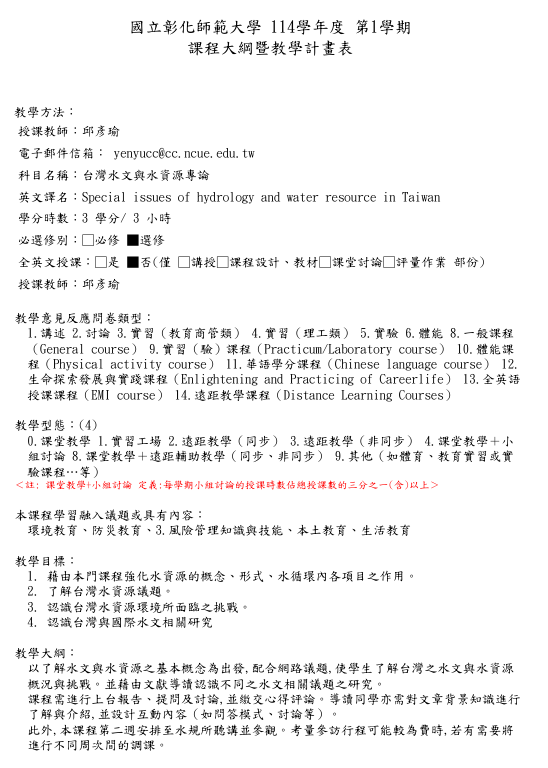
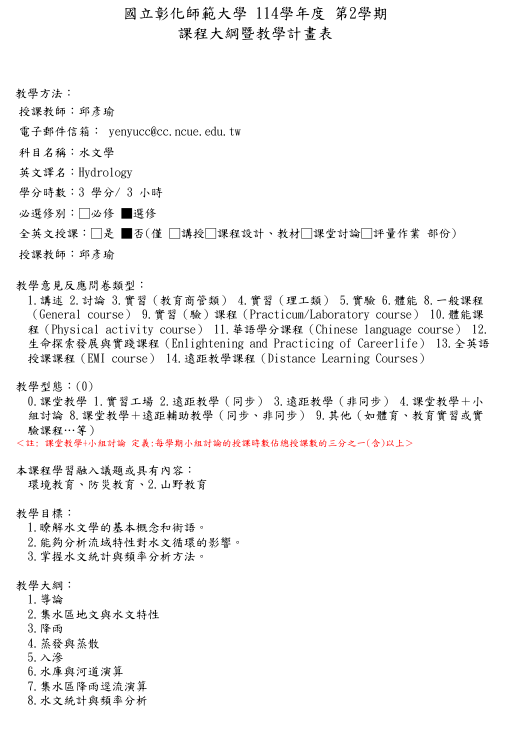
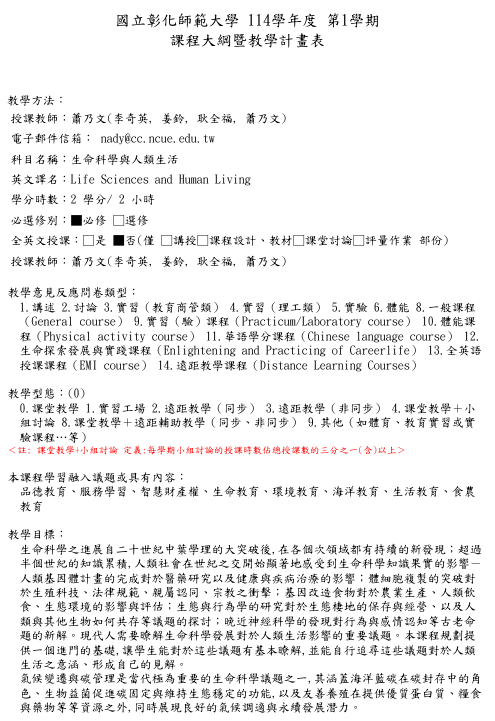
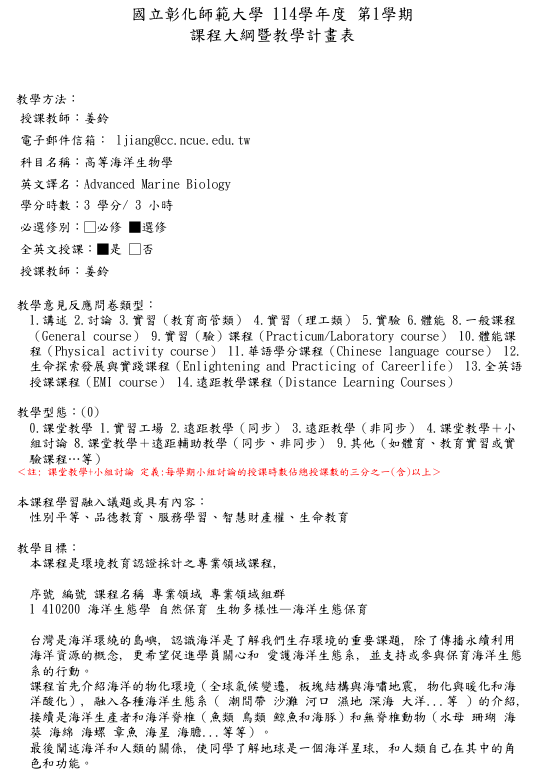
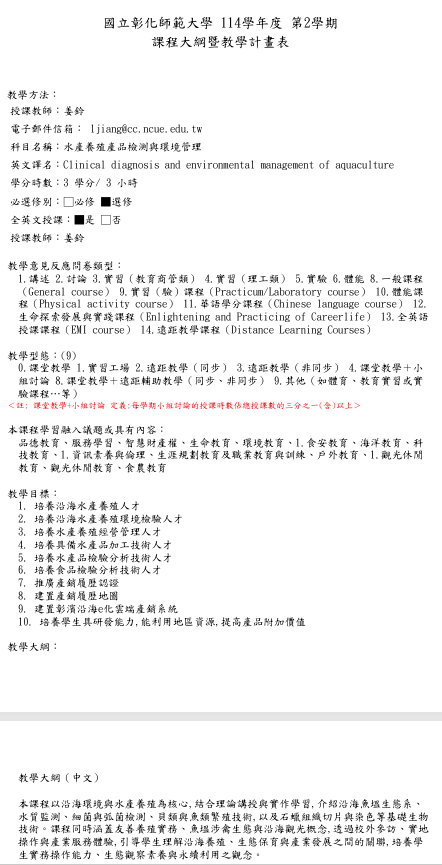
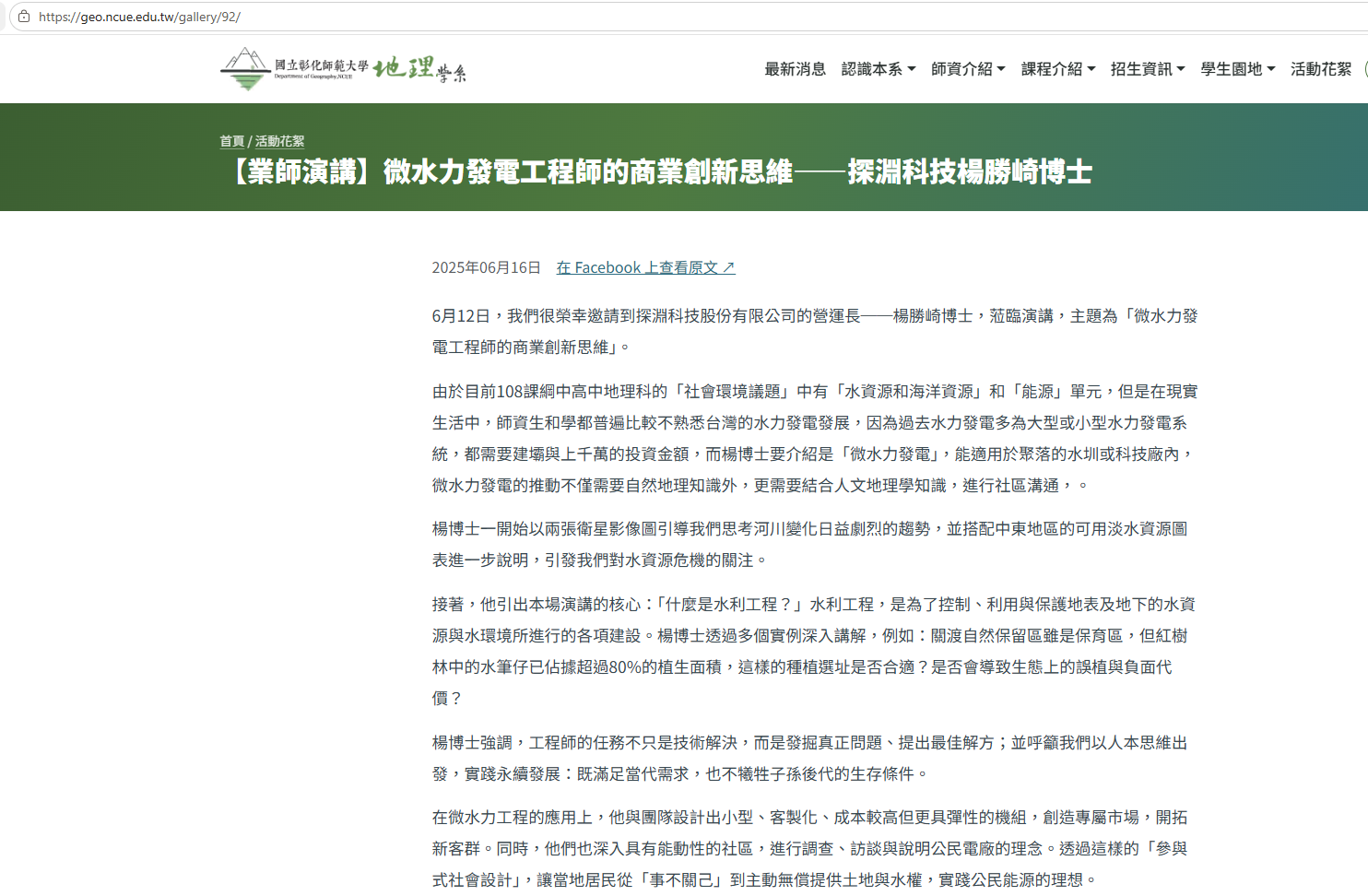
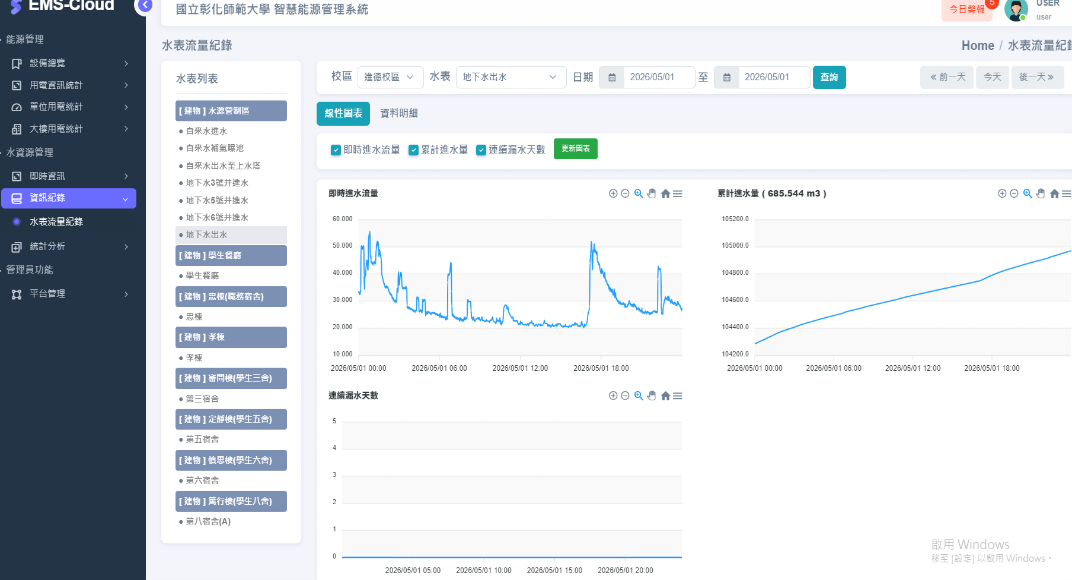
NCUE’s Department of Geography offers the course “Special Issues of Hydrology and Water Resources in Taiwan” to strengthen students’ grasp of water resource concepts and the water cycle and to introduce water resource issues and challenges in Taiwan and around the world. In the “Hydrology” course, students learn basic hydrological concepts and analytical methods and study how groundwater and surface water interact and affect water resource management. During the semester, students also visit major water resource facilities in central Taiwan, including the Water Resources Planning Branch, Water Resources Agency, Ministry of Economic Affairs, Shigang Dam, Jiji Weir, and Zhongguakeng Creek, in these field trips, they learn how reservoir management can both protect water resources and generate renewable energy, supporting regional water security. Course outline webpages are shown in Figures 7-8.
Through the above projects and courses, NCUE actively participates in water resource safety and protection, contributes to promoting sustainable water resource utilization, and demonstrates achievements in educational promotion and professional talent cultivation, laying the foundation for Taiwan's water resource sustainability and water culture heritage.
2. Details of the related projects and activities are as follows:
(1) Resilient Changbin: Sustainability of Changhua’s Coastal Environment and Industries under Climate Change
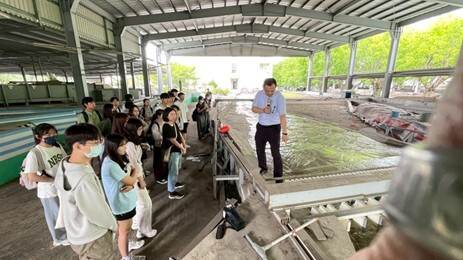
Using the “Resilient Changbin” USR Project as a platform, NCUE brings together university education and research, local communities, schools, the aquaculture industry, and environmental education partners to carry out water quality monitoring, aquatic ecological surveys, and aquaculture environment management along the Changhua coast, eventually turning water resource research into local water environment governance and conservation actions.
In practice, NCUE held 3 free aquaculture probiotics workshops and 10 free workshops on promoting and practicing the circular economy for discarded shells, as shown in Table 2 and Figure 9. Through its probiotic research, NCUE also screened 4 bacterial strains for gene sequence analysis to assess how well they break down harmful substances in water and improve shellfish health The result provided a scientific basis for eco-friendly aquaculture and water environment management.
Facebook page of the “Resilient Changbin: Sustainability of Changhua’s Coastal Environment and Industries under Climate Change” (Figure 10): https://www.facebook.com/NCUEUSR/
| NO. | Date | Activity Topic |
|---|---|---|
| 1 | 2025-02-19 | Blue Carbon: Waste Shell Workshop |
| 2 | 2025-03-20 | Cao-hu Junior High School Blue Carbon: Waste Shell Circular Economy Workshop |
| 3 | 2025-04-19 | Cao-hu Junior High School Blue Carbon: Waste Shell and Ecological Restoration Workshop |
| 4 | 2025-05-24 | Circular Economy and Marine Art Workshop |
| 5 | 2025-06-06 | Circular Economy and Marine Art Field Trip Workshop |
| 6 | 2025-06-26 | Fangyuan Elementary School Blue Carbon: Waste Shell and Ecological Restoration Workshop |
| 7 | 2025-07-15 | Hand-in-Hand Blue Carbon: Waste Shell Ecological Restoration Workshop |
| 8 | 2025-07-19 | Marine Blue Carbon Wetland Field Trip Workshop |
| 9 | 2025-10-18 | Marine Citizen Scientist Workshop |
| 10 | 2025/11/14 | Waste Shell Recycling and Reuse Workshop |
| 11 | 2025-04-22 | Probiotics and Aquatic Product Vibrio Testing Workshop |
| 12 | 2025-05-13 | Probiotics Cultivation and Expansion Workshop |
| 13 | 2025-11-17 | Marine Beneficial Bacteria and Blue Carbon Workshop |
(2) NCUE’s “Changhua Coastal Manila Clams Habitat Survey and Conservation Education Promotion Program”
(a) NCUE collaborated with the Changhua County Marine Food Research and Production Cooperative Limited, the Environmental Education Center, Cao-hu Junior High School, Hanbao Elementary School, Fangyuan Elementary School, Houliao Elementary School, and local communities to promote water quality and ecological monitoring, manila clam habitat surveys, and marine citizen science education at Xinbao Wetland and along Changhua's coastal areas. Through cross-school, community, and industry collaboration, NCUE established a collaborative model spanning water quality monitoring, environmental education, and local action to jointly promote water safety and ecological conservation.
(b) NCUE held a series of marine citizen scientist courses at Xinbao Wetland and Wanggong Harbor (Figures 11–13), including seasonal “Manila Clam Habitat Surveys” (with sediment improvement experiments), survey volunteer training, seed teacher training, and the “Manila Clam Baby Detective Squad.” These activities raised the attention that coastal residents, teachers, students, and local government give to water quality monitoring and water safety.
(c) The project results show that sediment improvement promoted the growth of coarse-sediment indicator species such as manila clams and hard clams, while suppressing the dominance of hard clams and increasing carbon sequestration potential and benthic biodiversity. The participation of citizen scientists also increased the volume of survey data and strengthened community awareness of water security and conservation, altogether establishing a model that combines scientific research with education outreach.
(3) Water Safety Cooperation Training
(a) From September to December 2025, NCUE and the Special Police Fourth Headquarters, NPA, MOI co-organized “Police Special Examination Swimming Training Course” (Figure 14). A total of 615 trainees completed the course. This strengthened the professional training of police personnel.
(b) In 2025, 24 elementary schools held water self-rescue courses at NCUE’s swimming pool, where professional coaches from Xinxiang Swimming Academy taught students to rescue themselves in water or improve their swimming skills (Figure 15). The courses recorded 17,000 participants over the year.
(c) To develop the swimming skills of young people in Changhua City and nearby communities and to train future competitive swimmers, the “Xinxiang Swimming Training Team” was established. About 100 elementary to high school students currently train with the team every week (Figure 16).
(4) Field Trip for the Department of Geography’s “Hydrology” Course:
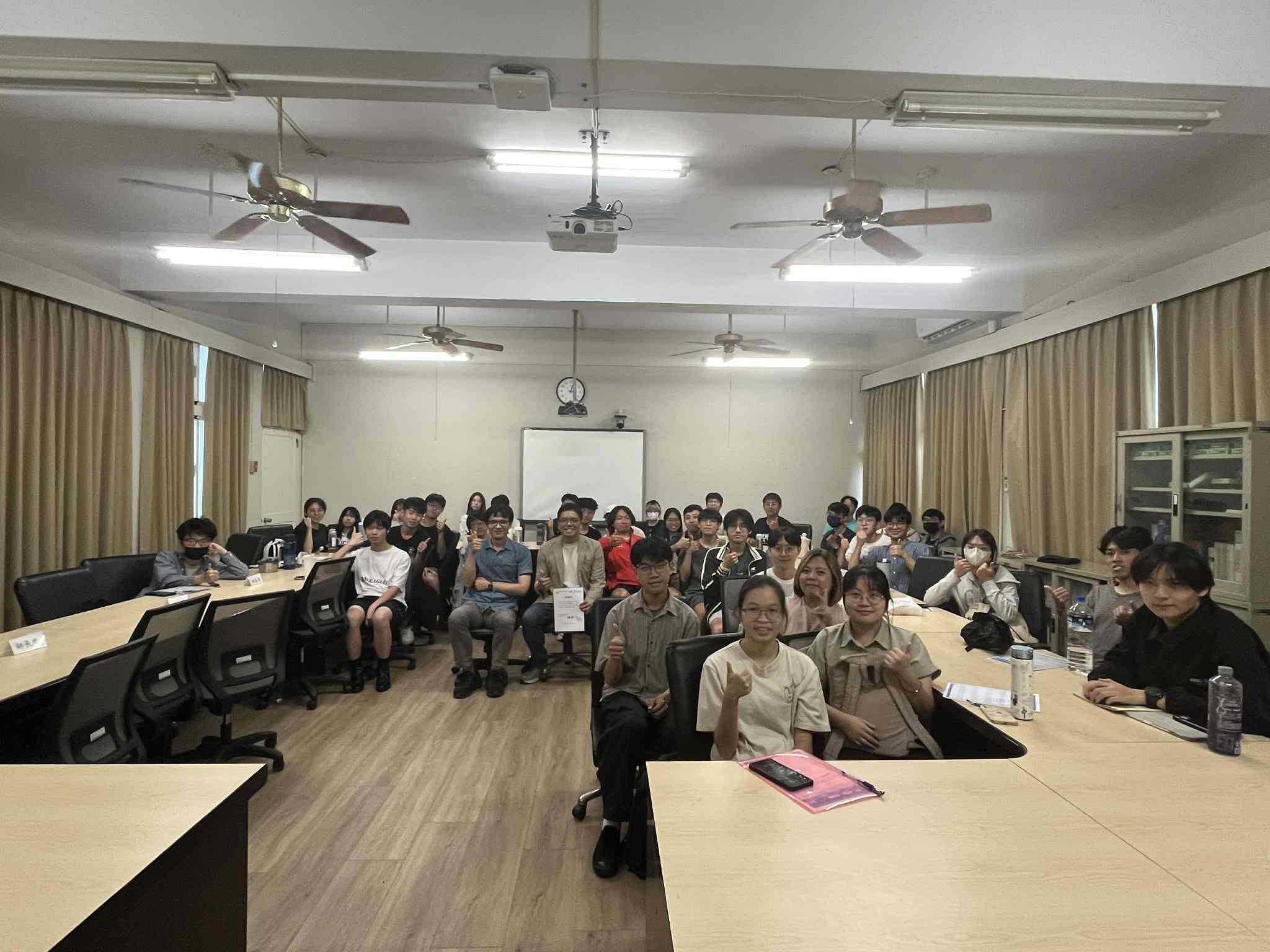
In 2025, NCUE’s Department of Geography offered the “Hydrology” course with an off-campus field trip in which students visited the Water Resources Planning Branch of the Water Resources Agency, Ministry of Economic Affairs, and the Fuma Canal in Changhua. This cooperation with government water agencies deepened water resource management and water safety education (Figure 17).
The course featured water resources professionals introducing watershed governance, hydraulic modeling, hydrological monitoring, and river management techniques. It also included visits to the flow meter calibration laboratory, the Water Resources Planning Artifact Museum, and the Zengwen River hydraulic model for students to understand practical applications such as flow measurement, hydraulic experimentation, river channel management, flood control engineering, and watershed management. Students also observed the Fuma Canal's water resources facilities and the surrounding environment on site. They discussed the impact of water resources engineering on local water supply, irrigation, and regional development. The discussions enhanced students' understanding of government water resource governance, water safety, and sustainable utilization policies.