SDG 6.4.2
SDG 6.4.2 Water reuse measurement
1. NCUE has an artificial lake called "Baisha Lake" with an area of approximately 9,000 m2. It serves as a retention basin during rainy weather, collecting rainwater and runoff from the surrounding buildings and green spaces. The collected rainwater is then utilized for irrigation of the lawns and gardens (Figure 1).

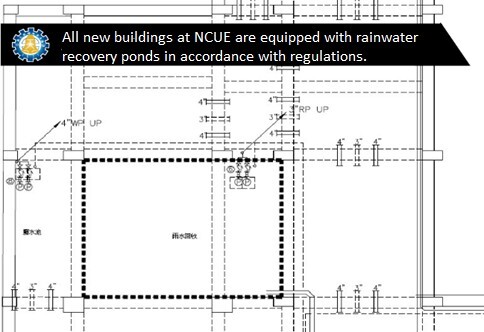
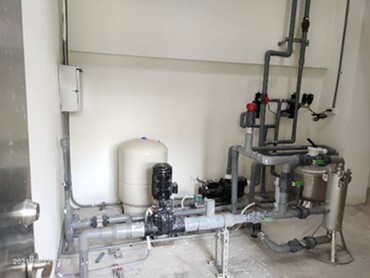
2. Since 2003, every new NCUE building has been equipped with a rainwater harvesting tank as required by green building regulations. The harvested rainwater is used to flush toilets and irrigate landscape plants. The rainwater harvesting tanks in the 5 completed buildings have a total capacity of 423.9 m3, which reduces the amount of tap water and raw water from NCUE’s own wells used for domestic and irrigation each year, as shown in Table 1.
| No. | Campus | Name of building | Capacity of rainwater recovery tank |
|---|---|---|---|
| 1 | Jinde Campus | Wang Jin-Ping Activity Center | 35 m3 |
| 2 | Jinde Campus | Academic Main Hall (Teaching Building) | 89.78 m3 |
| 3 | Shida Campus | College of Engineering | 203 m3 |
| 4 | Shida Campus | Student Dorm 10 | 72.72 m3 |
| 5 | Jinde Campus | College of Science Building I (phase 1) | 23.4 m3 |
3. Since 2003, NCUE buildings have been equipped with rainwater harvesting tanks as required by regulations, as shown in Figures 2–3.
4. All NCUE buildings have been retrofitted with water-saving fixtures, including new water-saving faucets, water-saving toilets, dual-flush toilets, water-saving shower fixtures, and automatic sensor flushing systems, to reduce domestic water use by faculty and students.
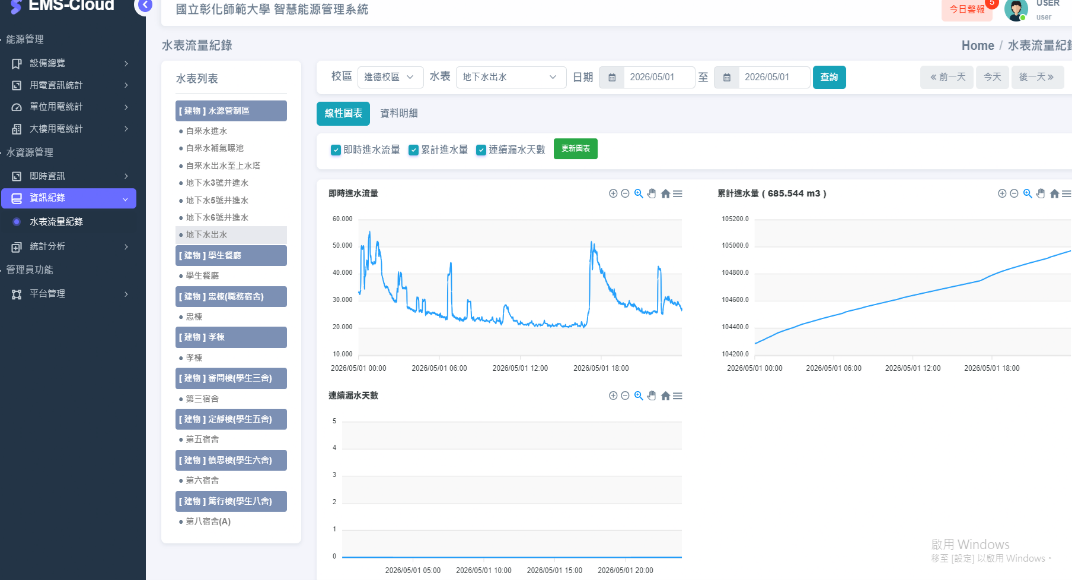
5. By the end of 2025, NCUE had installed 7 ultrasonic smart water meters on Jinde Campus (15 meters in total) and 23 new ultrasonic smart water meters on Shida Campus. Also, every building on Shida Campus has its own groundwater and tap water meters to monitor its water use. NCUE analyzes the consumption and event data that the smart meters transmit wirelessly to assess water use, and the management system automatically plots flow trend charts that can be used to detect abnormal usage. Real-time data from the smart meters allow NCUE to manage campus water use effectively and monitor water resources. With smart meters installed across its campuses, NCUE consolidates all types of water resource data as a basis for water balancing, allocation, leak detection, and management. Figure 4 shows the interface of NCUE’s campus-wide Energy Management System (EMS). Website: https://ems.ncue.edu.tw/backend