SDG 7.2.5
SDG 7.2.5 Energy wastage identification
1. At the end of each year, NCUE holds a campus-wide energy conservation task force meeting to review the effectiveness of the past year's electricity-saving policies and to set electricity-saving measures for the following year. The President chairs the meeting, and the units responsible for managing each building serve as task force members. The energy management unit also compares each building's growth in electricity use with previous years and applies rewards and penalties, so that members of every unit develop the habit of saving electricity. Past reviews show that air conditioning is currently NCUE's largest energy consumer, followed by lighting.
2. NCUE operates an energy management system (EMS) (Figure 1) that monitors the hourly, daily, monthly, and annual electricity use of more than 33 buildings and related equipment on campus. NCUE uses the data to track daily electricity use in each building, analyze campus electricity use patterns, and verify the results of its annual energy-saving measures.
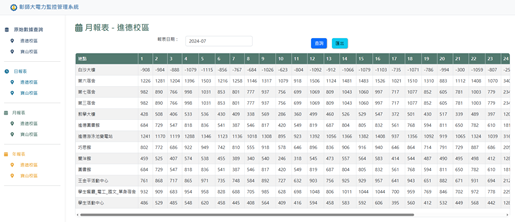
3. Specific functions of the EMS are as follows:
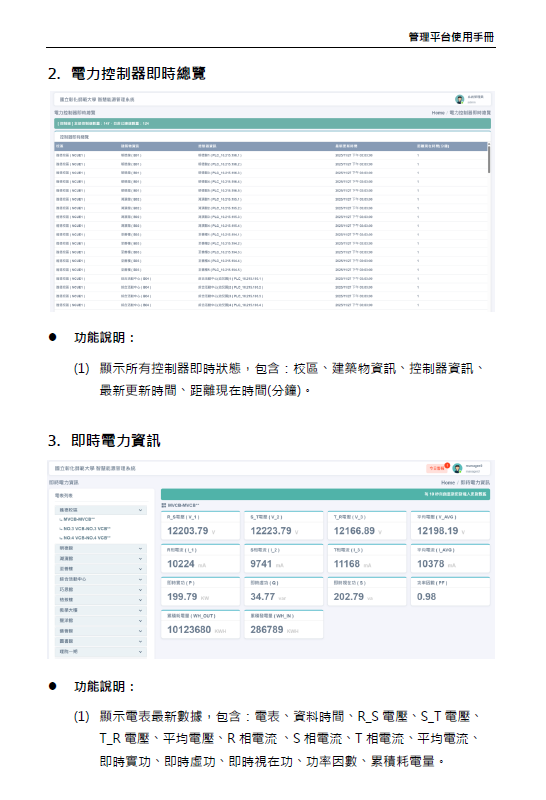
(1) Measures the real-time voltage, current, power, demand, frequency, and other important parameters of each building.
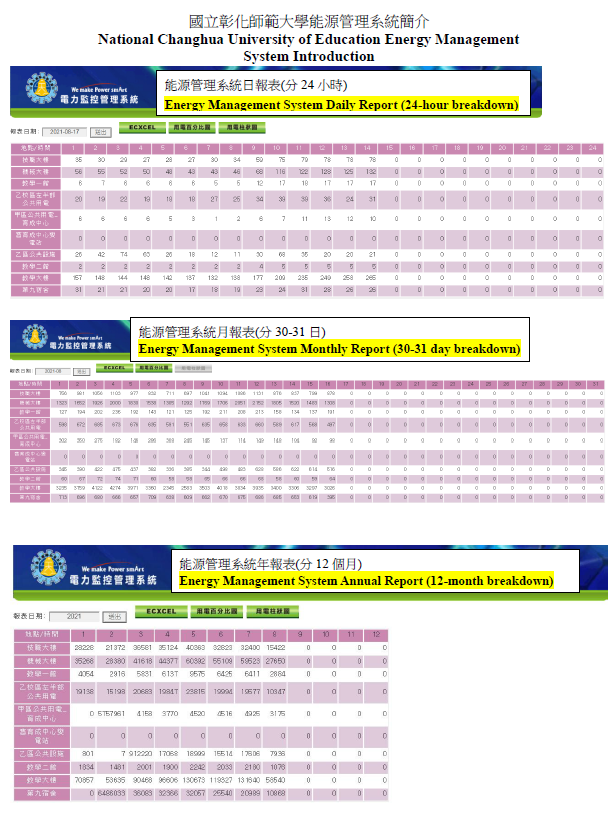
(2) Generates reports to display the cumulative energy consumption of all buildings in the entire campus on an hourly, daily, and monthly basis.
(3) Figure 2 shows the Introduction to NCUE's Energy Management System.
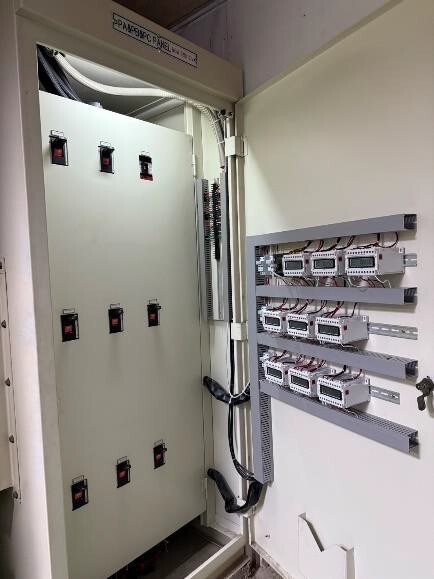
4. NCUE has installed smart meters on the Shida and Jinde Campuses (Figure 3), adding communication-enabled meters and current transformers to each circuit in the high- and low-voltage substation enclosures. NCUE has also built a new energy management system, which stores the collected data in its database.
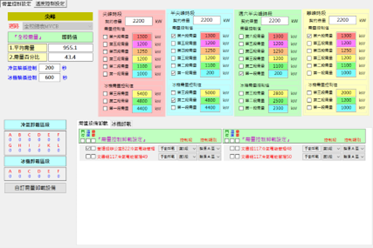
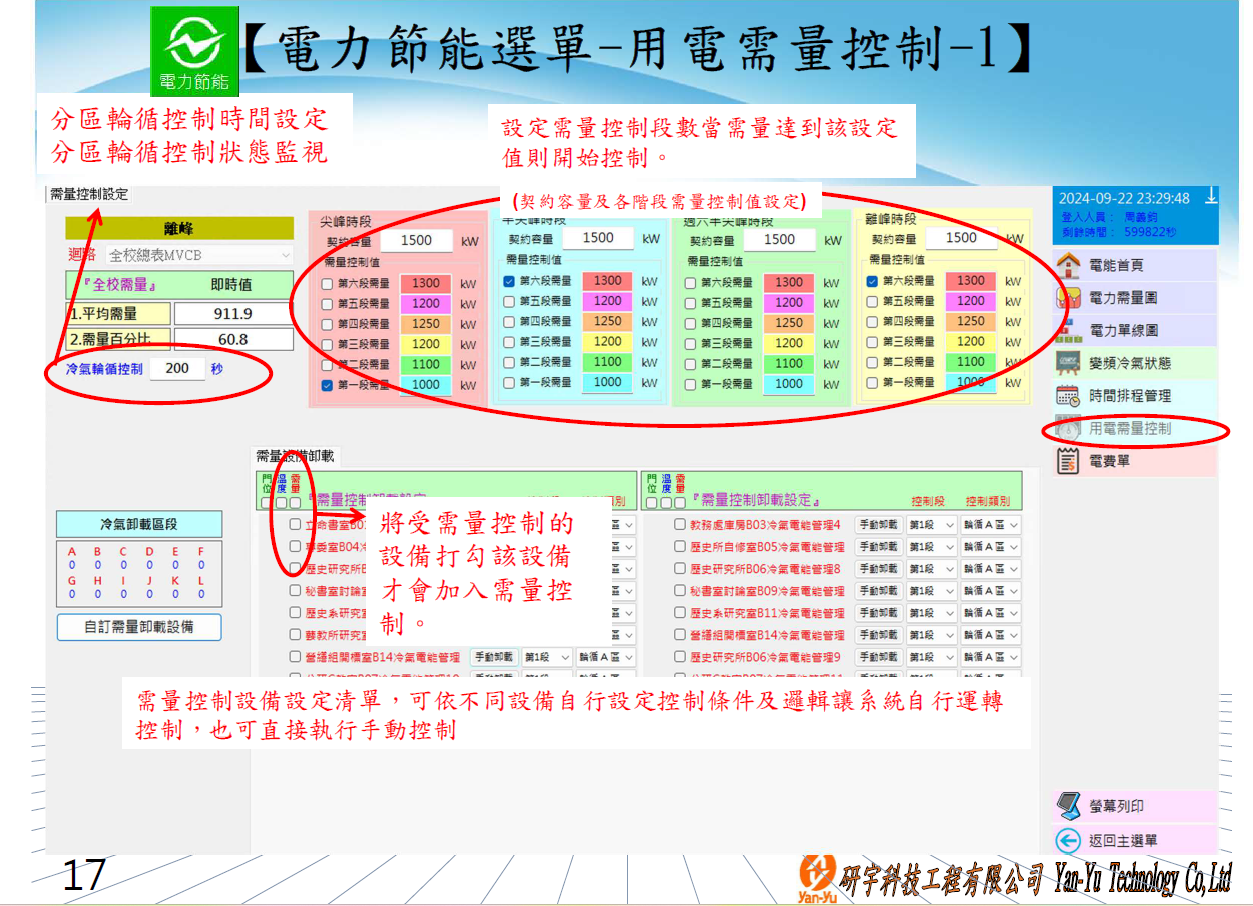
5. To implement an effective energy management system, improve energy efficiency, and reduce energy costs, NCUE has equipped all air conditioning units in the Baisha Building with temperature monitoring, load-shedding, and scheduled shutdown control functions, integrating demand management to regulate peak power usage and prevent exceeding contracted capacity limits (Figure 4).
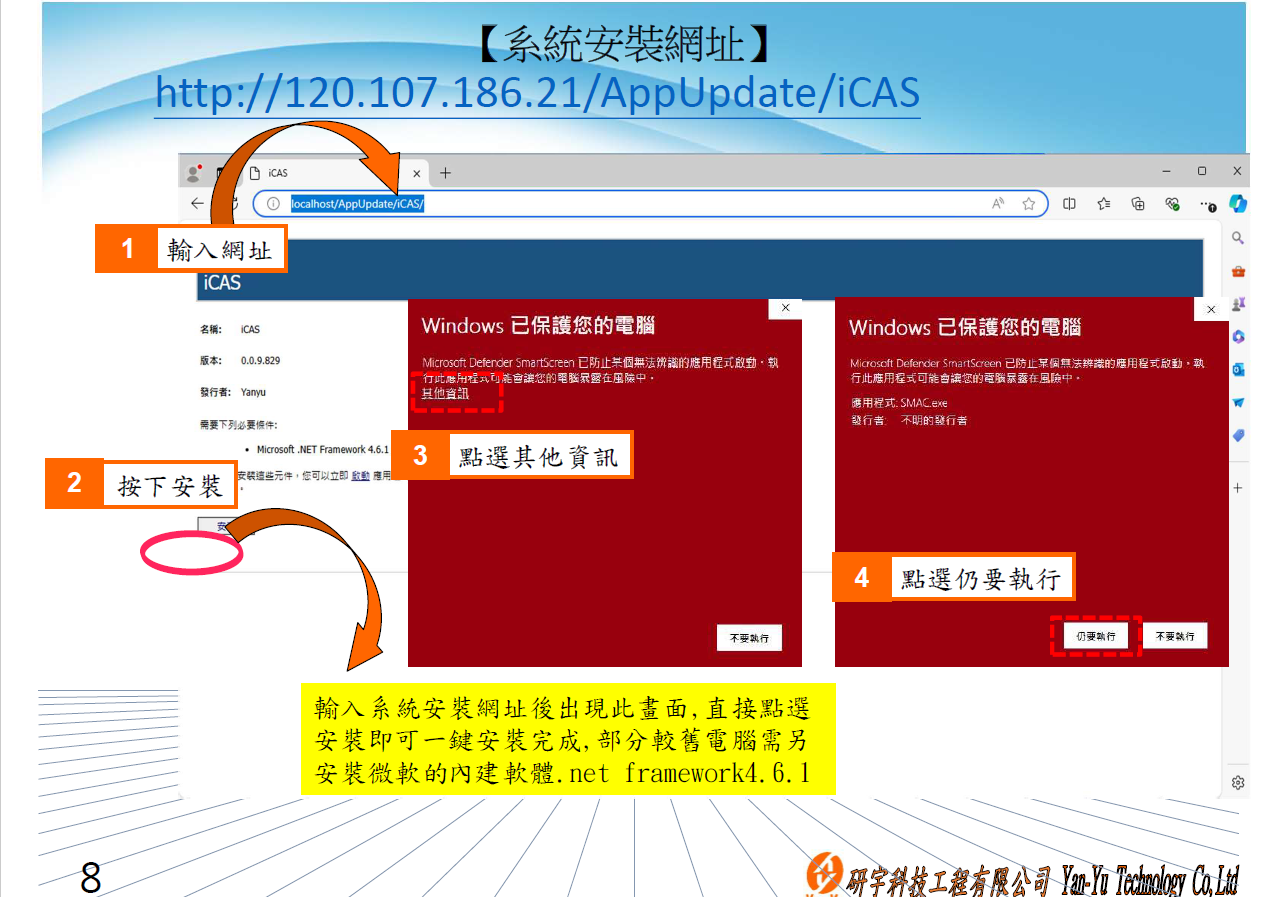
Link to the monitoring system: http://120.107.186.21/AppUpdate/iCAS (app installation required)[cite: 62, 95]
Figures 5–6 show the installation and operation interfaces of the Baisha Building's air conditioning energy-saving system.
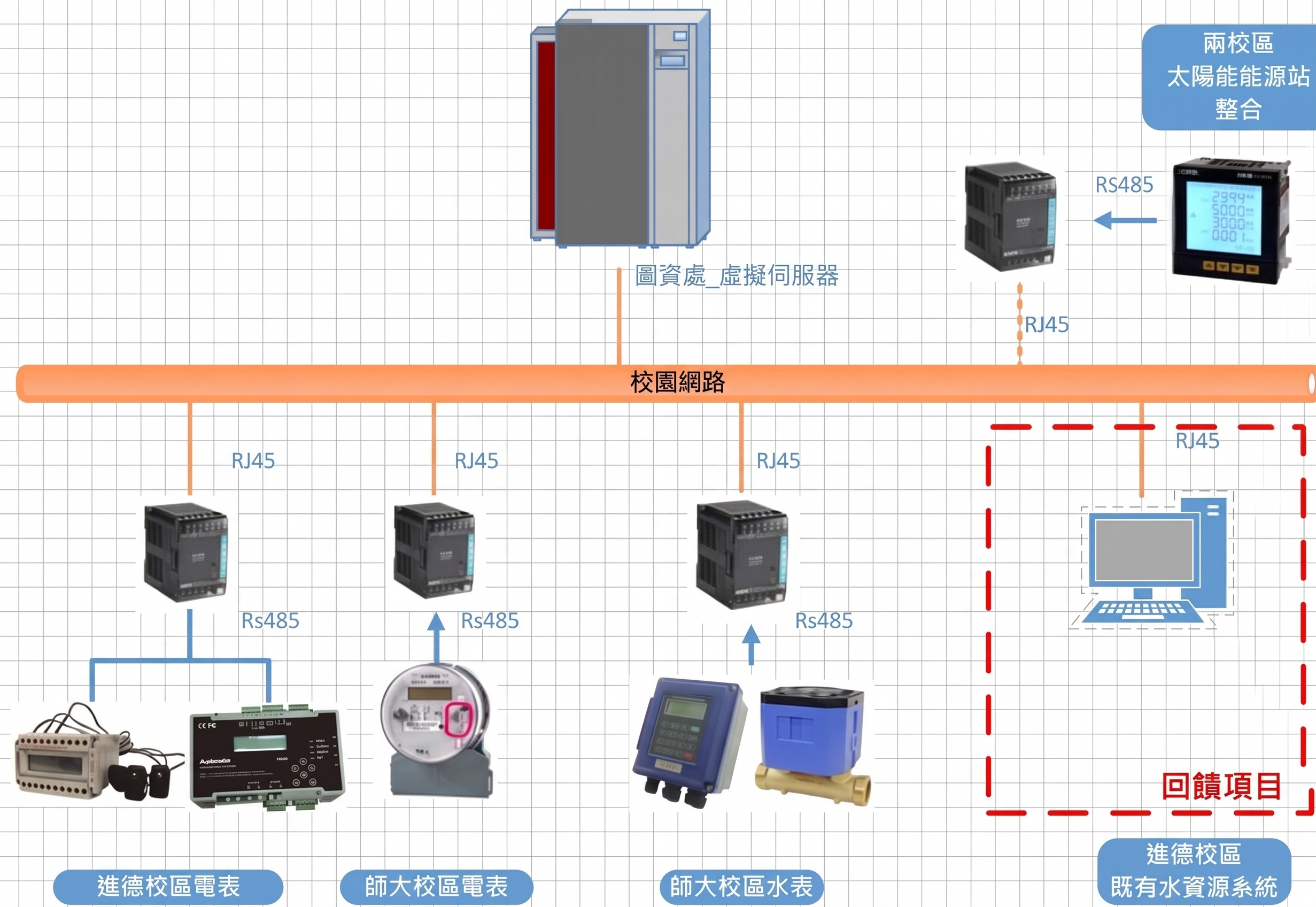
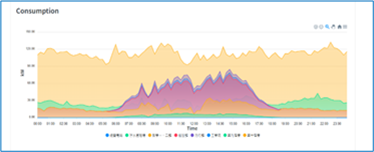
6. In 2025, NCUE completed the campus-wide installation of smart meters, ultrasonic water meters, and an integrated Energy Management System (EMS) (as shown in Figures 7-9), improving the efficiency of campus energy and water resource usage and implementing energy conservation and carbon reduction. This project covers 27 sites on the Jinde Campus and 10 sites on the Shida Campus, with a total of 812 smart meter circuits installed (596 circuits on Jinde Campus and 216 circuits on Shida Campus), along with 24 newly installed ultrasonic water meters (1 for groundwater discharge on Jinde Campus and 23 on Shida Campus), as well as 137 data collectors and 117 current transformers. The smart electricity and water meters collect data in real time every minute (or at intervals of less than 10 seconds), including current, voltage, active power, reactive power, apparent power, power factor, and cumulative electricity consumption, as well as instantaneous flow and cumulative water consumption.
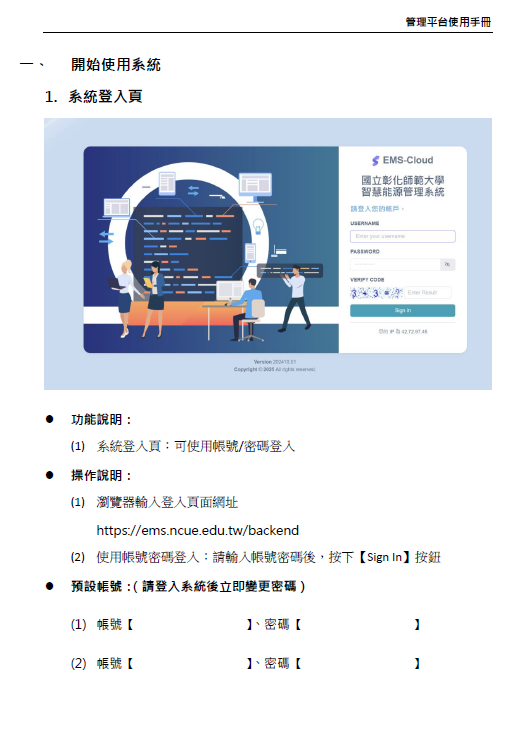
At the same time, this project has established a campus-wide smart Energy Management System (EMS), which features core functions including real-time overview of electricity and water usage, energy management reports, and intelligent alerts for over-contract usage and water leaks. The system architecture adopts a hierarchical design (comprising cloud, fog, and edge layers, with both on-site operation and maintenance and a cloud-based web interface), providing real-time power flow and water usage monitoring, downloadable daily/weekly/monthly/annual electricity and water usage reports (supporting JSON/Excel/PDF formats), a daily alert overview (covering meter disconnections, voltage anomalies, and water leakage alerts), and management of spaces and facility buildings. It also incorporates tiered permission management via single sign-on (SSO), system operation logs, and data collector malfunction alerts. In addition, the system supports the allocation and management of electricity circuits by building and floor, unit-based electricity usage statistics (automatically apportioning shared electricity costs among departments based on floor area and proportion), evaluation of Taipower's optimal electricity rate plans, and integration—via API—with the existing 17 solar power generation sites and energy storage equipment across both campuses, enabling analysis of the benefits of renewable energy adoption and carbon reduction.
Through the installation of smart meters and the Energy Management System (EMS), NCUE expects to improve energy usage efficiency by more than 10%, thereby implementing energy conservation and carbon reduction. Figures 10-11 show the interface of NCUE’s campus-wide Energy Management System (EMS). Website: https://ems.ncue.edu.tw/backend[cite: 62, 95]