SDG 3.3.6
SDG 3.3.6 Smoke-free policy
To protect the health of all faculty, staff, and students from the harmful effects of tobacco, including second-hand and third-hand smoke, NCUE follows the Health Promoting University model and has built a tobacco control structure with a primary prevention framework.
1. Cross-departmental smoke-free working group and its seven areas of responsibility
On 12 May 2023, the School Health Committee approved the establishment of a cross-departmental smoke-free working group, convened by the Dean of Student Affairs and drawing on administrative and academic units. The group covers seven areas:
- (1) Environment (Office of General Affairs, Health Center, and student canteens): improving smoke-free signage at main campus entrances and in public areas.
- (2) Campus patrols (Student Service Section, campus security guards, Military Training Office): daily patrols of tobacco hotspots by designated staff or by the smoke-free awareness vehicle.
- (3) Health education (Health Center): distributing information on tobacco and new tobacco products through multiple channels and media.
- (4) Reporting point (Office of Student Affairs): an accessible reporting point for violations and for illegal sale of e-cigarettes.
- (5) Smoking cessation education and support (Health Center): cessation techniques, carbon monoxide (CO) testing and clinical follow-up for staff and students who smoke.
- (6) Sanctions (Student Service Section, Personnel Office): disciplinary procedures and follow-up support for students and staff who breach the rules.
- (7) Teaching (Center for General Education): embedding tobacco control and preventive medicine in formal courses such as Health Education and Introduction to Social Work.
2. Smoke-free and e-cigarette regulations
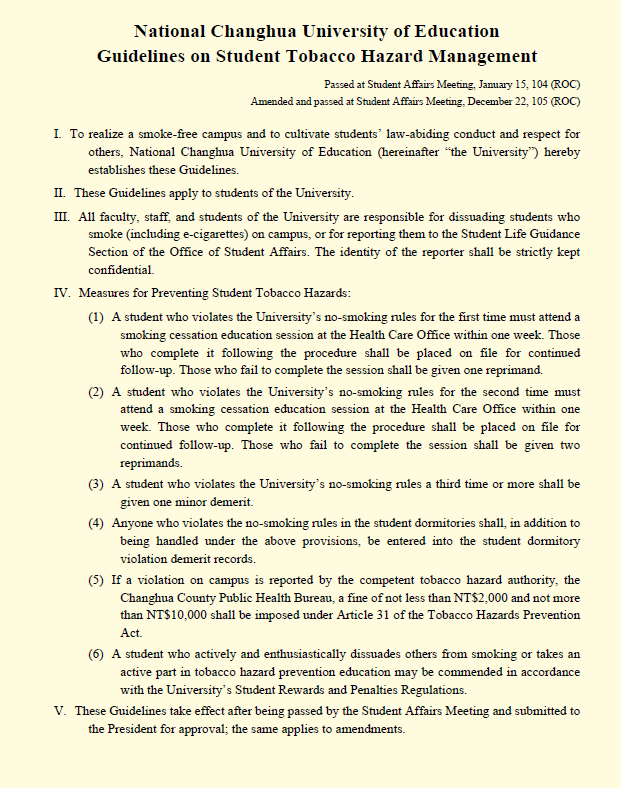
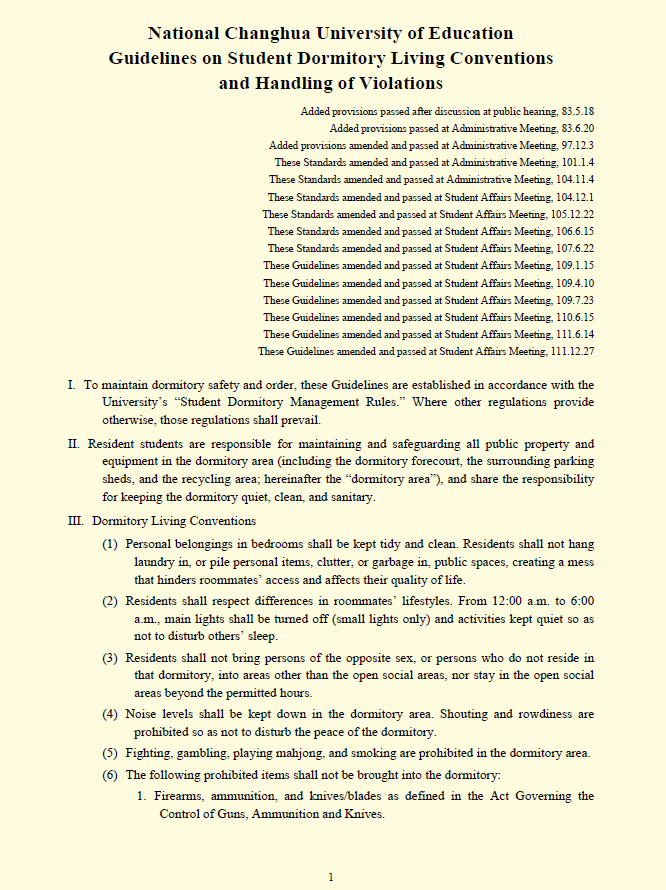
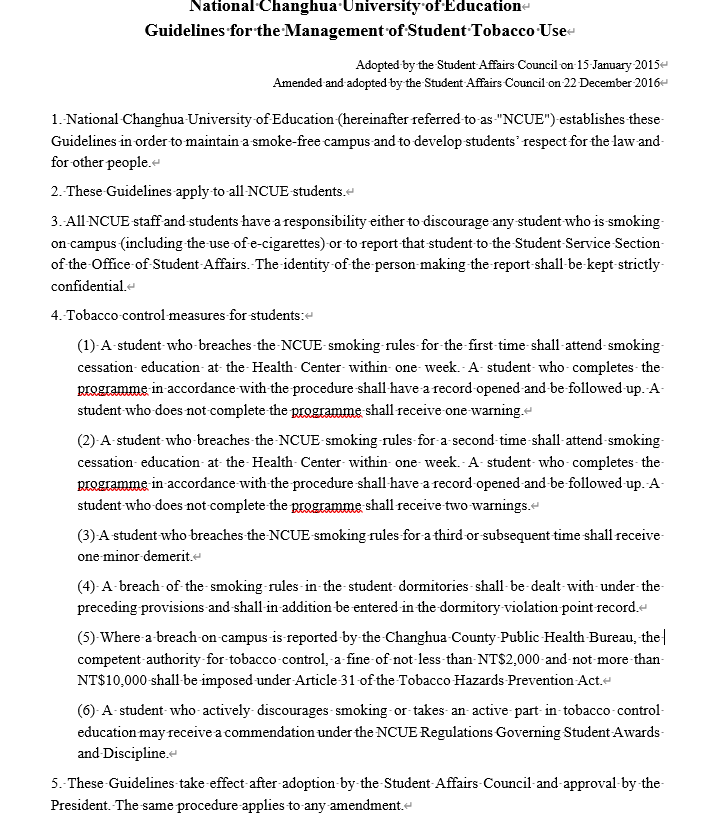
NCUE has adopted the Guidelines for the Management of Student Tobacco Use (Figure 1), which establish the tobacco control structure and provide confidential, non-judgmental smoking cessation education. To address e-cigarettes and heated tobacco products, the university has included e-cigarette provisions in the Student Dormitory Code of Conduct and Guidelines for Handling Violations, prohibiting the use, possession and sale of these products on campus and in the dormitories.
3. Tobacco control results under the 2025–2026 Health Promoting School program
The program's work on new tobacco products and a smoke-free campus combines health education, environmental measures, hotspot surveys and cessation support. Results are set out below.
(1) “Know on Arrival: NCUE Smoke-Free” signage and online awareness
Between 1 September and 30 December 2025, the Health Center of the Office of Student Affairs coordinated an inspection of campus no-smoking signage and improvements to the smoke-free environment. Smoke-free campus and no-smoking signs were posted at the main gates and west side gates of the Jinde and Shida campuses and on other main routes. Information on the harms of e-cigarettes and on the smoking ban was published regularly on the Health Center website, the university Facebook page and campus digital signage, so that staff, students, visitors and local residents are informed on arrival. (Figures 2–3)
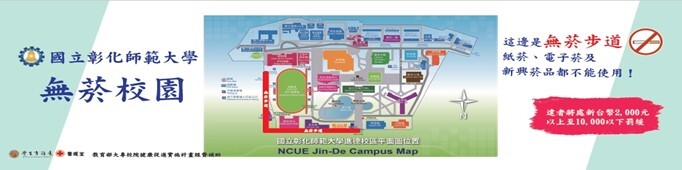
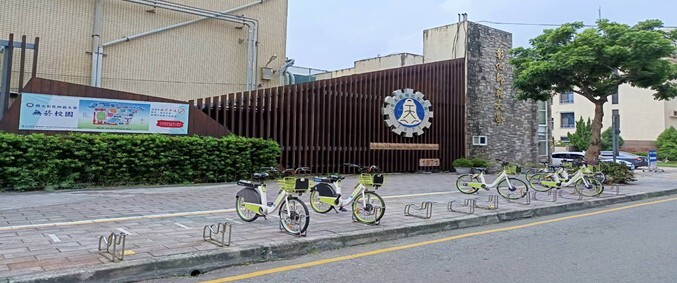
Figure 2. Jinde Campus: “Know on Arrival: NCUE Smoke-Free” signage


Figure 3. Shida Campus: “Know on Arrival: NCUE Smoke-Free” signage
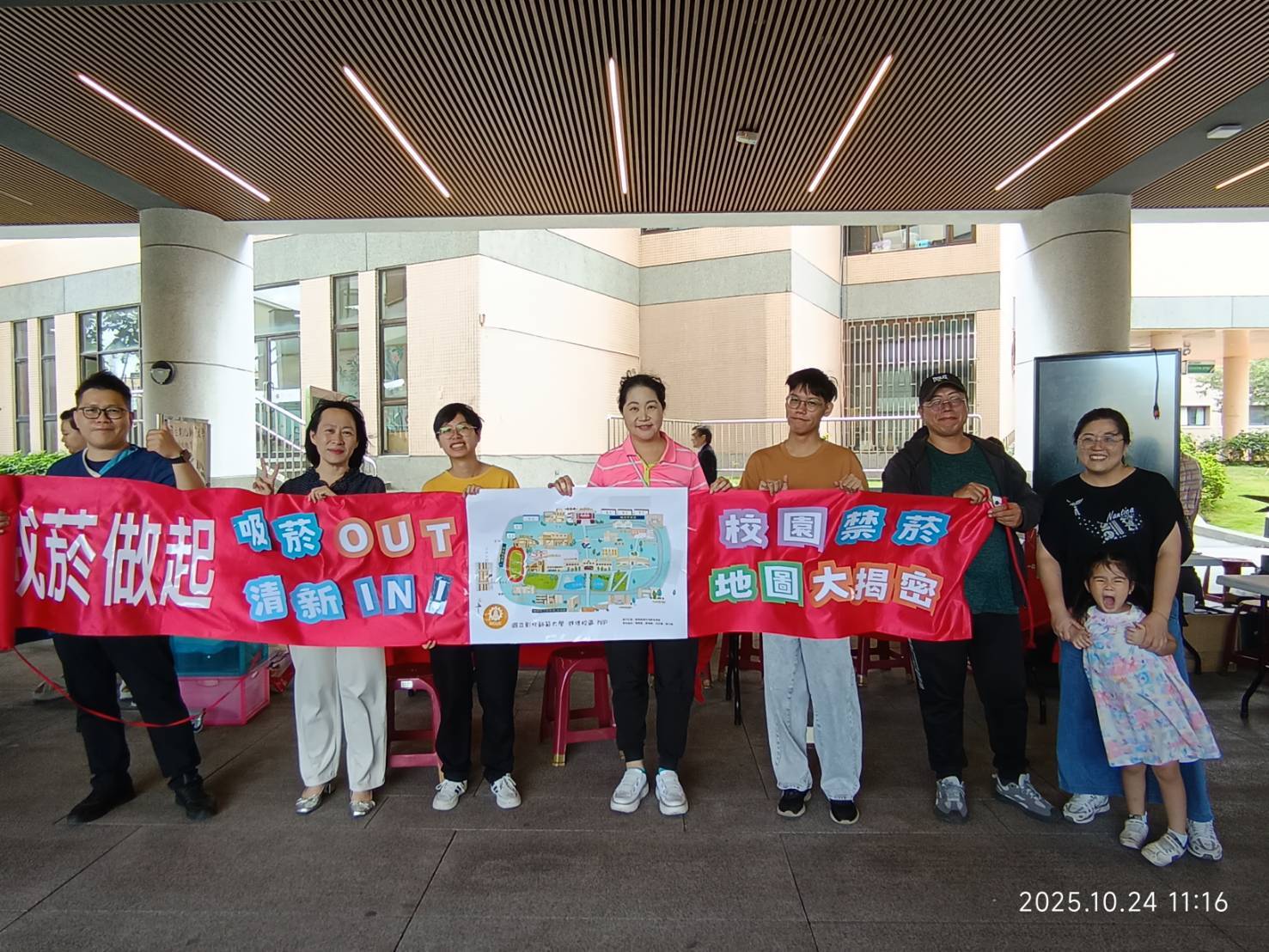
(2) “Smoking OUT, Fresh Air IN! The Campus Smoke-Free Map” anniversary campaign (Figure 4)
During the anniversary fair on 24 October 2025, NCUE set up a tobacco control stand in the ground-floor plaza of the Wang Jin-Ping Activity Center. The stand used a campus smoke-free map exploration activity, a map matching game, interactive challenges on smoking and e-cigarettes, and one-to-one consultations with a nurse to explain current tobacco control law to staff, students and local residents. 80 people took part (33 men, 47 women), two additional no-smoking signs were installed at the main gate, and participants answered 95% of the quiz questions correctly.
(3) “Smoke-Free Campus Watch” online hotspot survey (Figure 5)
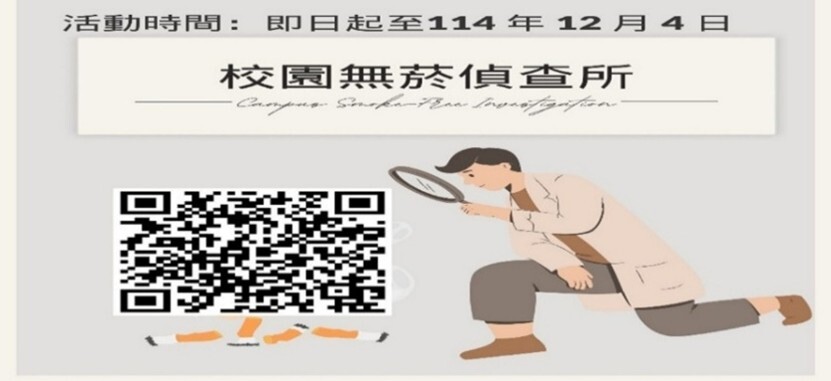
To plan smoke-free improvements and patrol routes more precisely, NCUE ran an anonymous online survey of students, “Smoke-Free Campus Watch”, from 24 November to 4 December 2025. 74 students responded (16 men, 58 women). Their responses identified areas around the dormitories, club activity spaces and campus boundaries where cigarette ends collect or smoking is likely. The Health Center passed the findings to the units responsible, including the Student Service Section and campus security, which increased patrols, inspections and informal advice in those areas.
(4) Smoking cessation education: clinical support and one-to-one CO testing (Figures 6–7)
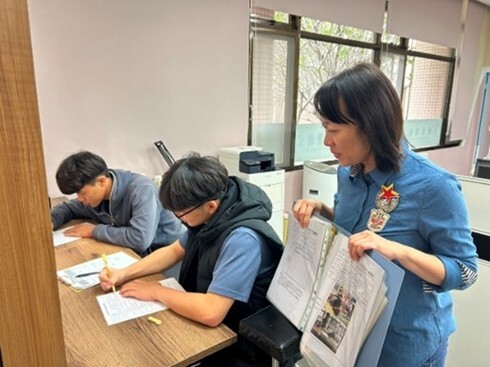
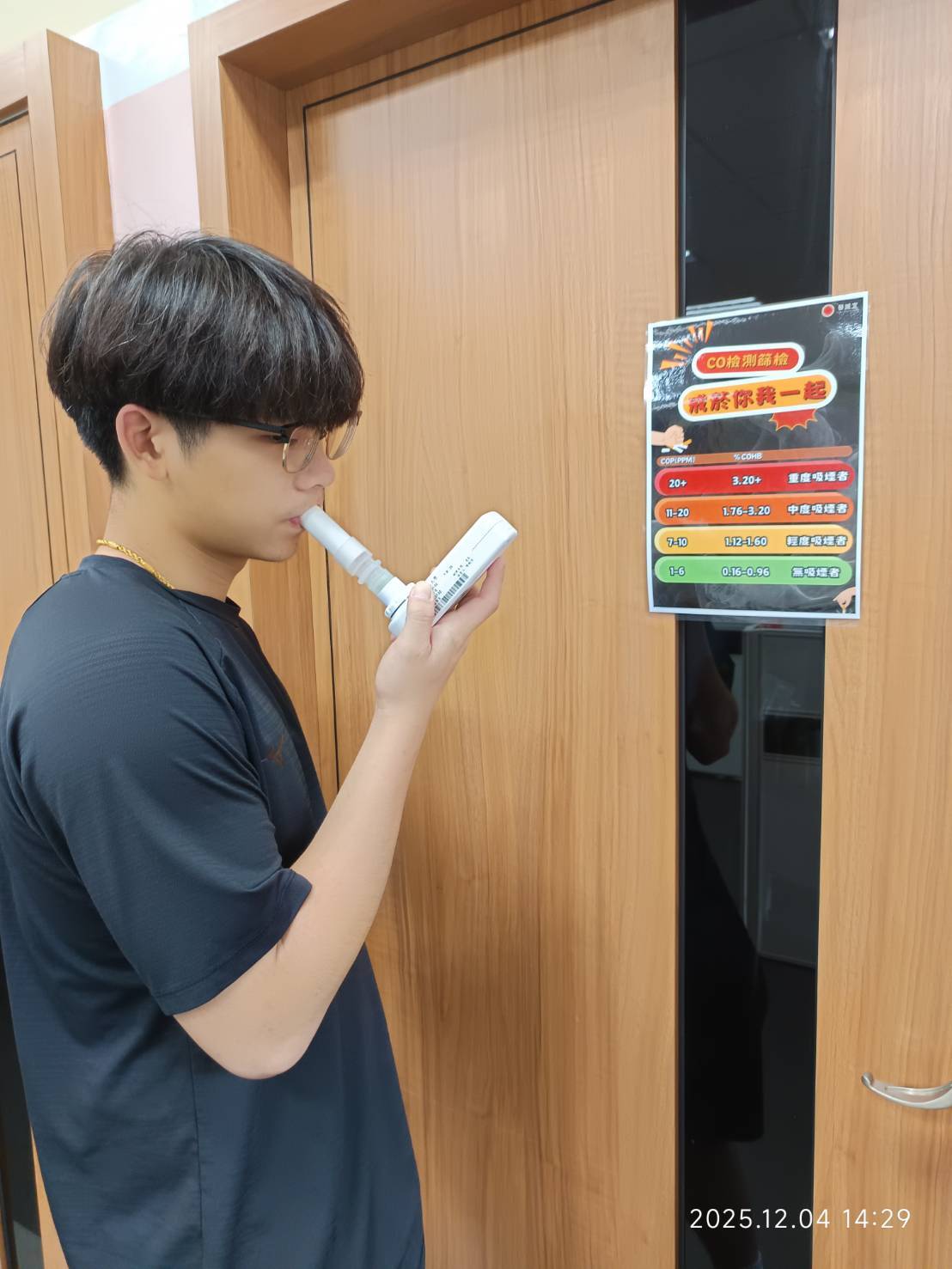
Under the Tobacco Hazards Prevention Act and school health policy, NCUE introduced a confidential clinical smoking cessation service in the 2025–26 academic year. The first assessment round was completed on 21 November 2025, and four cessation education sessions were held at the Health Center on 26 November and 3, 10 and 17 December. The sessions covered the legal framework, nicotine replacement therapy, and adjustments to daily routine, and provided one-to-one carbon monoxide (CO) breath testing so that students could monitor their exposure. Three students who had breached the smoking rules (3 men) attended all sessions, a 100% completion rate.
(5) Smoke-free signage upgrade (Figure 8)
Between February and June 2026 NCUE upgraded and extended its smoke-free signage. The project replaced two smoke-free campus signs at the main gates of the Jinde and Shida campuses and installed no-smoking and cessation signs at four further high-traffic public locations, including next to the FamilyMart store on the Shida Campus, the entrance to the university canteen, and the gymnasium and sports facilities. All main public entrances and major venues now carry signage.
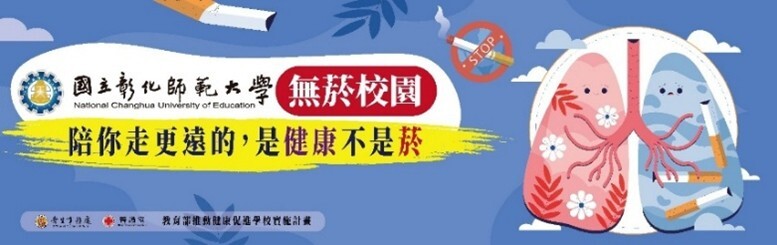
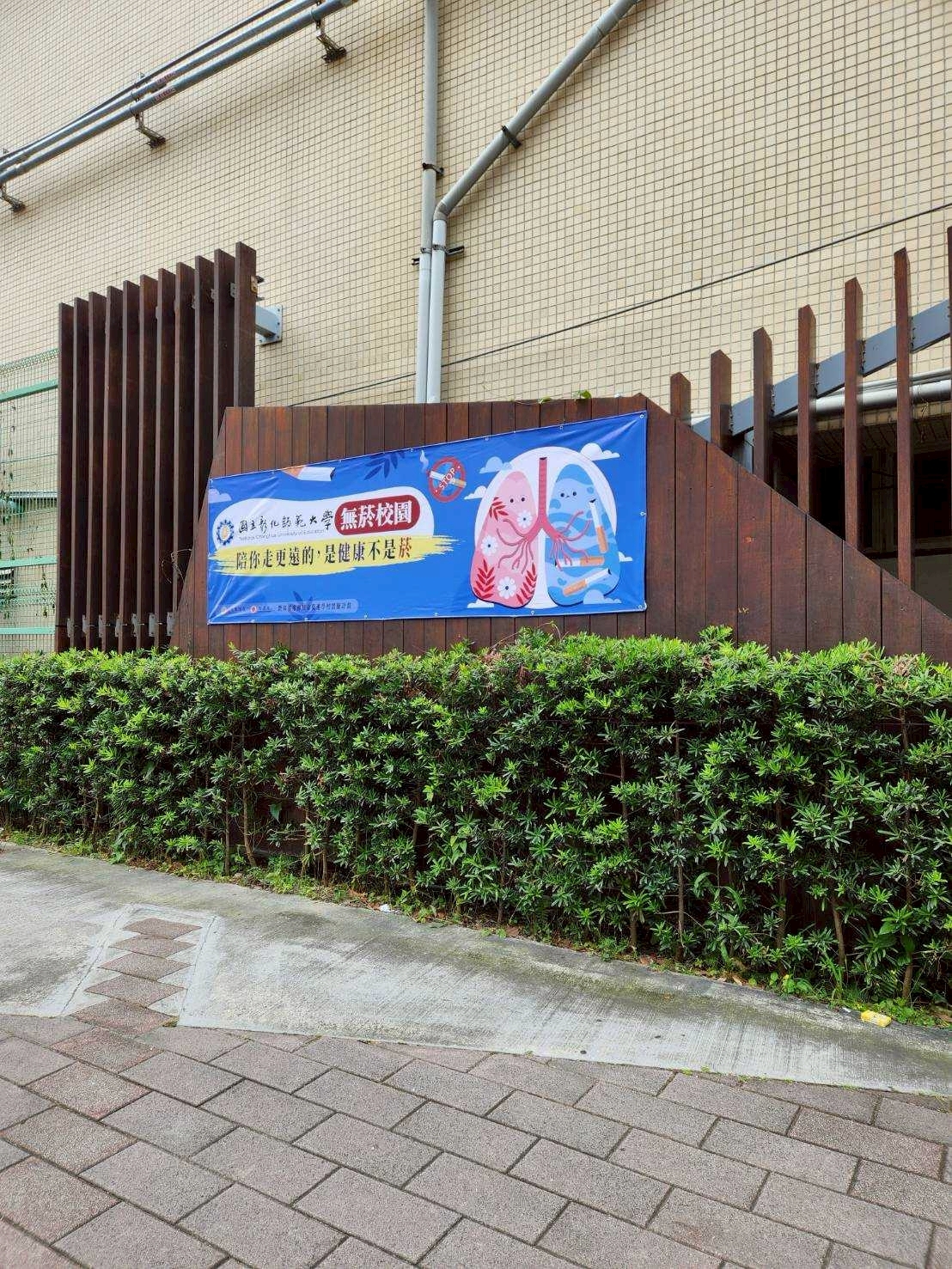
Figure 8. Jinde and Shida campuses: smoke-free campus signage upgrade
(6) Substance abuse prevention outreach to local schools (Figures 9–10)
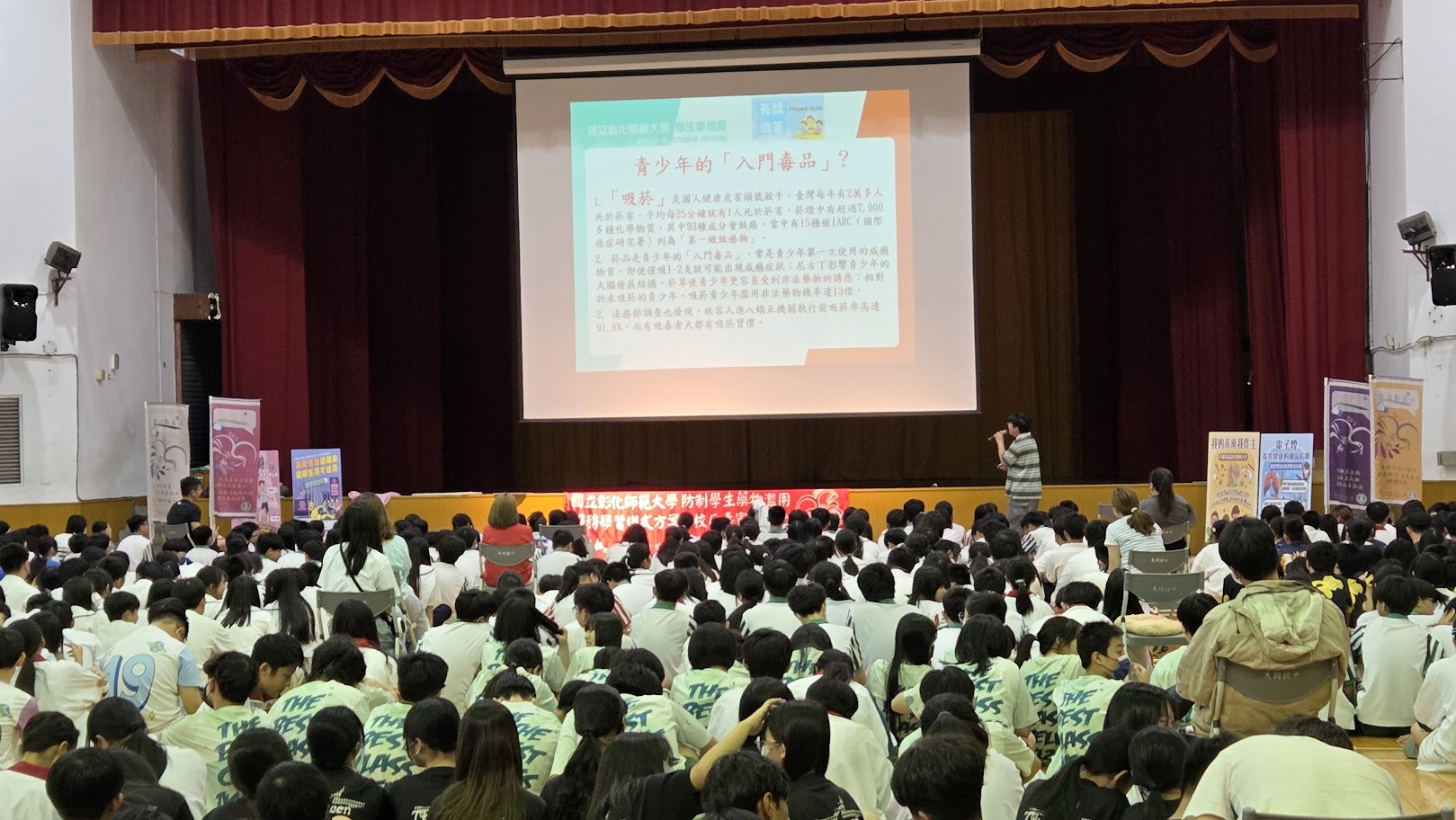
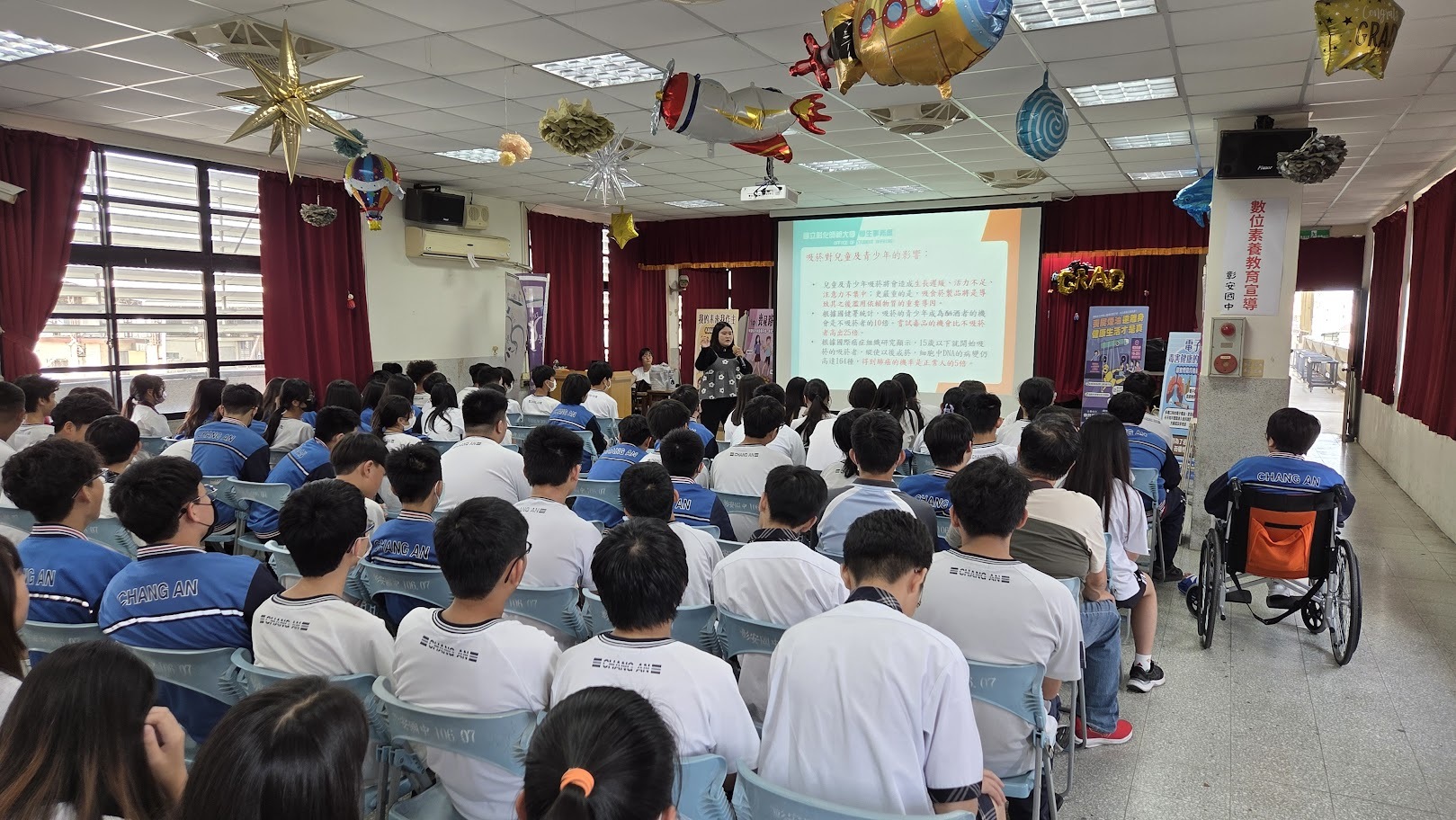
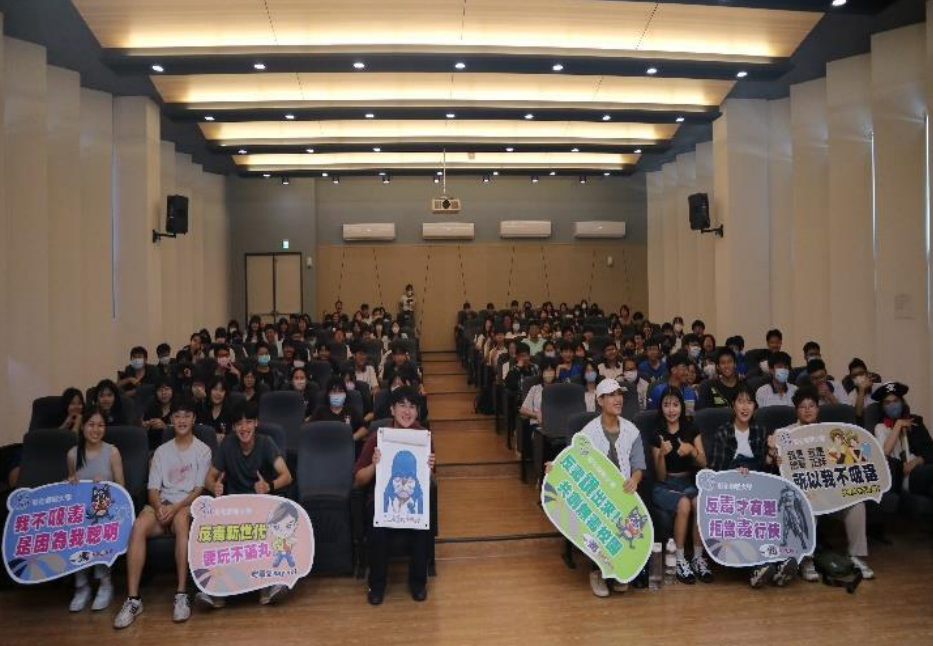
Working with the Ministry of Education and local government, an Office of Student Affairs team led student volunteers from the Department of English to Yuanlin Junior High School and Zhang'an Junior High School in Changhua County on 28 April 2026. Built around the four themes of observing, understanding, learning and acting, the sessions used presentations, short films and interactive teaching to explain how new psychoactive substances are disguised and how to refuse them, with specific coverage of the health risks and legal restrictions relating to etomidate vape cartridges, cigarettes and e-cigarettes. Two sessions were held and 1,078 junior high school students took part.
4. Outreach: smoke-free neighborhoods, smoke-free restaurants and rural health promotion
NCUE extends its smoke-free environment and healthy living work into the surrounding community, working with local government, local businesses and social welfare organizations.
(1) Smoke-free walkways around the campus and joint arrangements with the public health bureau
NCUE works with the Changhua County Public Health Bureau, the Changhua City Office and neighboring communities on joint tobacco control. No-smoking signs marking smoke-free walkways have been installed at the main campus entrances and on adjacent footpaths, making the boundary of the smoking ban clear to visitors and residents. NCUE tobacco control volunteers work with cleaning staff to clear cigarette ends and litter from public spaces around the campus, and campus security officers and the Changhua County Public Health Bureau carry out joint inspections and give informal advice at smoking hotspots outside the campus.
(2) Smoke-free restaurant certification for local businesses
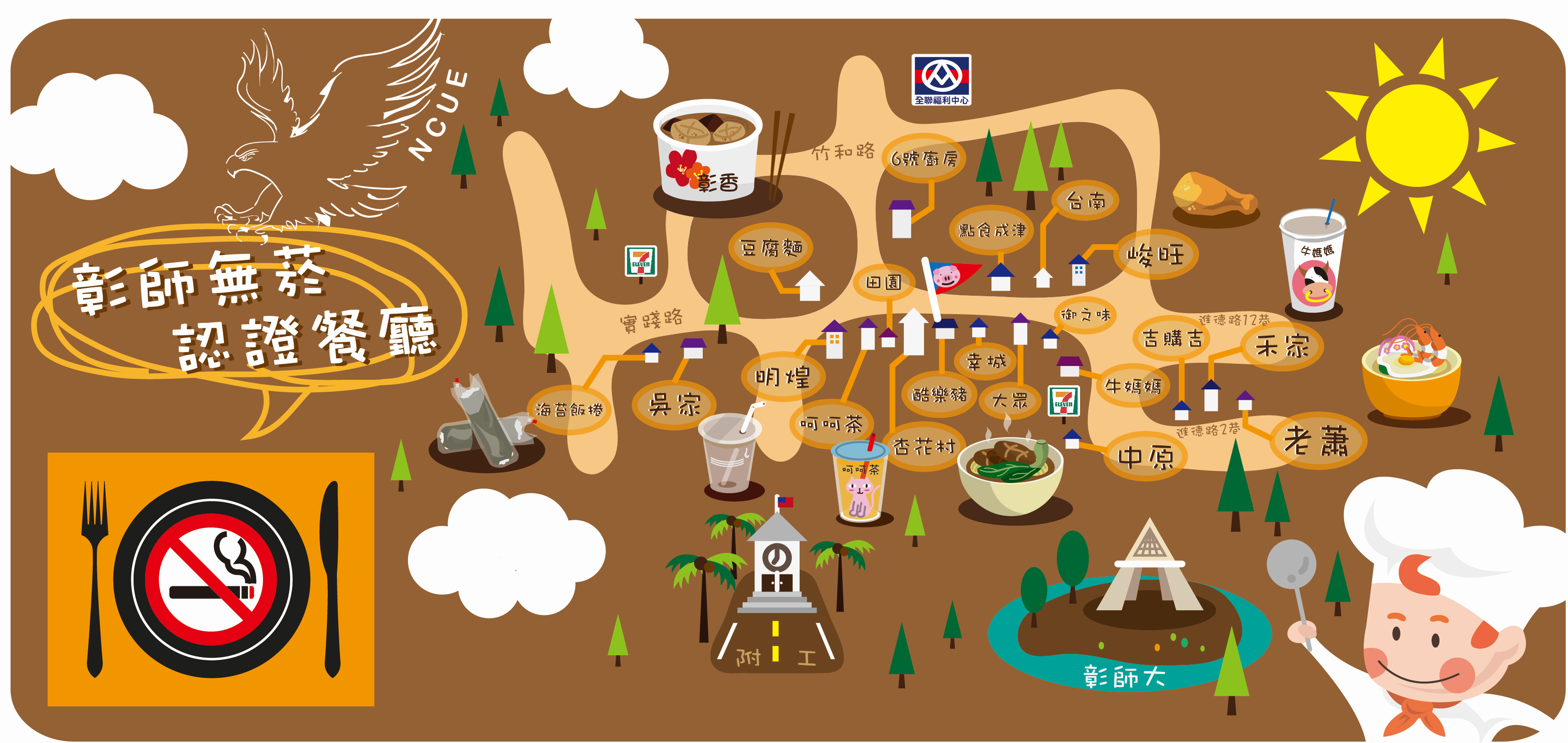
To extend smoke-free environments to places where staff and students eat, NCUE works with restaurants around the Jinde and Shida campuses. Following visits and guidance from the Health Center and food hygiene volunteers, 20 restaurants near the campuses signed a no-smoking undertaking and received NCUE smoke-free restaurant certification. (Figure 11)
(3) Ministry of Education substance abuse prevention program and drama tours in rural schools
Under the Ministry of Education's Service-Learning Program for Substance Abuse Prevention in Higher Education, NCUE supports 11 student clubs, including the Department of English Student Association, the Department of Guidance and Counseling Student Association and the Baisha Xinyan Sign Language Club, in taking tobacco control and drug prevention into rural schools:
(a) Smoke-free and drug prevention outreach. In the 2024–25 academic year NCUE volunteer teams visited Nanguo Elementary School and Yangming Junior High School in Changhua City; Renfeng Elementary School and Tianwei Elementary School in Tianwei Township and Daxing Elementary School in Fuxing Township, Changhua County; and Yingpan Elementary School and Zhangxing Elementary School in Nantou City. Using drug prevention plays written by the Department of English volunteers, teaching on eight ways to refuse drugs, quizzes, bilingual delivery, and visual demonstrations of how smoking affects appearance and ageing, the teams reached 550 pupils. (Figure 12)
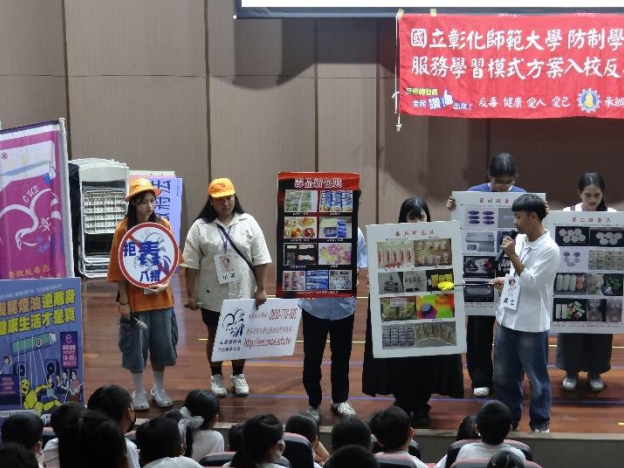
(b) Funding and continuity of outreach. For 2025–2026 the Ministry of Education approved funding of NT$346,740. In 2025, 99 student volunteers delivered bilingual drug prevention sessions at two junior high schools and drama-based sessions at six primary schools, reaching 1,058 students and teachers. Activities planned for 2026 cover three junior high schools using bilingual delivery and six primary schools using drama, with an estimated reach of 2,659 pupils. (Figure 13)
5. Policy documents
-
(1) NCUE Guidelines for the Management of Student Tobacco Use, which set out the rules for students on tobacco products (Figure 14):
https://stuaffweb.ncue.edu.tw/var/file/39/1039/img/592/624507397.pdf -
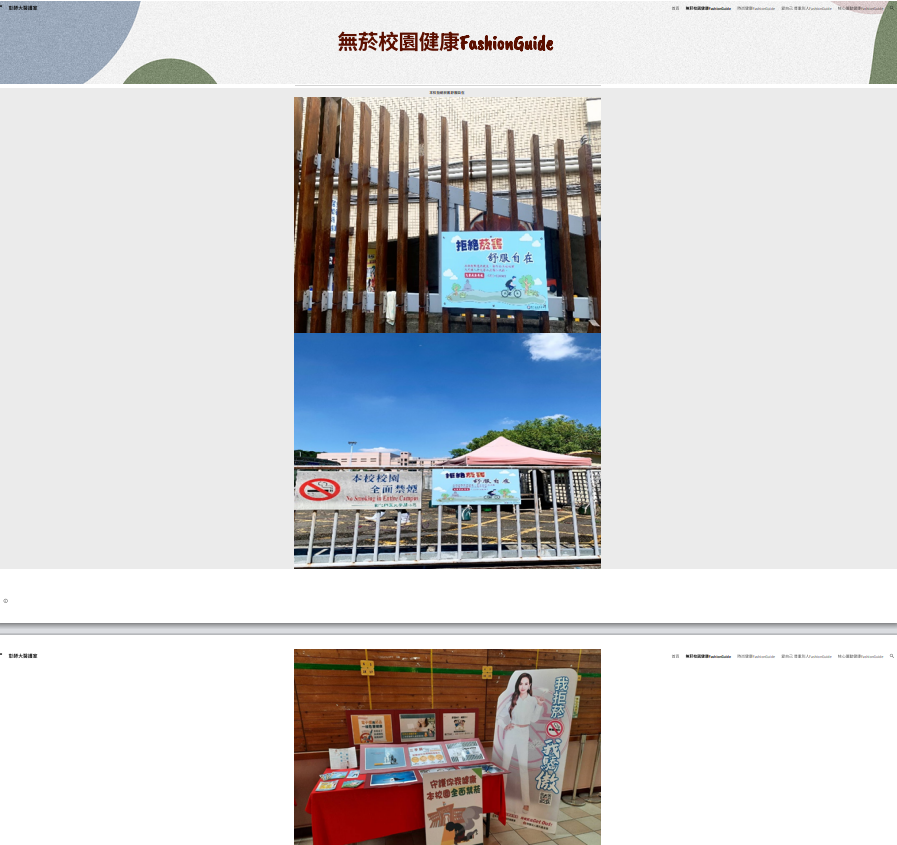
(2) Application to the Ministry of Education for 2022–2023 funding under the Health Promoting School Program for Higher Education — the “Fashion Health Fashion Guide” smoke-free campus project (Figure 15):
https://sites.google.com/gm.ncue.edu.tw/111health/無菸校園健康fashionguide -
(3) NCUE Student Dormitory Code of Conduct and Guidelines for Handling Violations, including the e-cigarette provisions (Figure 16):
https://studentweb.ncue.edu.tw/var/file/3/1003/img/517/356514929.pdf