SDG 4.3.3
SDG 4.3.3 Vocational training events (lifelong learning)
NCUE is one of Taiwan's three normal universities and an important institution for the continuing professional development of secondary school teachers in central Taiwan. Every year it offers training courses for in-service elementary and secondary teachers to help them strengthen their professional knowledge and skills. In addition, to fulfil the university social responsibility and help Changhua County develop high-quality talent, NCUE offers many extension education courses related to vocational training. NCUE also works with local government and business organizations to deliver in-service training for company employees. Details are provided below, together with relevant links, photographs and participant numbers as supporting evidence.
1. Regular vocational training courses
Each year NCUE holds second-specialization professional courses for elementary and secondary school teachers, professional training in science education, and senior leadership training for principals and directors, strengthening the elementary and secondary school teachers’ teaching skills, as well as the professional abilities of school leaders. NCUE was also the first university in Taiwan to establish a Community Counseling and Human Development Service Center serving the local residents, and it holds professional training for counselling personnel each year. Regarding development of business and industrial talent, NCUE has worked with local government and business organizations over many years to deliver training for second-generation business owners and elite women leaders in business.
(1) Professional growth for secondary school teachers:
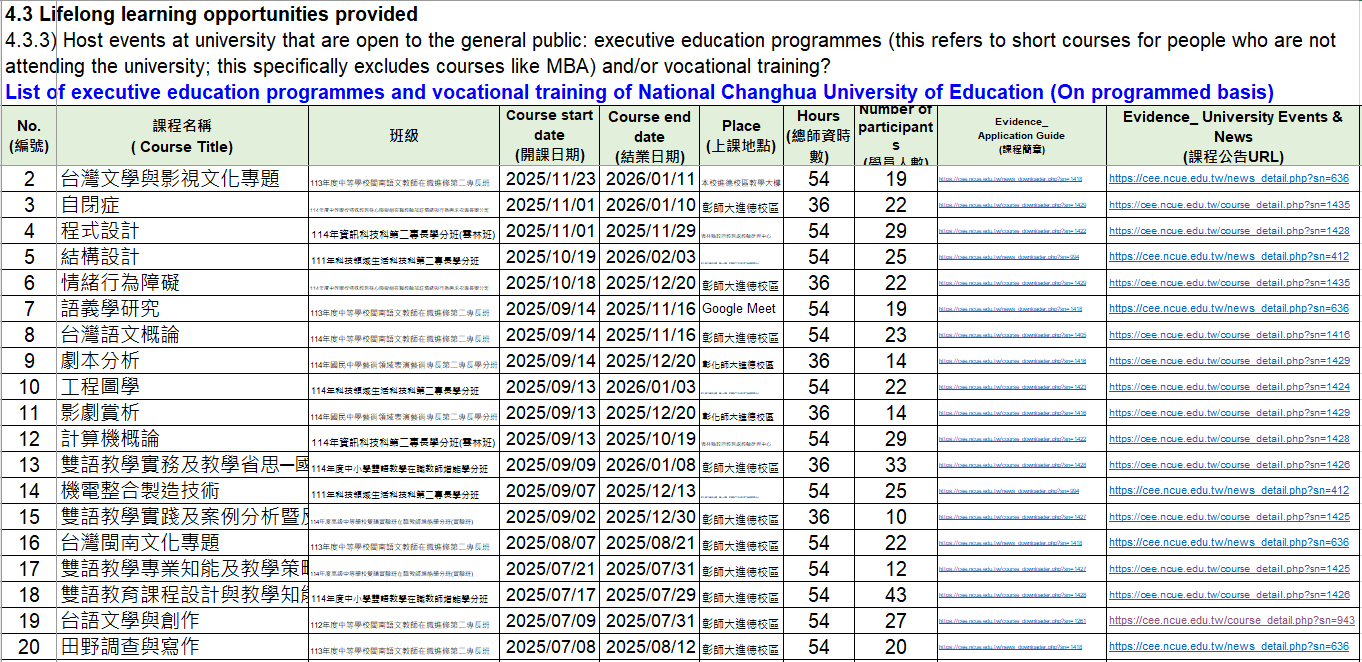
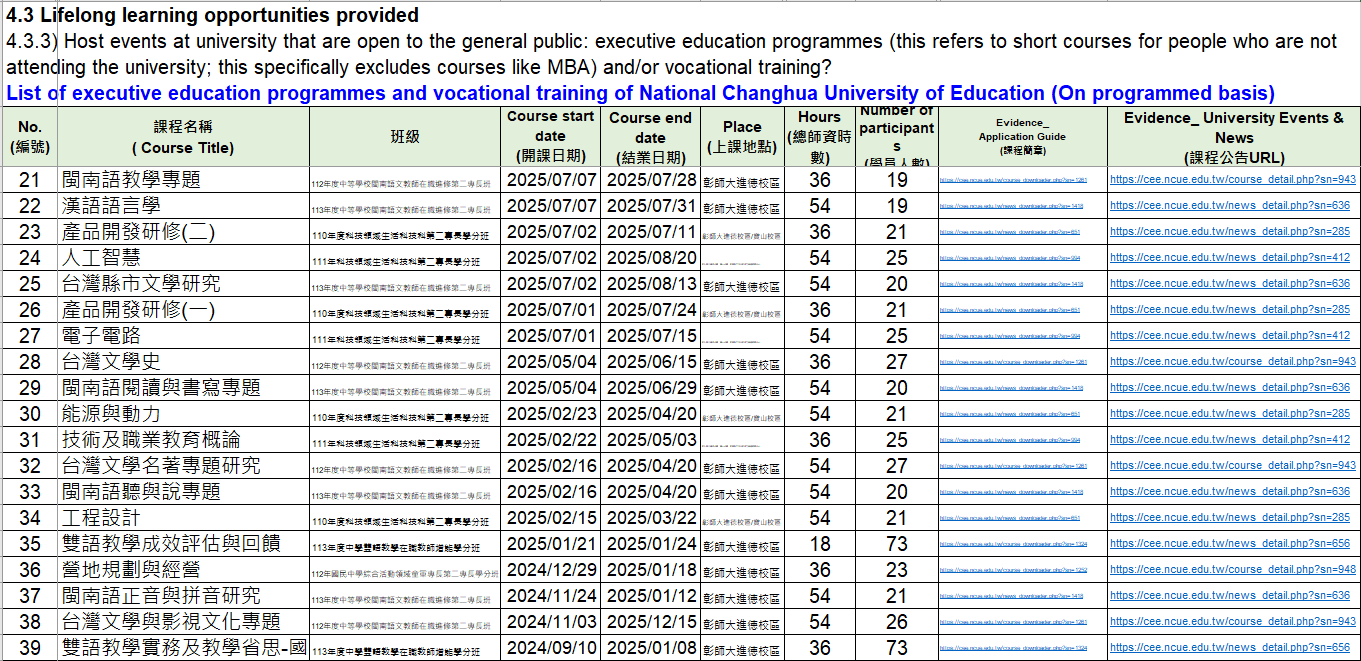
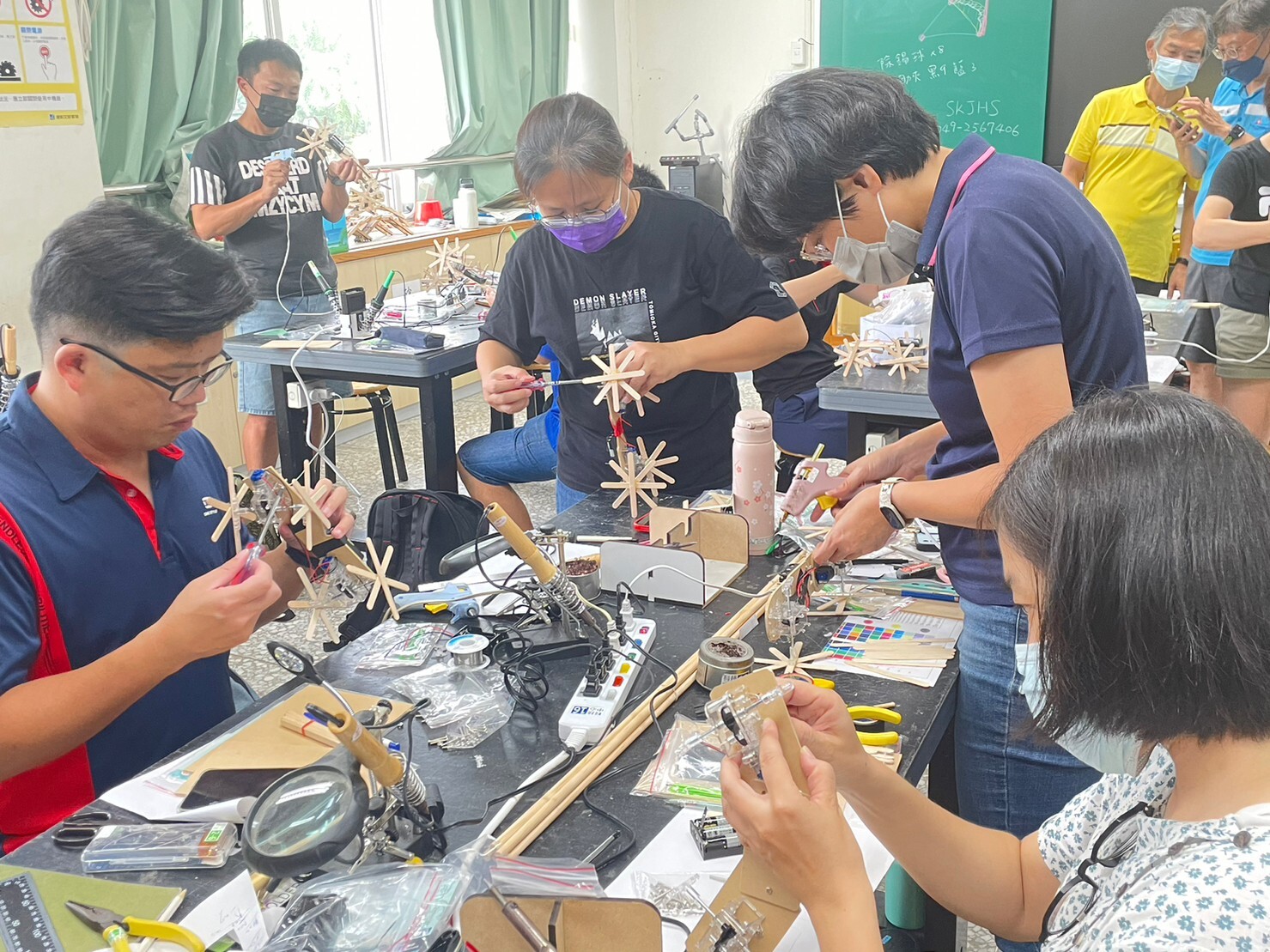
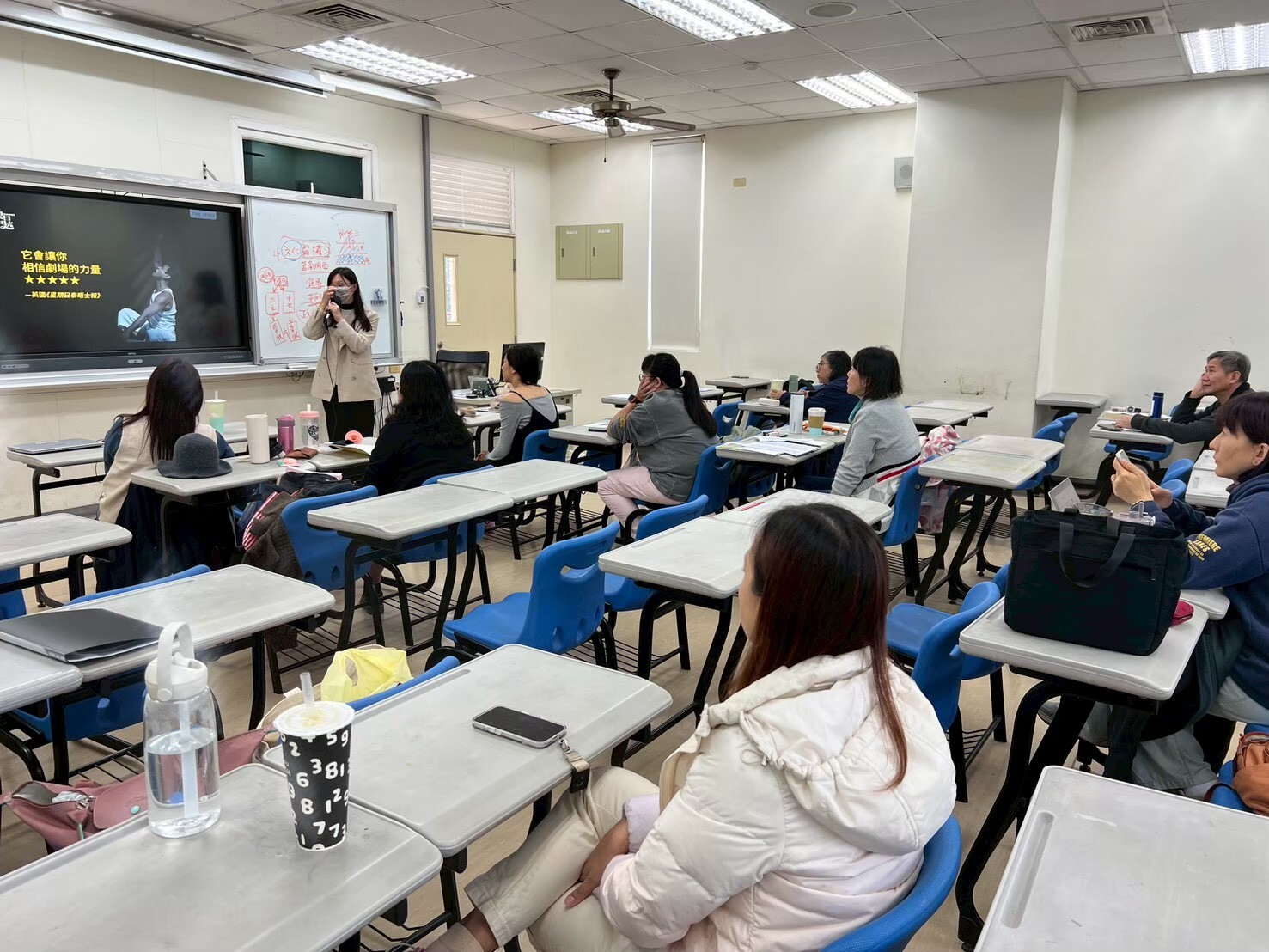
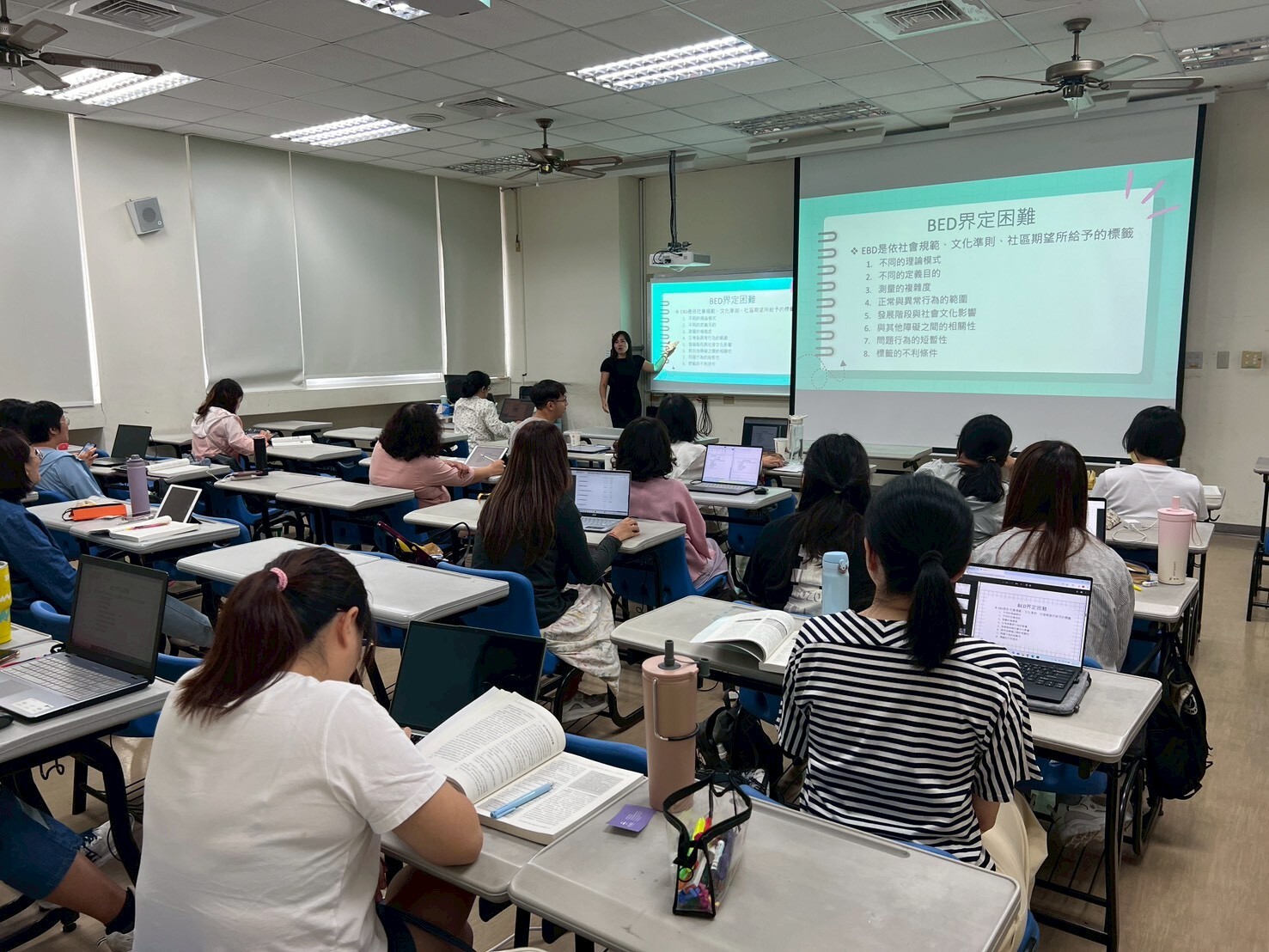
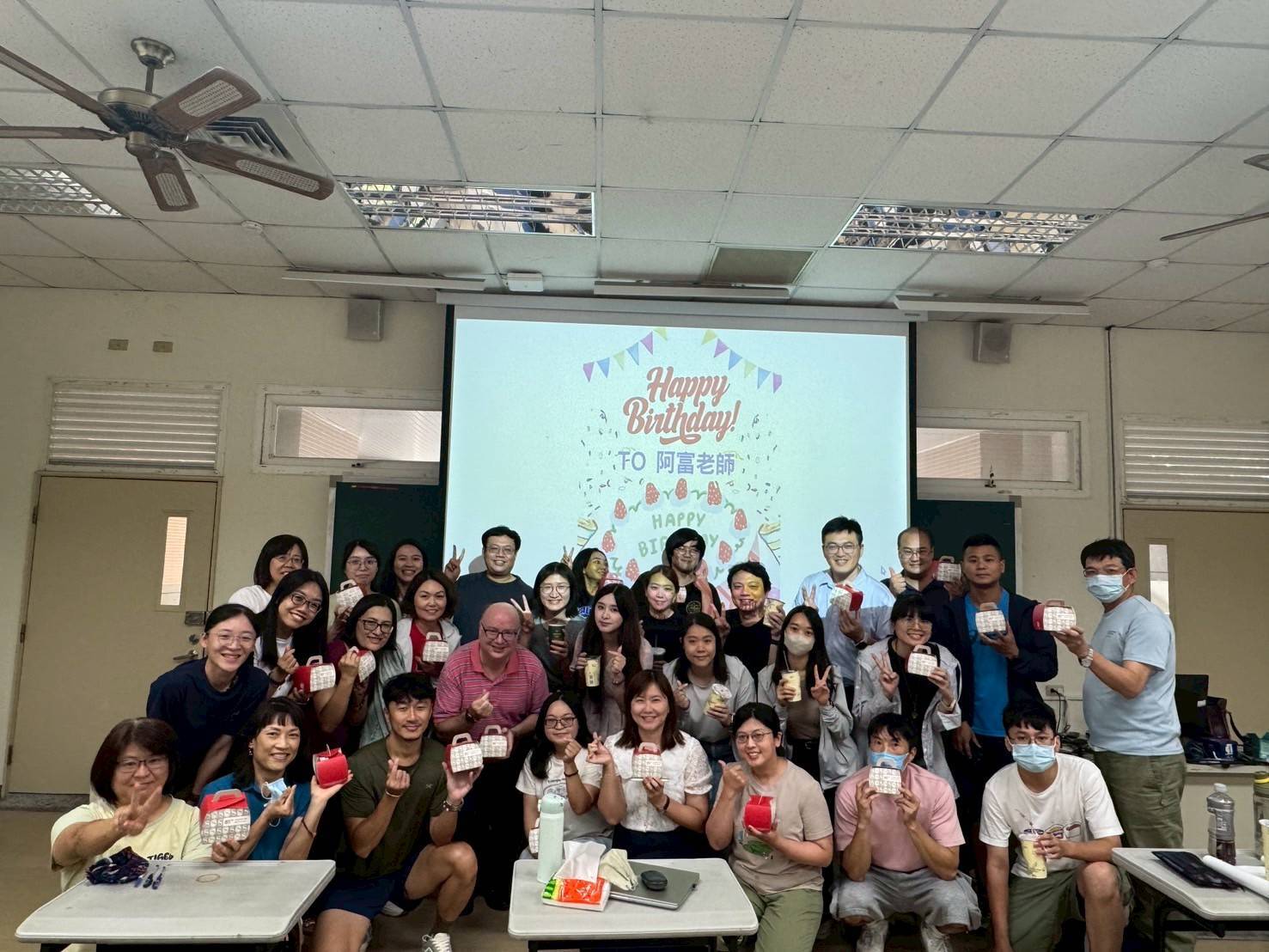
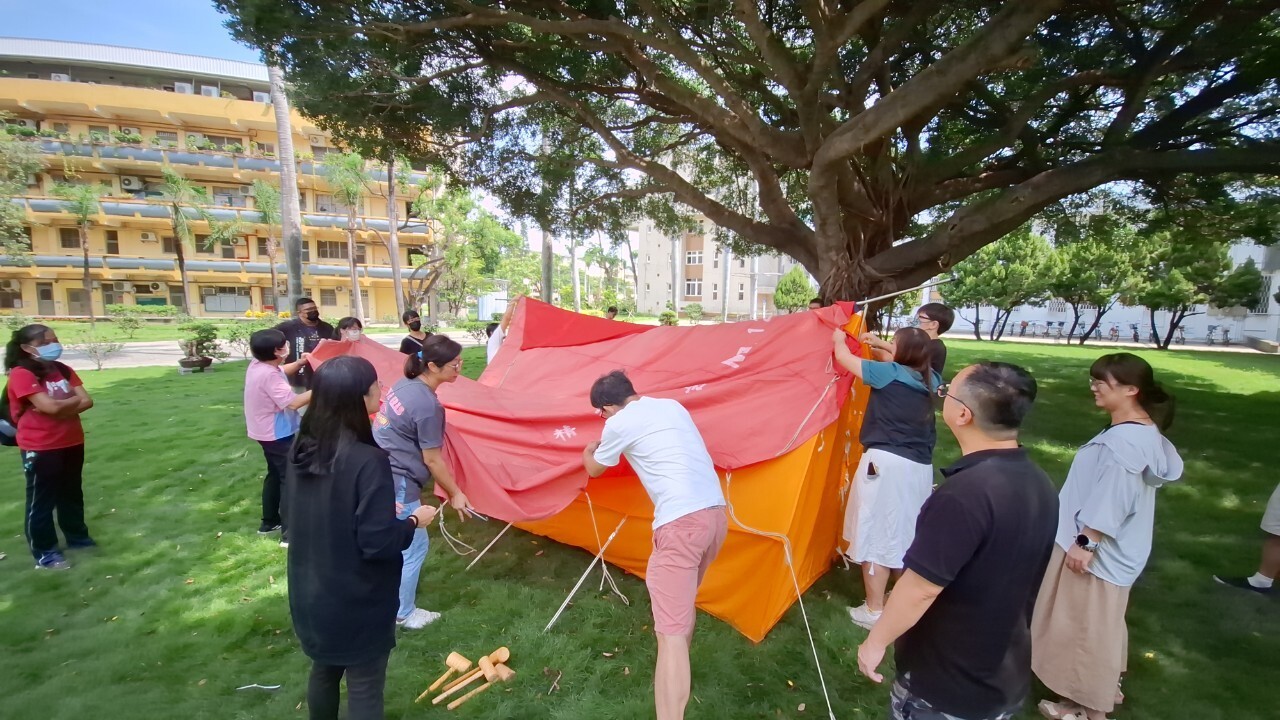
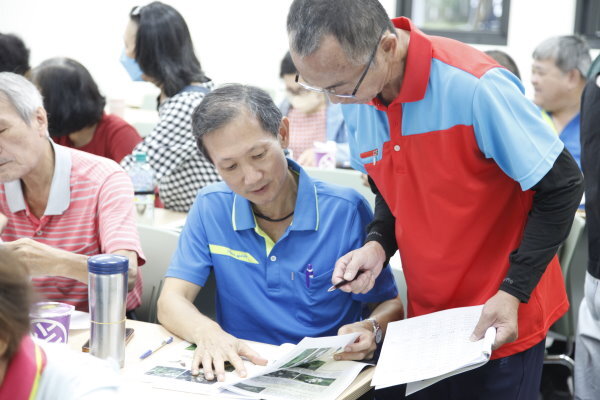
In line with Ministry of Education policy and the further-study needs of secondary school teachers, NCUE offers second-specialization programmes and professional enhancement programs for in-service teachers in a range of fields each year, helping in-service teachers develop proficiency, acquire new pedagogical knowledge, and strengthen their teaching competence. In 2025, a total of 39 courses were offered across fields. These include Taiwanese language, information technology, living technology, bilingual instruction, performing arts, scouting education, and special education, amounting to 1,836 training hours with 981 attendances in total. Figures 1 and 2 show the list of all 39 courses with their open enrolment websites and prospectus. Figures 3 to 8 show photographs from the courses.
(2) Training Program for Principals and Directors of Elementary and Junior High Schools on School Management Competencies:
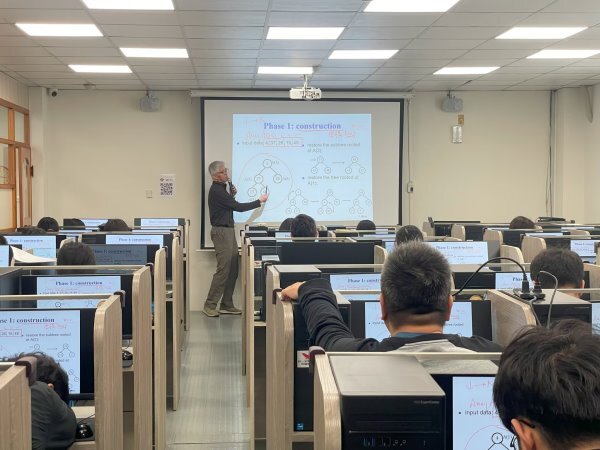
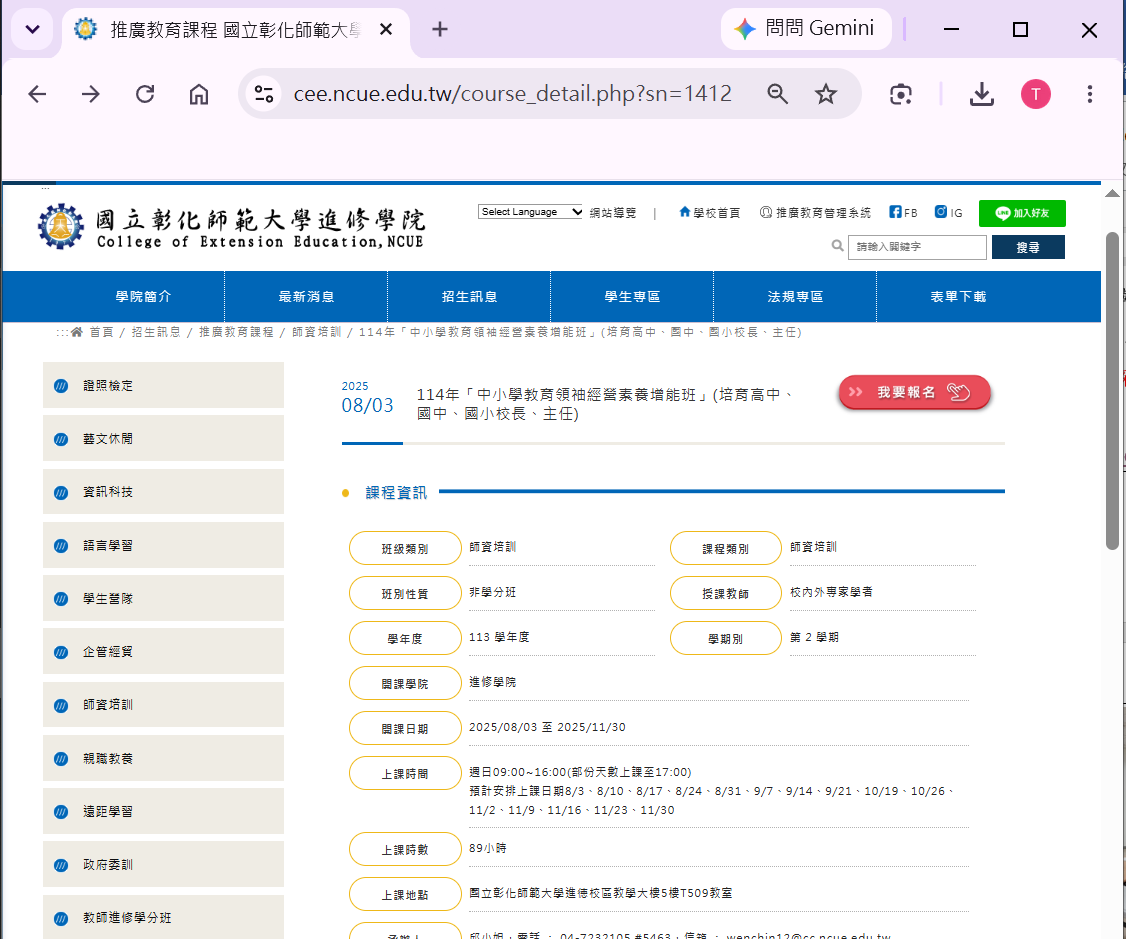
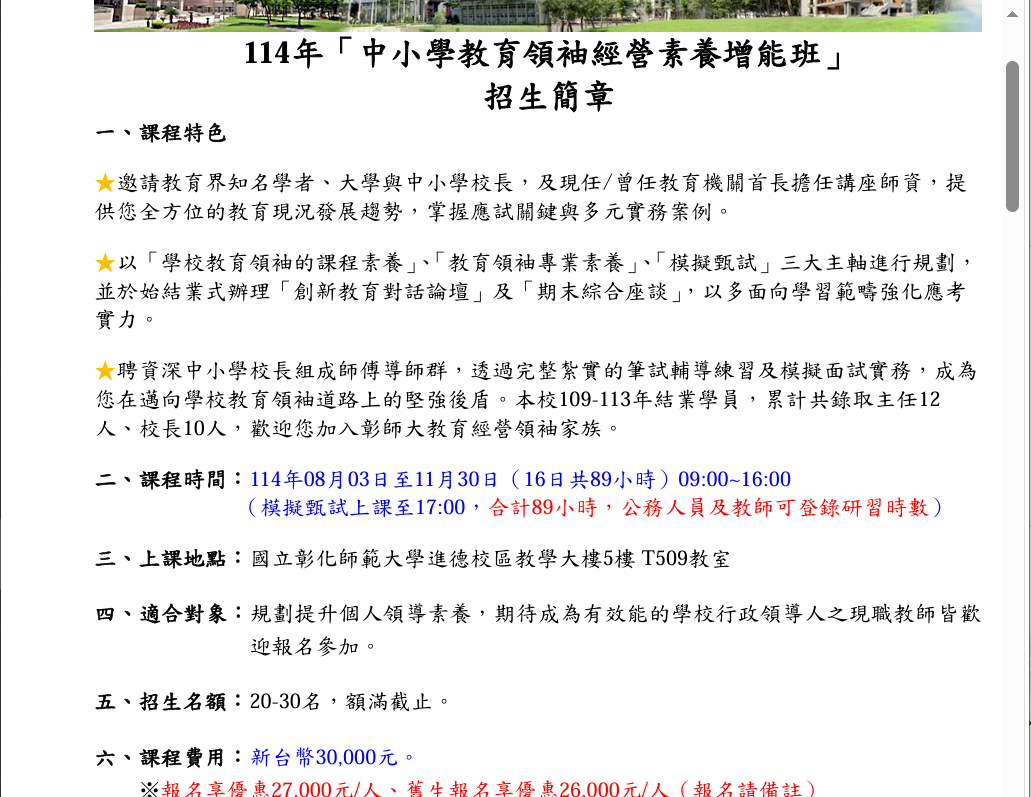
As the only normal university for secondary education in central Taiwan, NCUE actively fulfils its university social responsibility. Since 2020, each year the university holds one cohort of the Training Program for Principals and Directors of Elementary and Junior High Schools on School Management Competencies, with each course lasting for four months. The program invites well-known scholars in Taiwanese education, university and school principals, and heads of educational institutions to be speakers, providing educational administrators at elementary and secondary schools with a platform to gain comprehensive insight into current educational trends and exchange ideas with one another. The program has trained 98 senior administrative leaders of elementary and secondary schools to date, deepening NCUE's concrete contribution to raising the quality of basic education in the region. Figures 9 and 10 show the 2025 open enrolment website and prospectus, the year 114 shown in the figures is the Republic of China calendar year, equivalent to 2025, and Figures 11 and 12 show photographs from the course.
2025 Course Brochure: https://cee.ncue.edu.tw/course_downloader.php?sn=1492
(3) Professional training in science education for elementary and secondary school teachers:
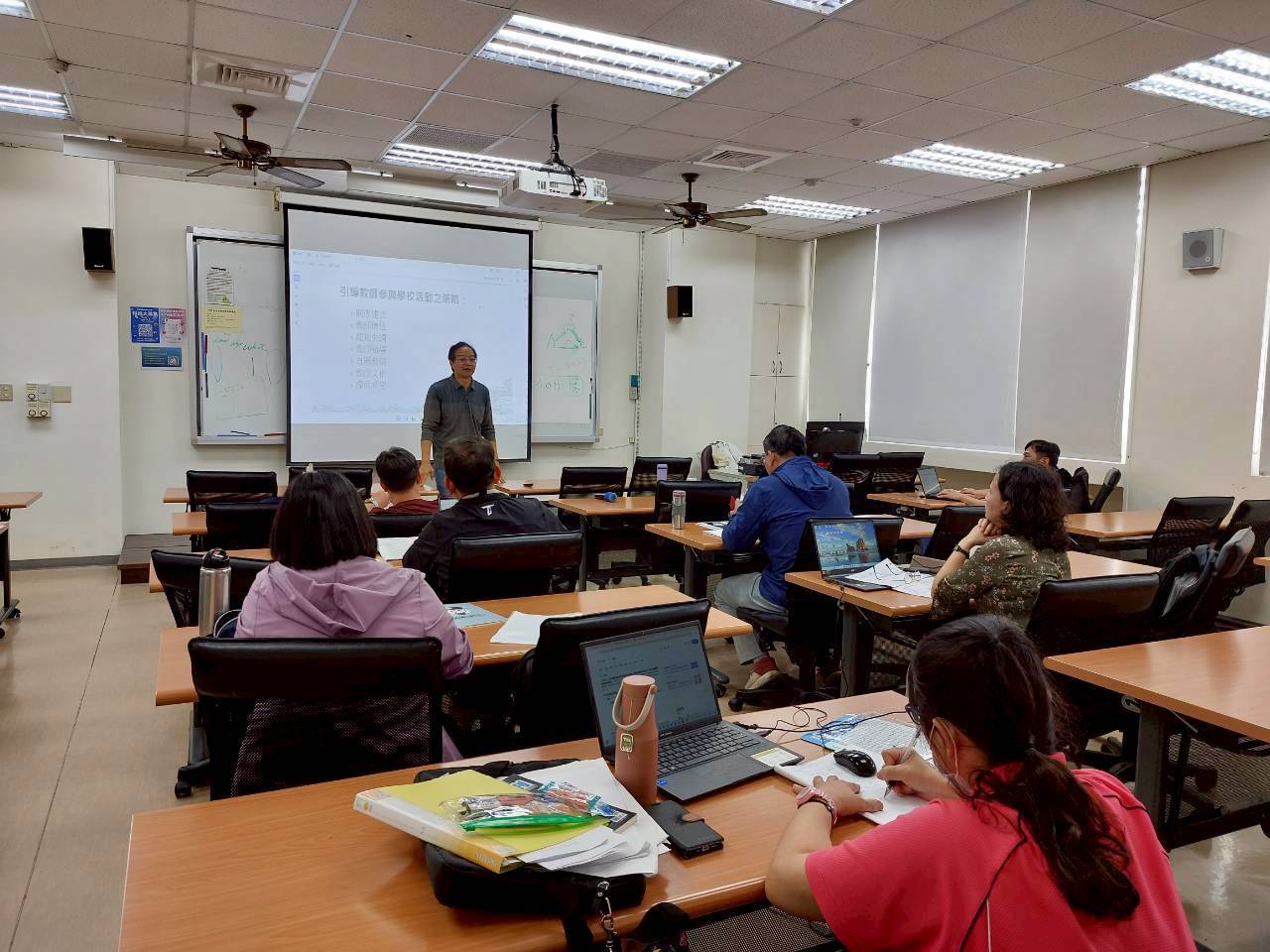
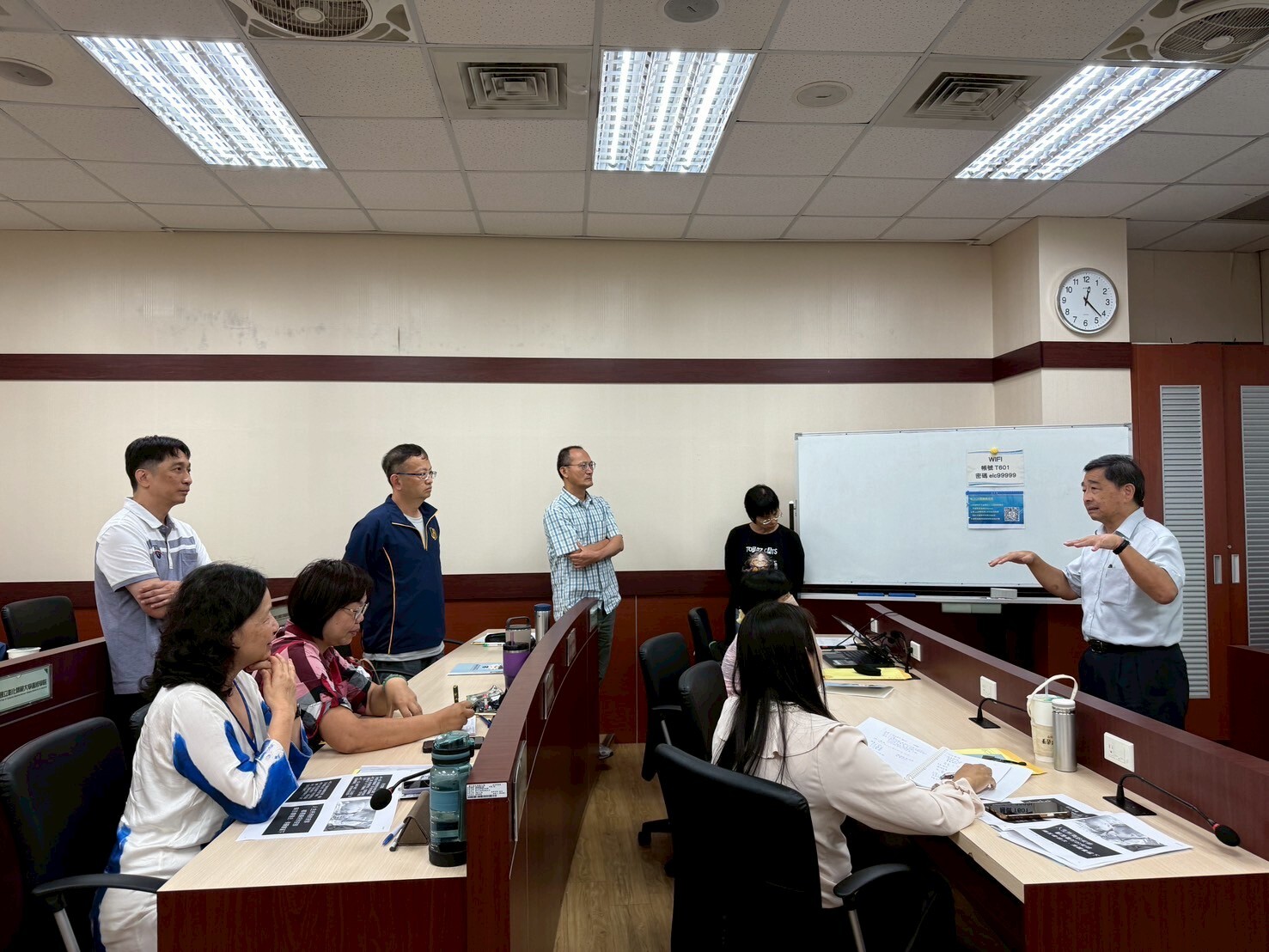
Professor Hsiao-Lin Tuan in NCUE's Graduate Institute of Science Education runs a K-12 Education Administration project. It enhances elementary and junior high school science teachers’ professional expertise and skills in designing inquiry-based and interdisciplinary (STEM) curricula. The project has seven objectives: (1) to help seed teachers develop expertise in inquiry-based teaching and prepares them to become future coaches through a coaching-based to professional development model; (2) to train entry-level seed teachers to have inquiry-based teaching competence, and develop advanced coaches and seed teachers in incorporating learning motivation into inquiry-based interdisciplinary (STEM) instruction; (3) to connect inquiry seed teachers and coach teachers nationwide and build a community network of inquiry teachers; (4) to disseminate the award-winning lesson plans, teaching professional outcomes and inquiry curricula produced by the project over the years to counties and cities across Taiwan; (5) to produce motivation-integrated inquiry curriculum designs on each SDG theme. (6) to produce motivation-integrated STEM inquiry curriculum designs on each SDG theme, and (7) to compile the award-winning inquiry lesson plans of the past five years and identify those relating to SDG topics as a reference for teachers nationwide.
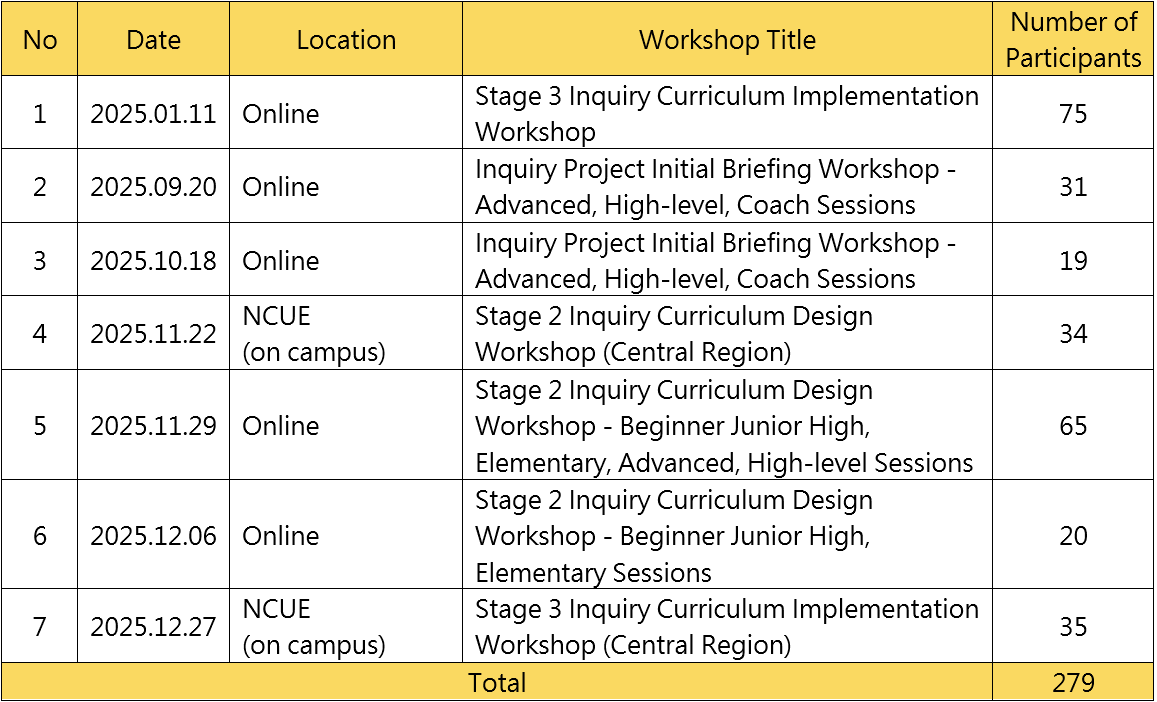
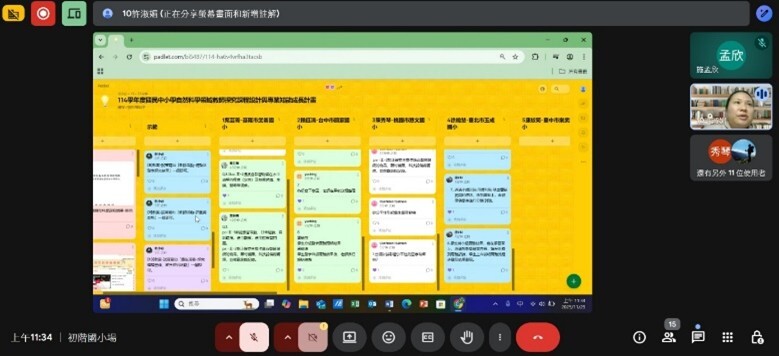
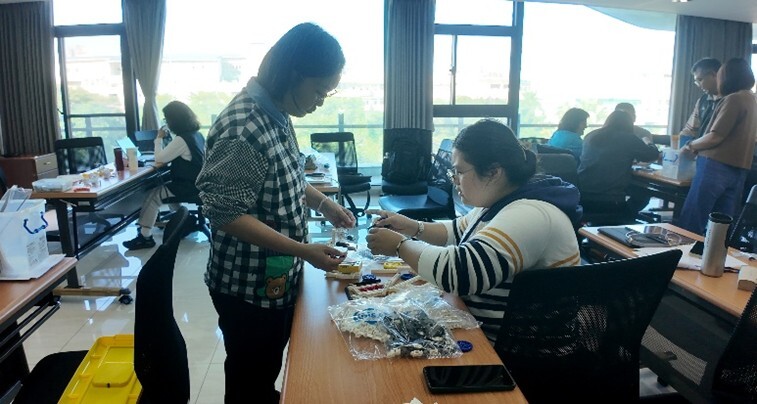
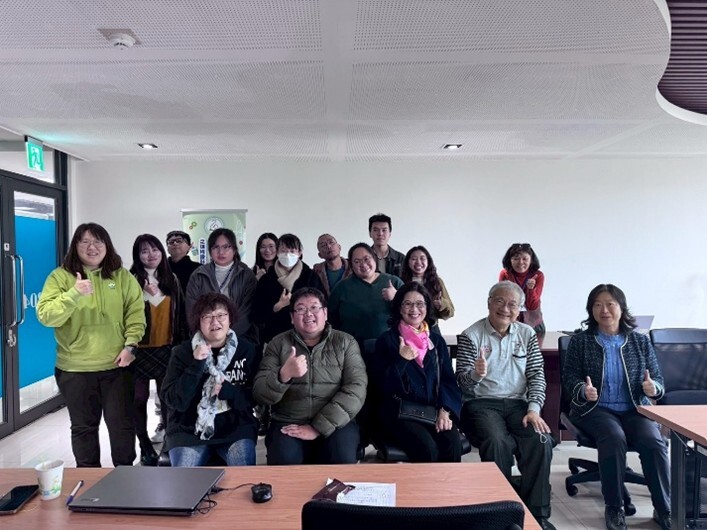
(a) In line with the Ministry of Education's aims and the needs of elementary and secondary school science teachers in the design, implementation and reflective review of inquiry-based instruction, NCUE offers regular annual training for elementary and secondary school teachers on introducing inquiry and practice under the new curriculum guidelines, on designing inquiry and practice courses, and on implementing them, thereby strengthening teachers' professional expertise in inquiry-based instruction. In 2025, NCUE held seven training sessions, amounting to 54 training hours with 279 attendances in total (Figures 13-16).
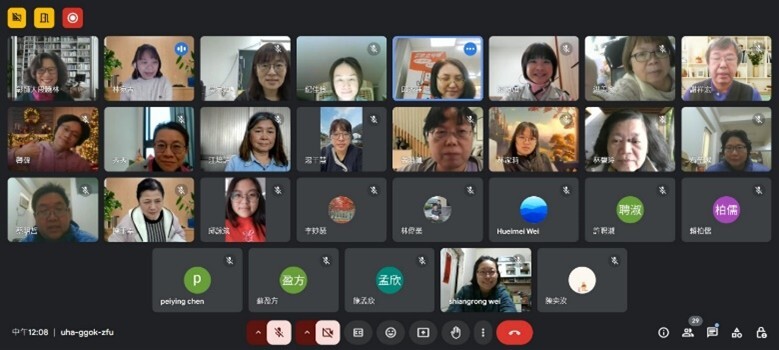
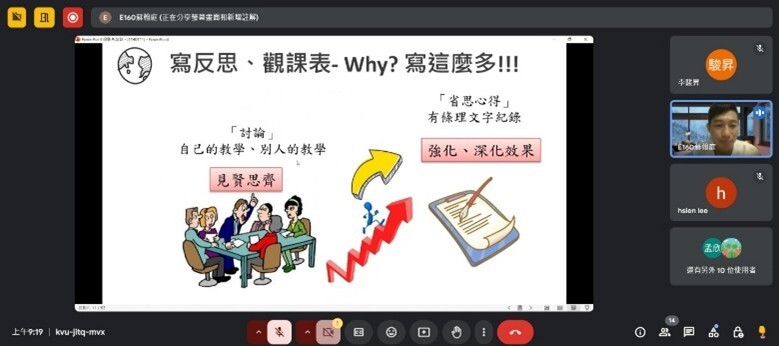
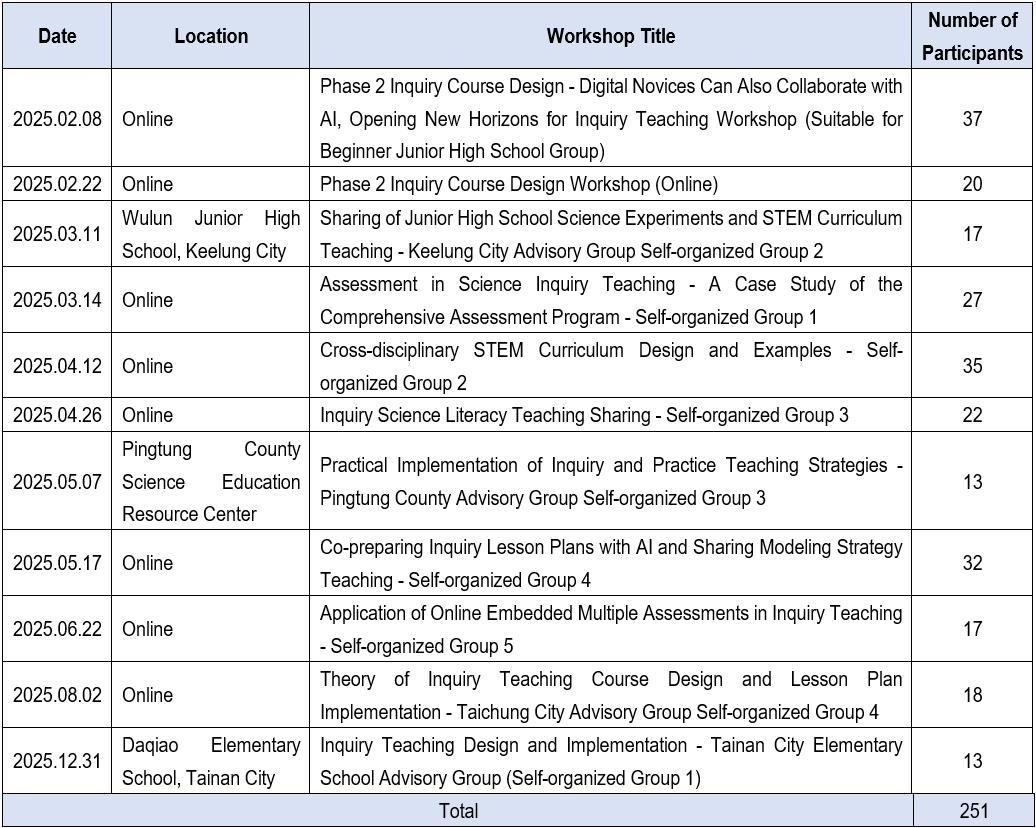
(b) Self-organised groups: Participants in the project have shown growing interest in forming their own study groups based on their needs in inquiry-based instruction. Alongside the three-stage training model, the project therefore offers additional self-organised group activities, with teachers who have reached advanced and coach level through the project serving as instructors, thereby meeting the project's goal of developing teacher leaders. In 2025, 11 self-organised groups were held, each lasting half a day, amounting to 33 training hours with 251 attendances in total. Figures 17 and 18 show photographs from two of the online self-organised group sessions; Figure 19 lists all 11 sessions.
(4) Counseling and Guidance Support Service for Teachers:
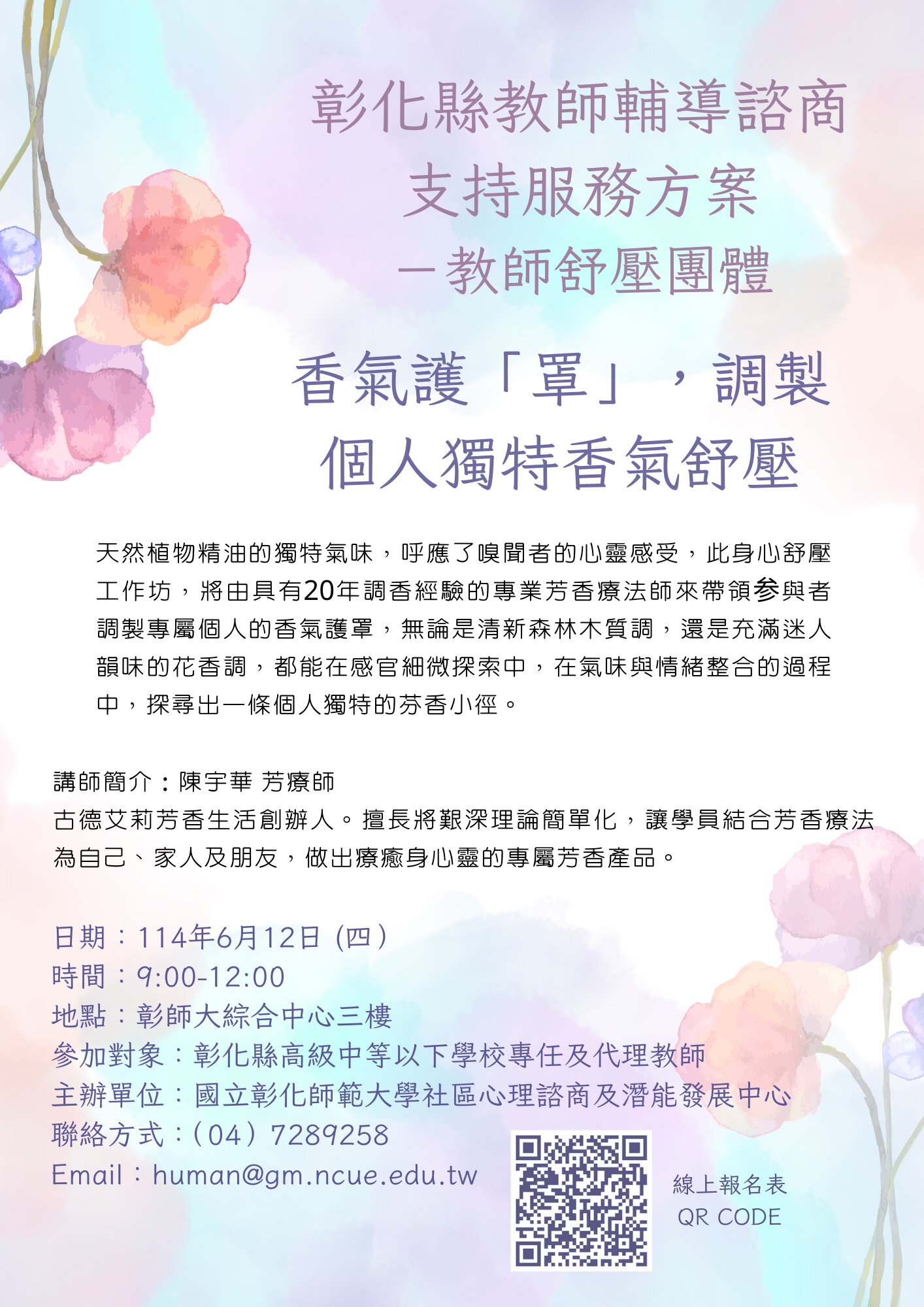
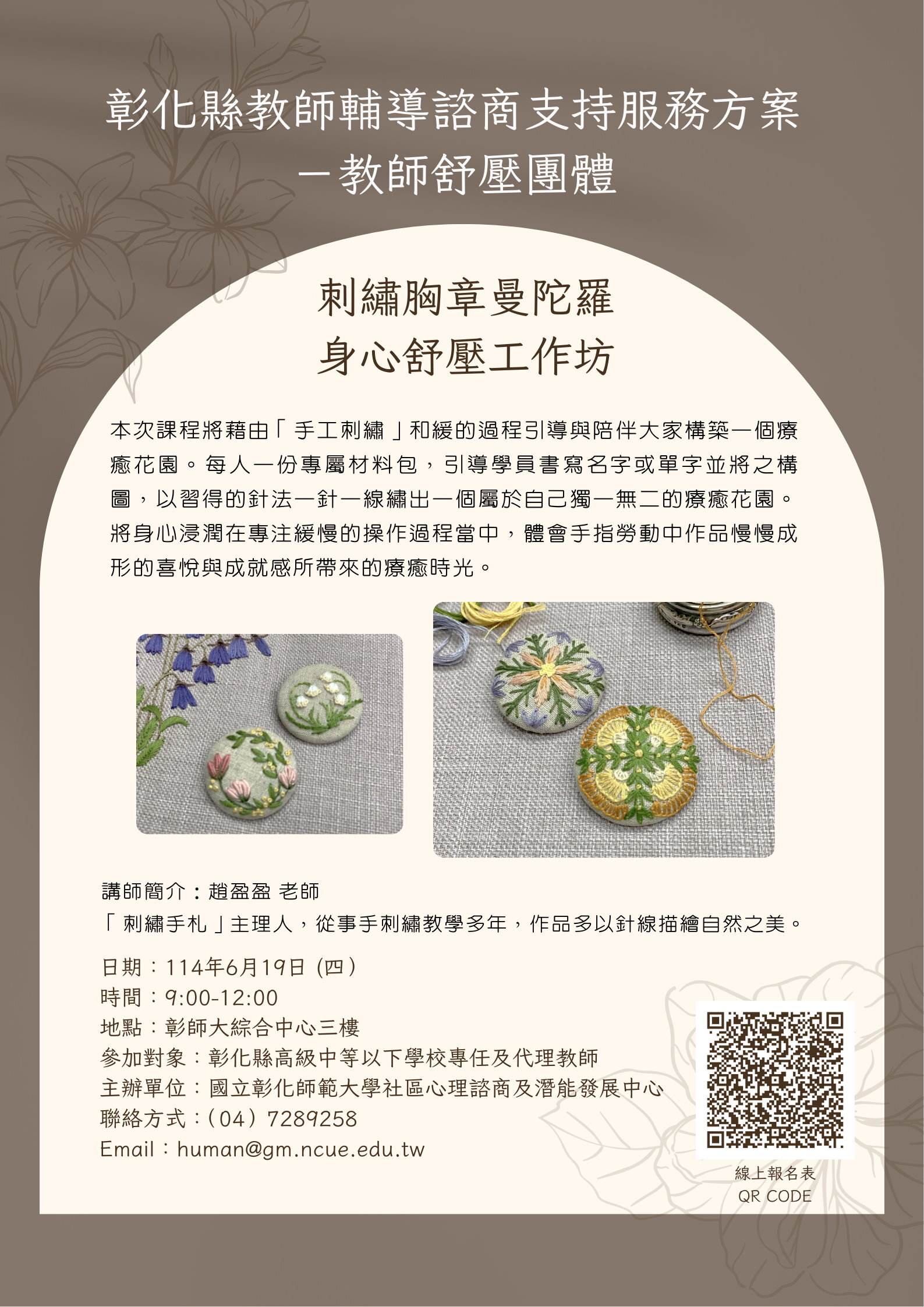
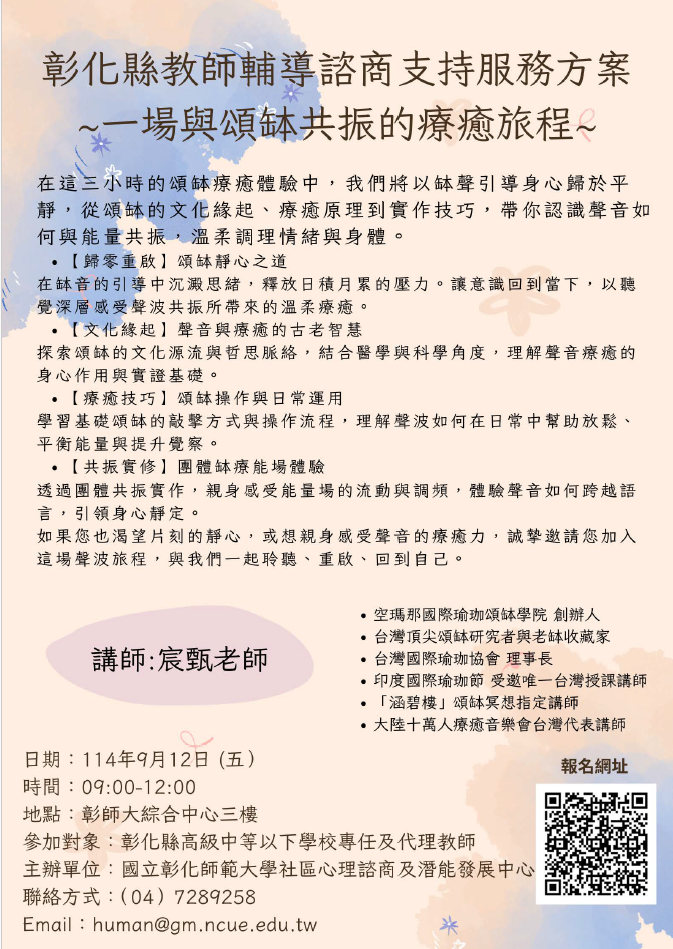
Since 2022, NCUE has been commissioned each year by the Changhua County Government to deliver the Counseling and Guidance Support Service for Teachers. It helps teachers aware of how they bear and adapt to stress, and thereby improves their mental health and capacity to cope with work. Through these approaches, they create productive cooperation and shared benefit between schools and the region. To help relieve teachers’ stress, take care for their physical and mental well-being, and build more connections between schools and the local community, NCUE held four restorative stress-relief activities in 2025. These included an aromatherapy stress-relief course, an embroidered badge and mandala mind-body stress-relief group, a botanical printing and dyeing group, and a healing journey group with singing bowl resonance. Registration information for each course was posted on the website. Figures 20 to 22 show the course posters.
(5) Developing business and industrial talent in Changhua County:
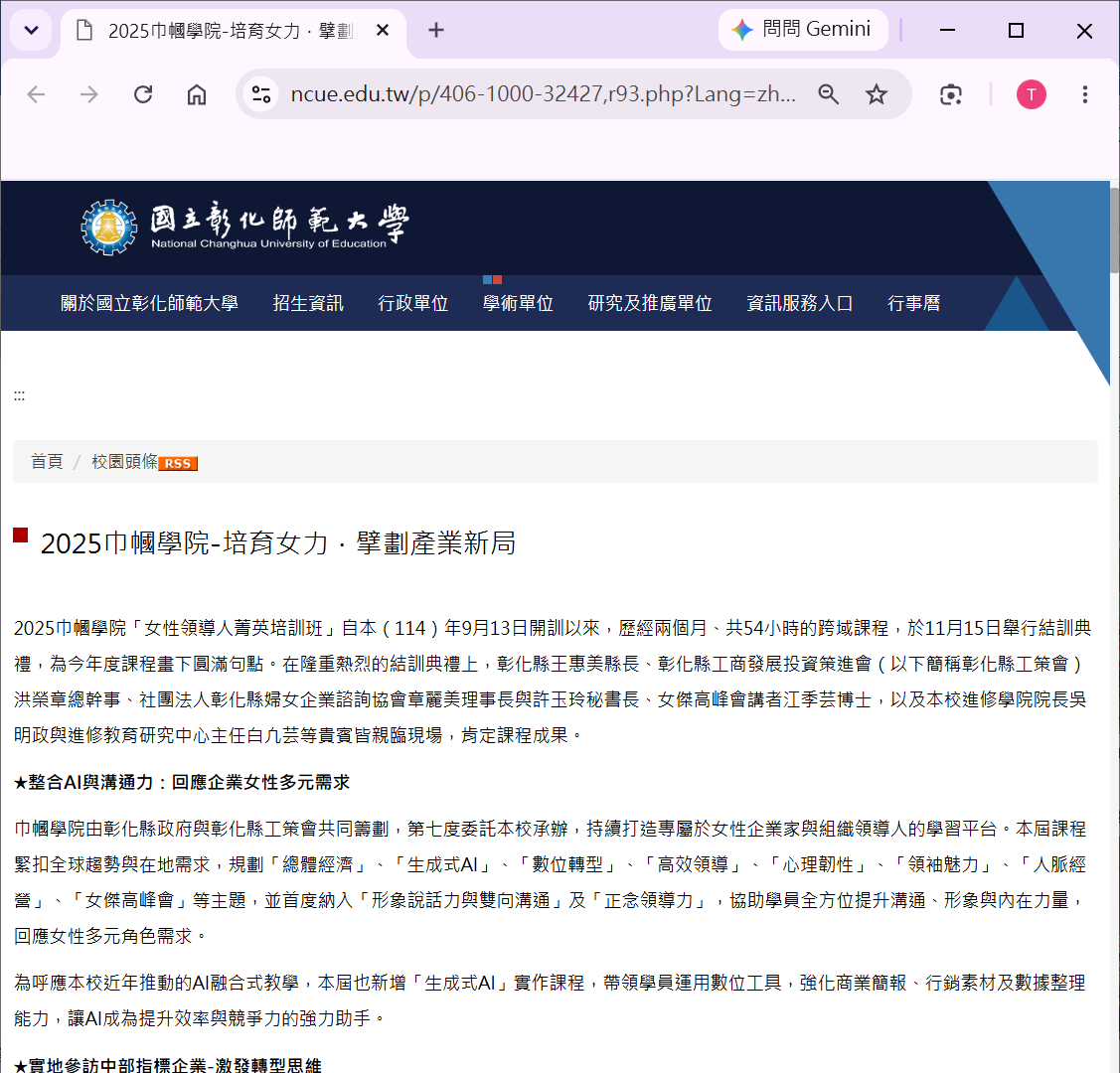
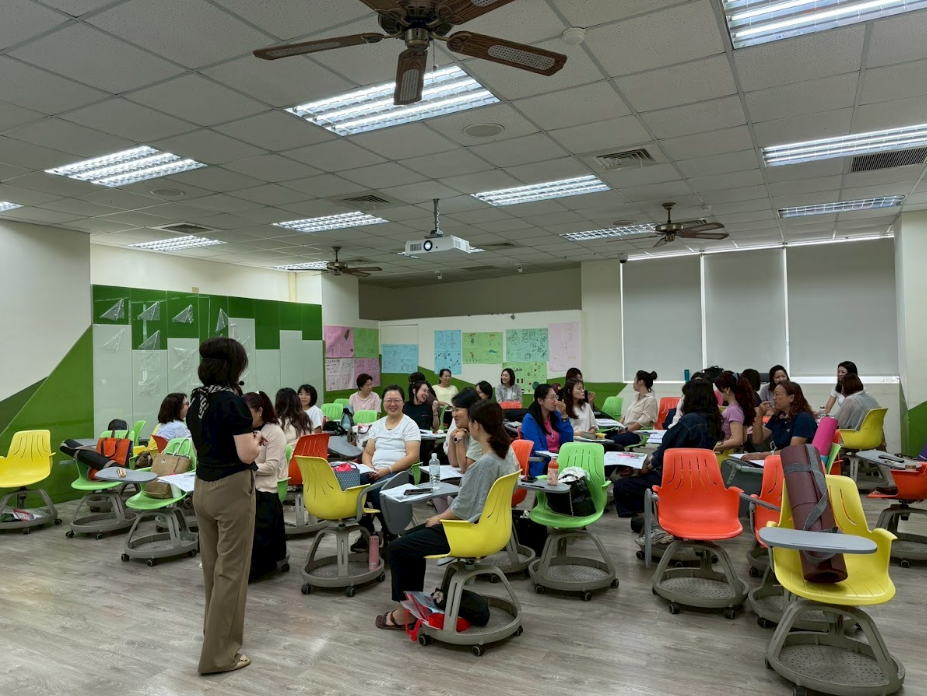
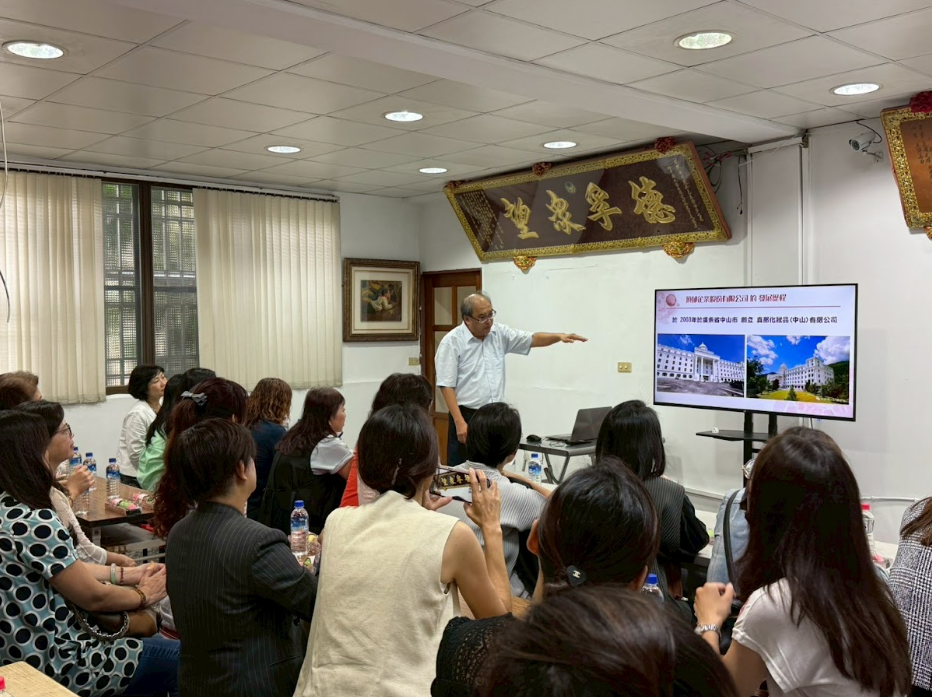
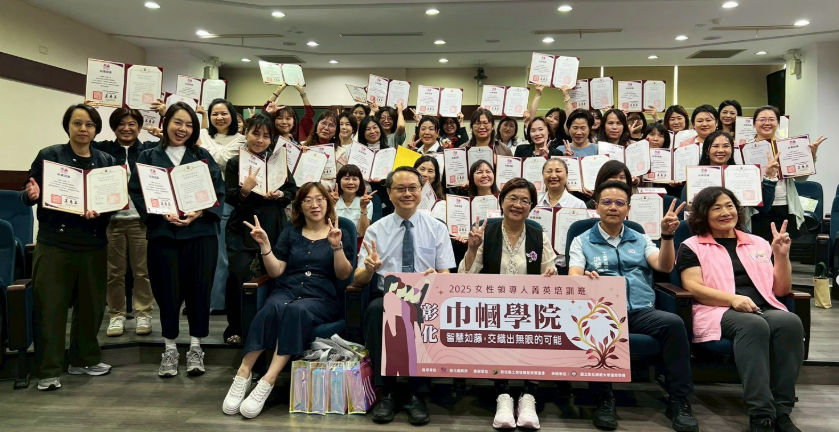
To help enterprises in Changhua county, where NCUE is located, develop the talents for keeping pace with the times and operating sustainably, since 2016, NCUE has worked with the Changhua County Government and private business organizations to conduct several projects. These include Young Entrepreneur Development Academy—Training Program for Second-Generation Elite Entrepreneurs, Women's Academy—Female Leadership Training Program, and E-commerce Academy—E-commerce Talent Training Program. Each cohort comprises 54 hours of instruction and, helping develop second-generation successors and women leaders for small and medium-sized enterprises in Changhua County, as well as equipping them with skills in management, innovative business operation, digital marketing, communication and negotiation. In response to the information age, the courses also include units on innovative applications of artificial intelligence and on big data analysis and applications. 463 participants have successfully completed the programmes on date. Figure 23 shows the NCUE News item on the 2025 Women's Academy, and Figures 24 to 26 show photographs from the courses.
NCUE News item on the 2025 Women's Academy: https://www.ncue.edu.tw/p/406-1000-32427,r93.php?Lang=zh-tw
(6) Induction training for beginning teachers:
Since 2017, NCUE has held the Induction Program on Professional Commitment and Teaching Practice for beginning teachers each year. The program aims to help beginning teachers in public schools at the secondary level or below strengthen their classroom management and develop innovative teaching skills, enabling them to adapt more effectively to their professional roles. In 2025, the program adopted a format of one day of synchronous online study plus two days of in-person training. The activities are held from August 4 to 15 in northern, central and southern Taiwan respectively. Participants by educational level were 387 from preschools, 1,812 from elementary schools, 813 from junior high schools, and 387 from senior high schools, giving a total of 3,399 (Figures 27-28).
(7) Green energy general education lectures and teacher community activities:
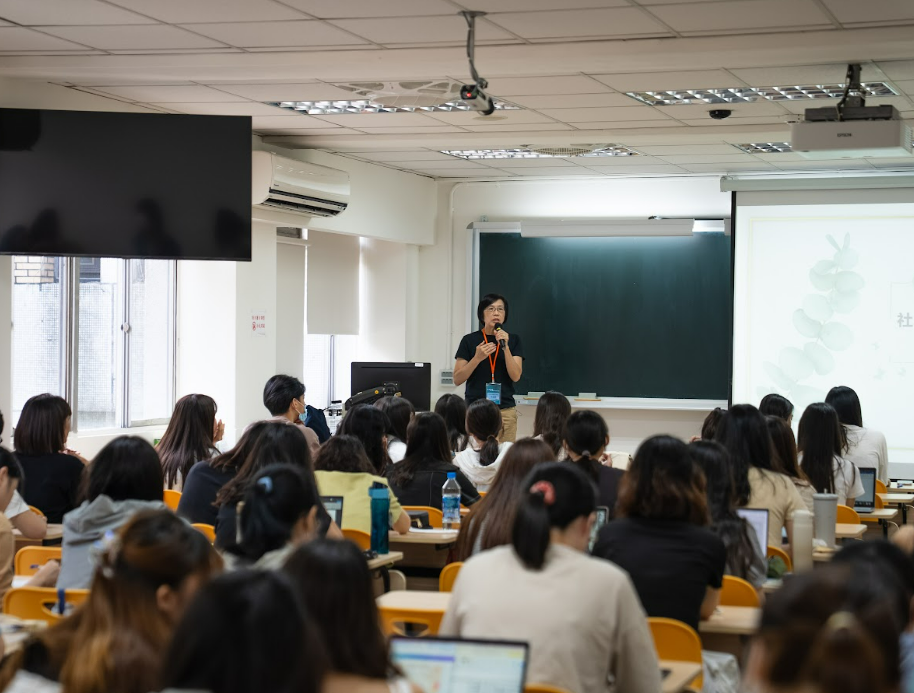
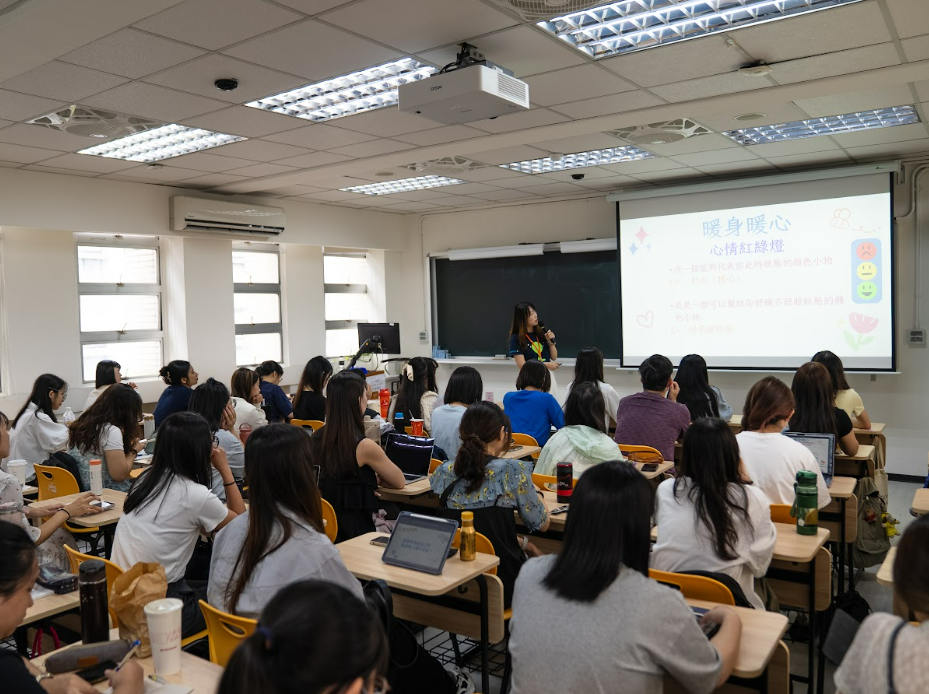
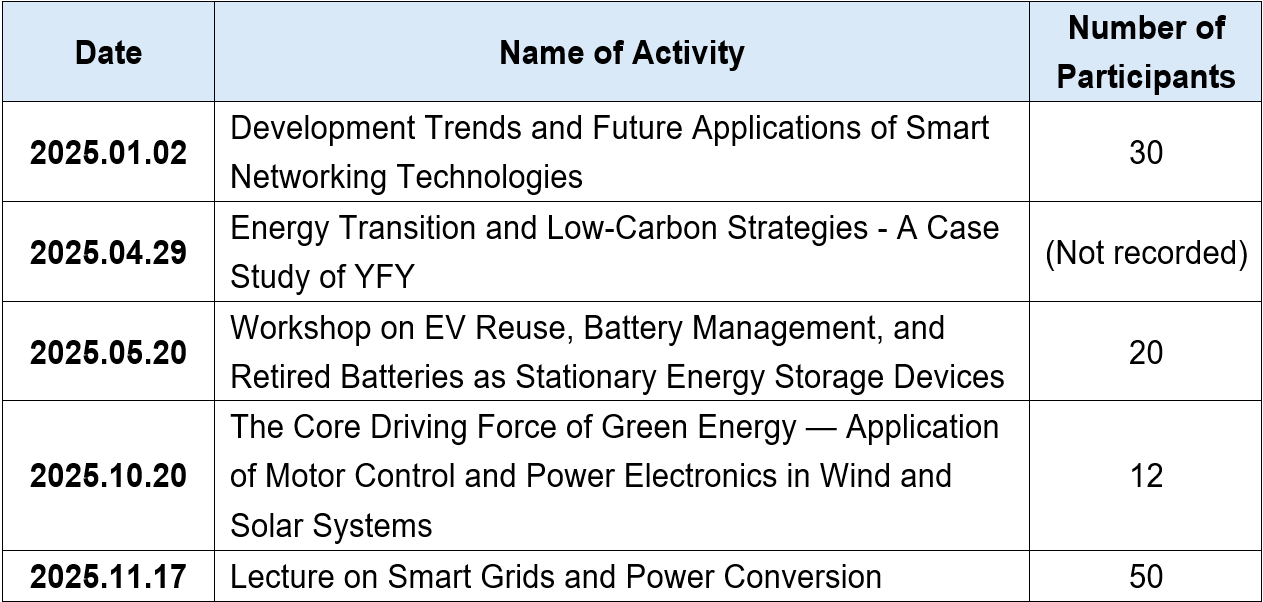
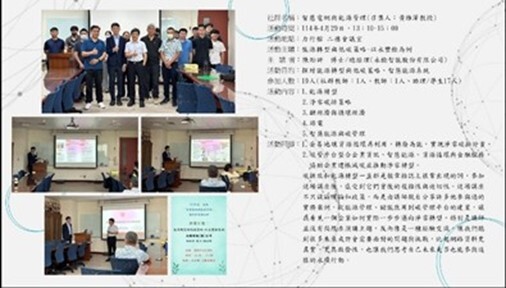
Through NCUE's energy education projects and its implementation of the Ministry of Education's fourth-phase (2025-2027) University Social Responsibility Project: Splendor of Changhua: Developing Wind and Solar Energy Resources (USR Hub), NCUE has organized green energy general education lectures. These give attendees an understanding of the current state of green energy and thereby build a basic grasp of the energy transition and of the present state and future challenges of green energy technology in Taiwan and worldwide. At the same time, a teacher professional community on smart grids and electrical energy has been established. Its members meet and hold discussions, and organise lectures and seminars, examining in depth the knowledge and integrated application of smart grids, renewable energy, energy storage technology and the Internet of Things. The aim is to promote these technologies, build a more stable, reliable and environmentally sound electricity system, and advance sustainable energy development. In 2025, NCUE held 5 green energy general education lectures and teacher community activities, with at least 112 participants. Figure 29 is a summary table of the 5 activities. Figure 30 shows an activity in progress.
2. Ad Hoc Vocational training courses held each academic year
Each year NCUE holds a variety of vocational training courses on an ad hoc basis, covering management training, special-topic education courses and second-language enhancement courses. Integrating ESG topics, NCUE holds several related activities, including ESG Sustainability Planning Training Program, green energy general education lectures, international science literacy forums, equipping seed teachers in elementary and junior high schools with expertise in these fields.
(1) Vocational training courses tailored to local needs:
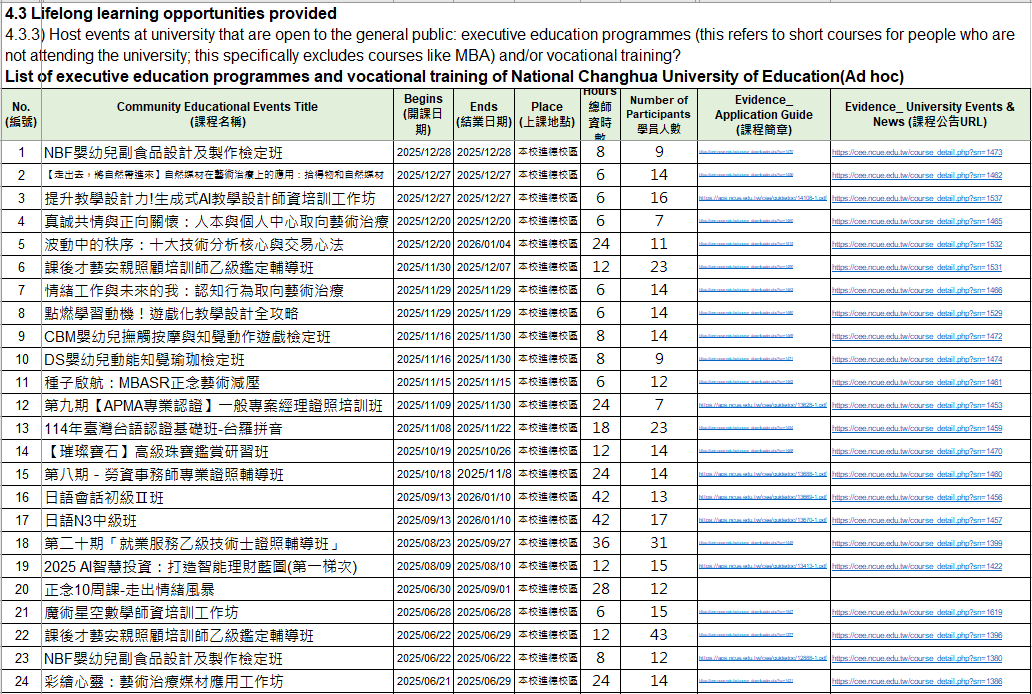
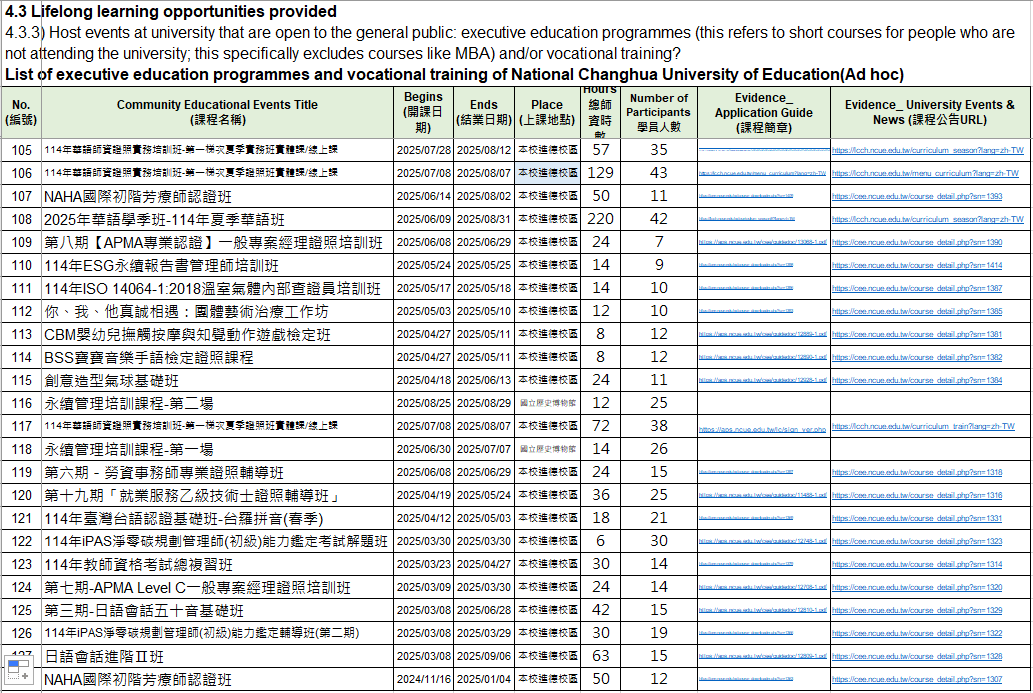
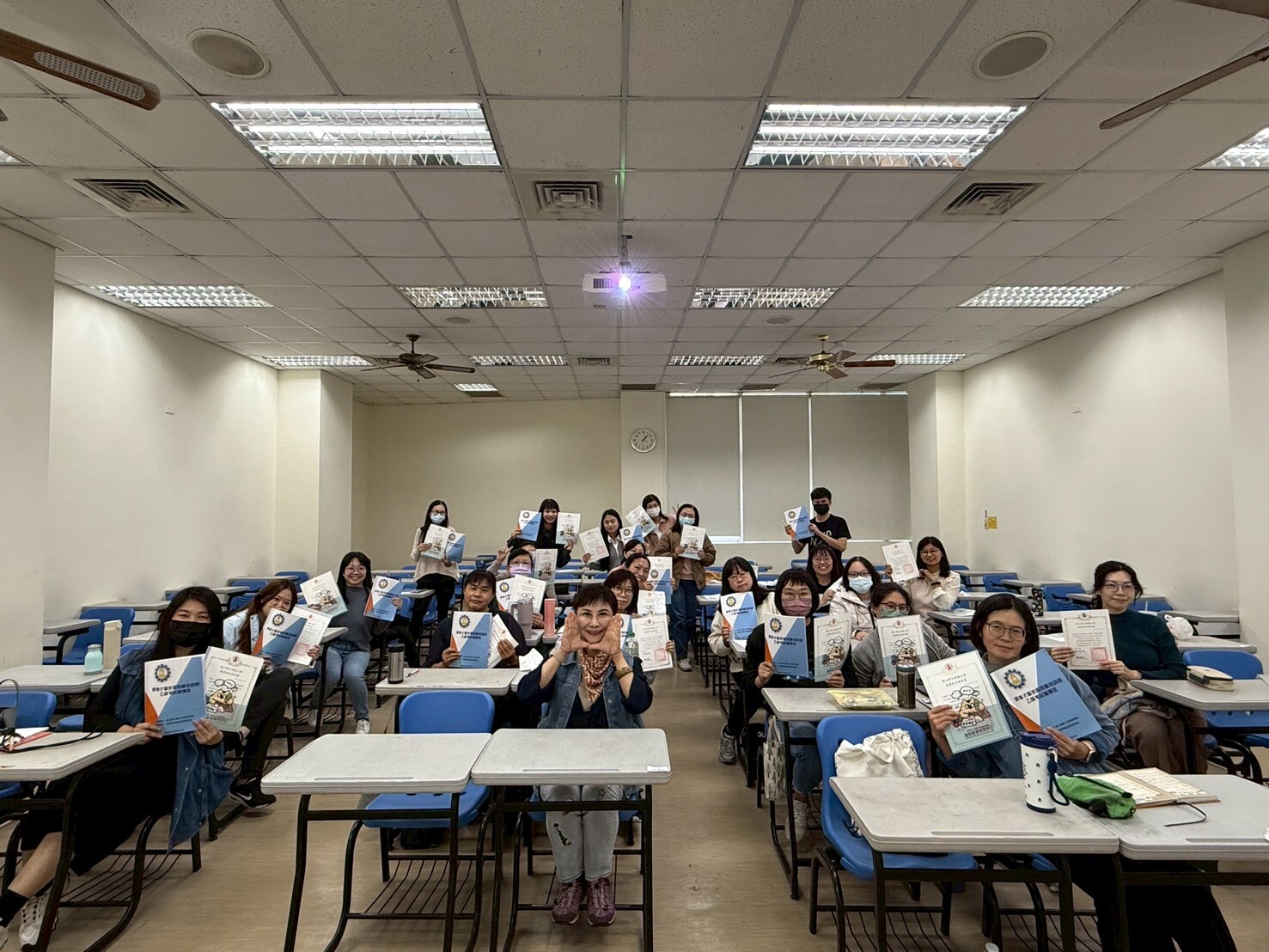
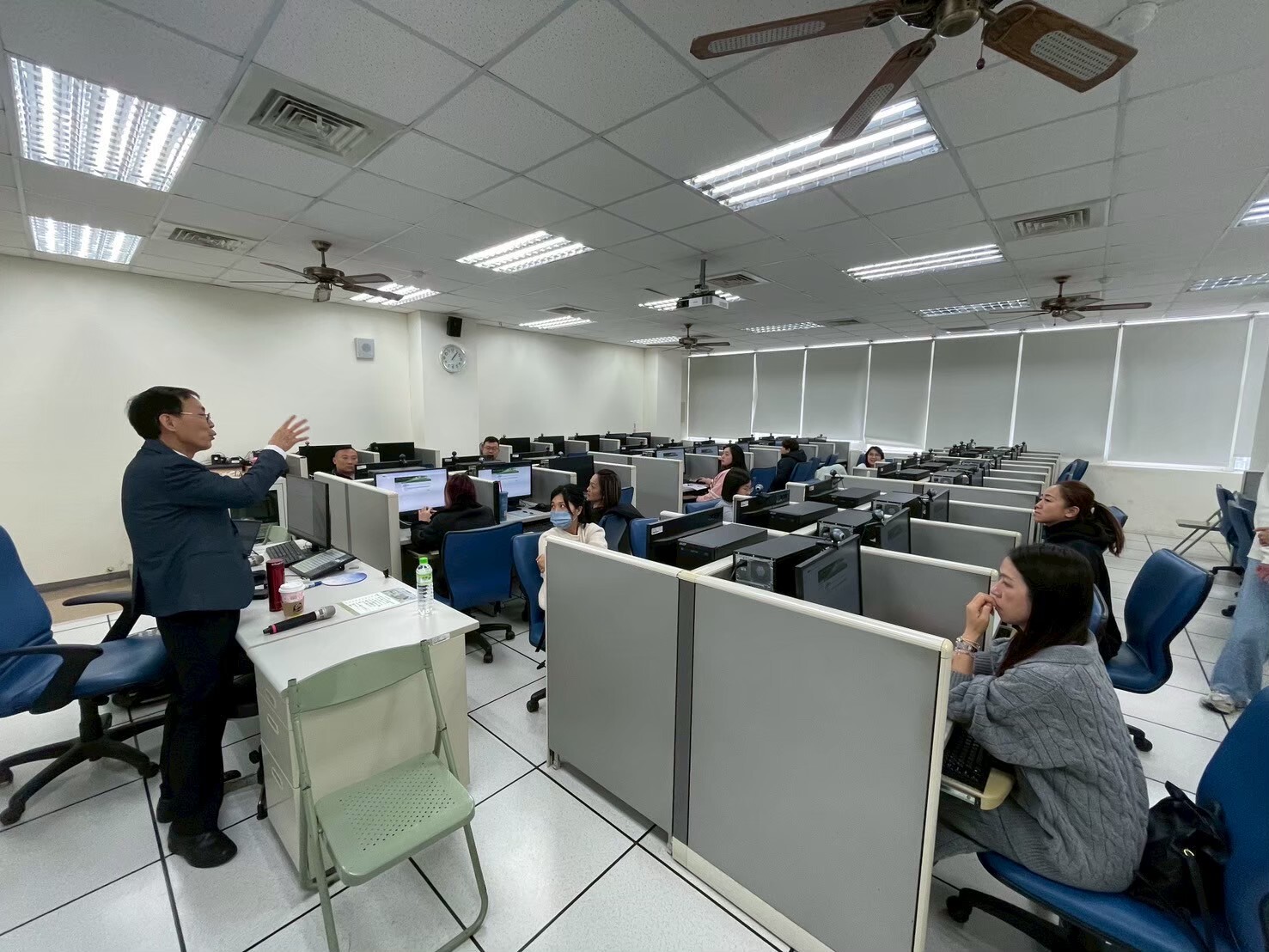
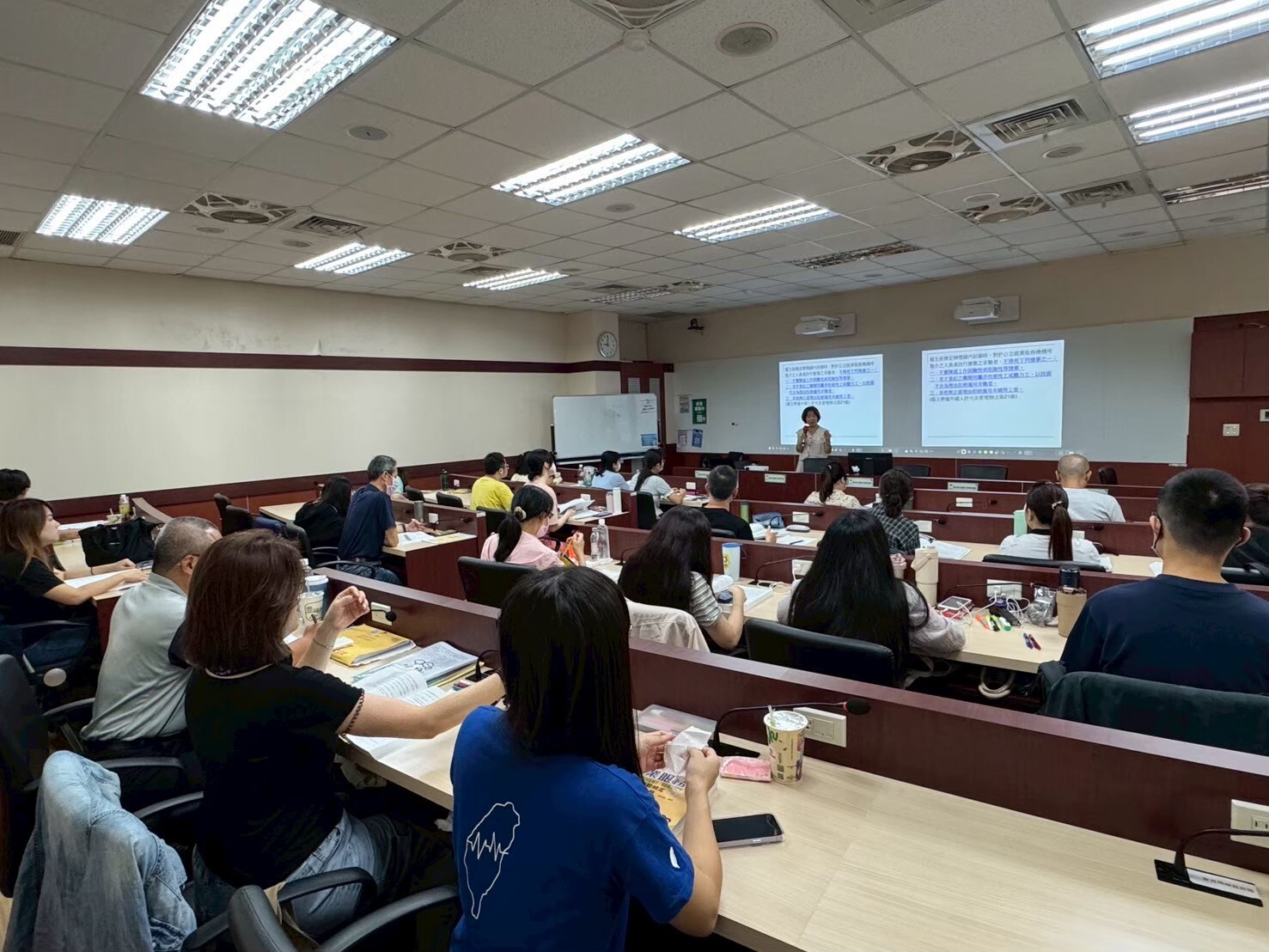
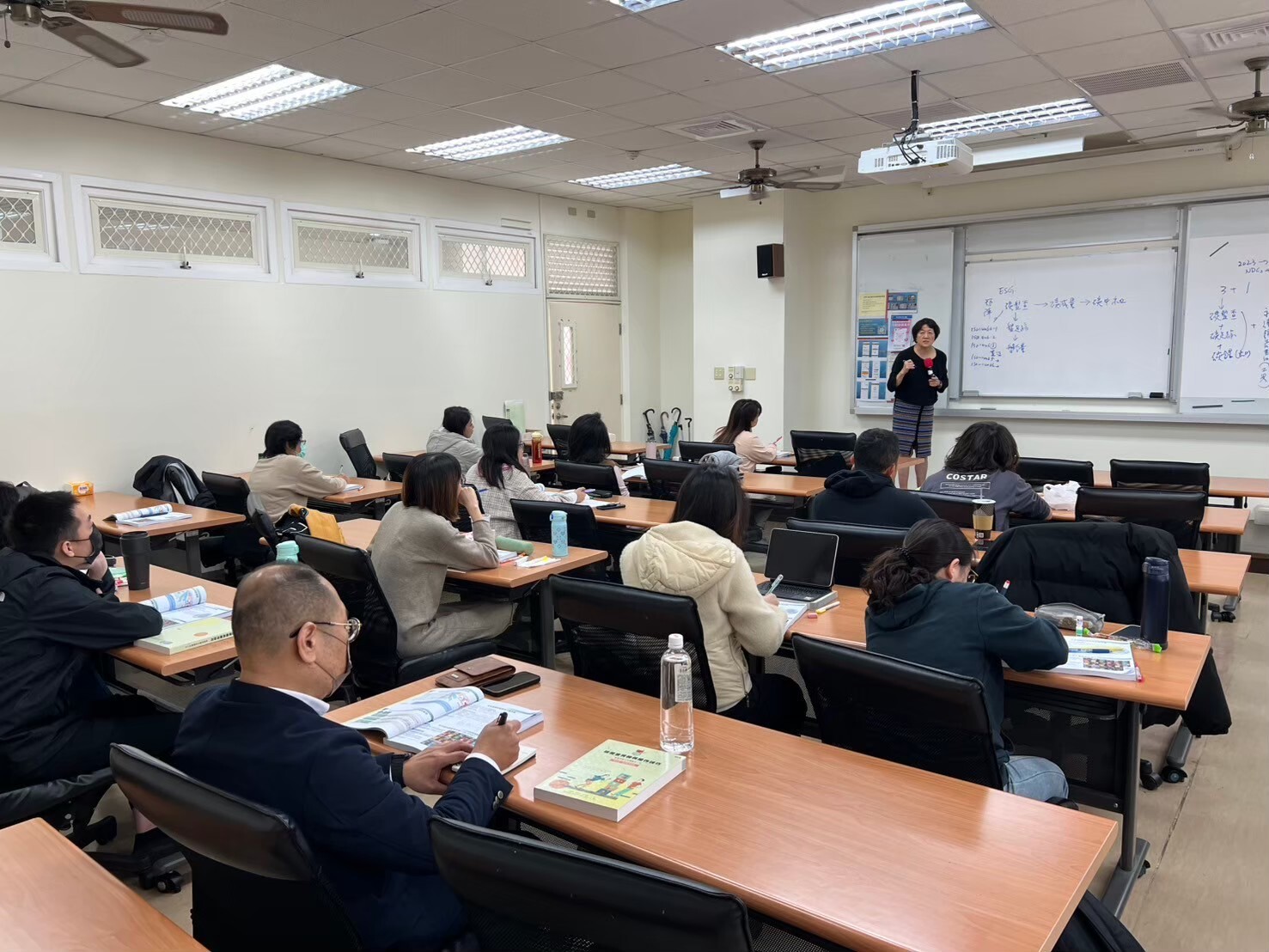
To promote lifelong learning and provide the public with opportunities for continued professional improvement, NCUE offers a range of vocational training courses for business leaders, employees, and technical professionals, tailored to the needs of local residents and local industries. These cover management training, special-topic education courses, second-language enhancement courses and other kinds of vocational skills education. In 2025, NCUE held a total of 128 classes were held, amounting to more than 3,838 training hours, and help 2,263 participants strengthen their knowledge and skills. Figures 31 and 32 give details of the courses (extract), and Figures 33 to 36 show photographs from the courses.
(2) 2025 Changhua County Labor College:
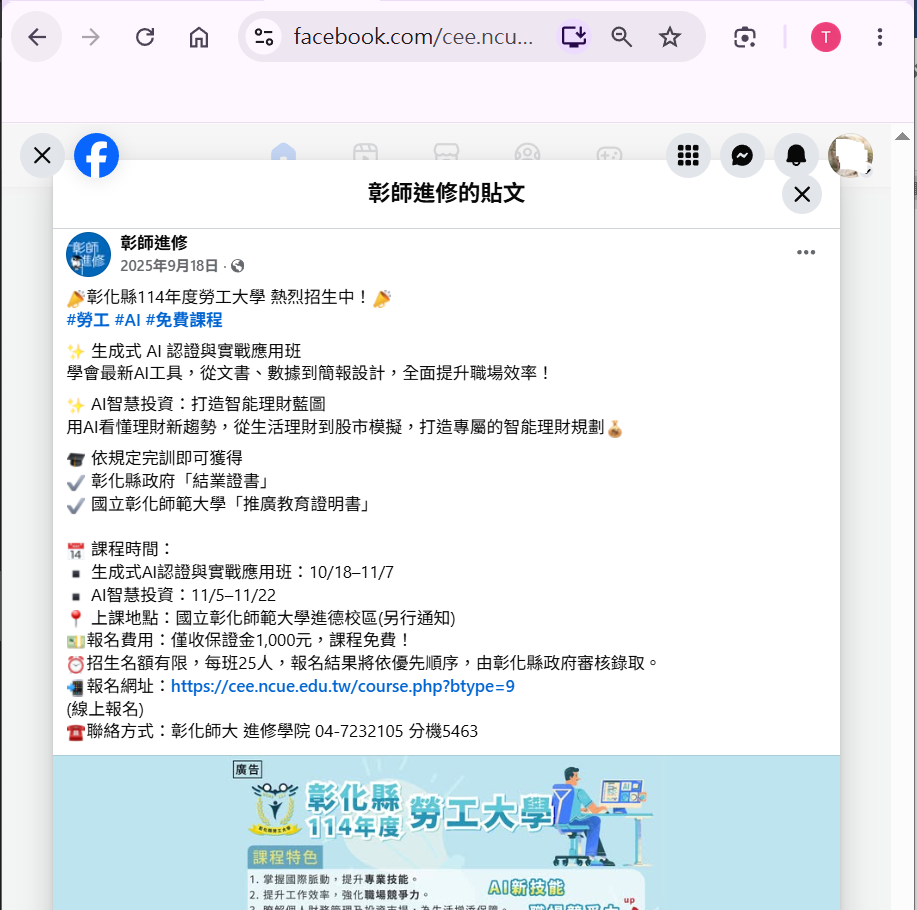
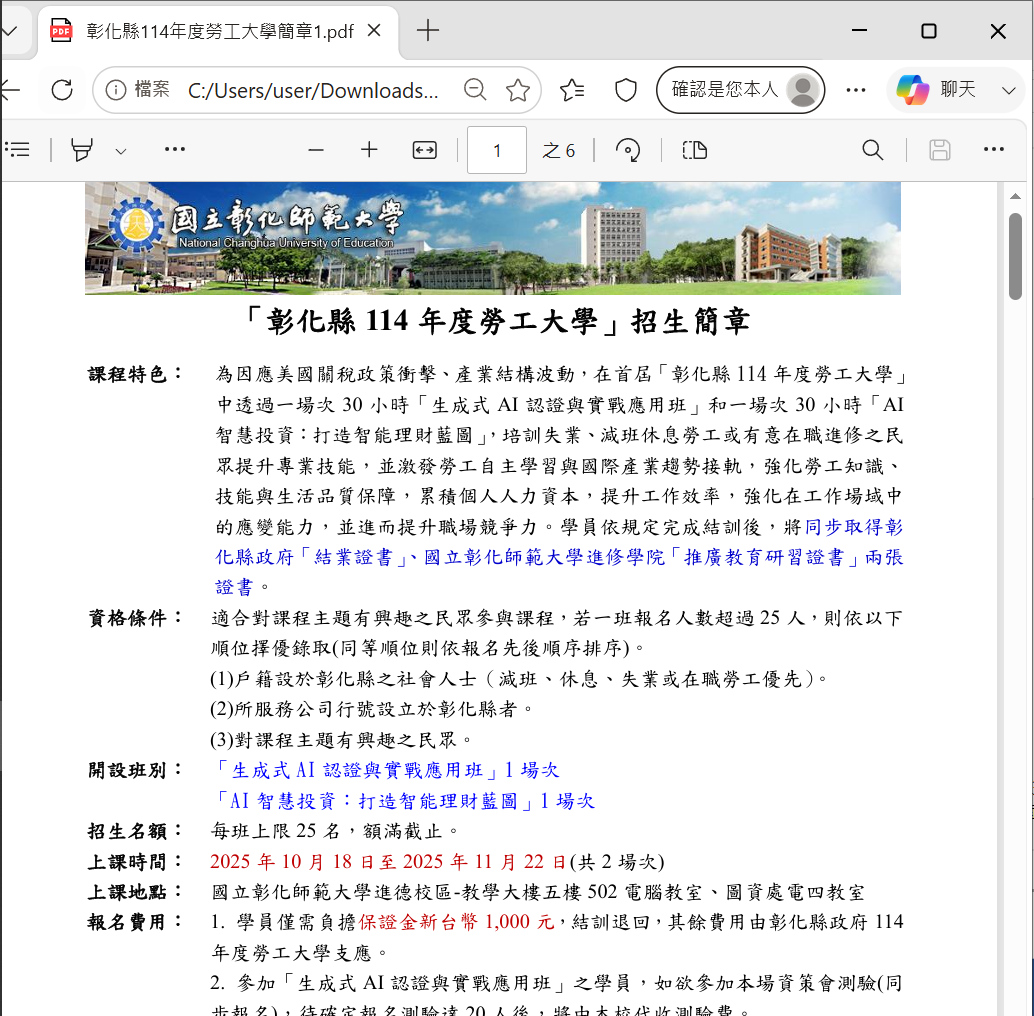
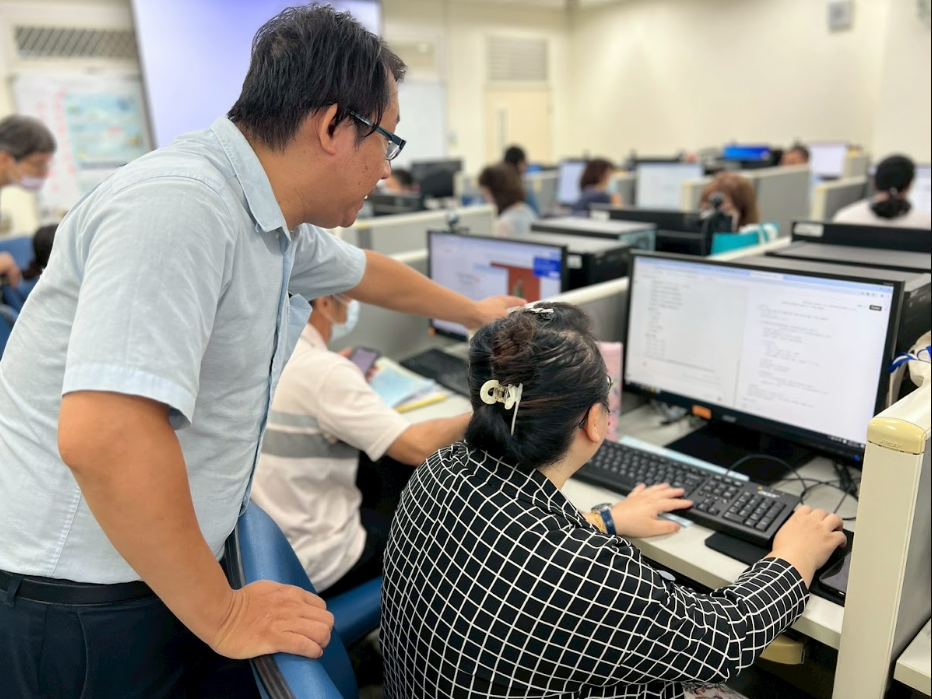
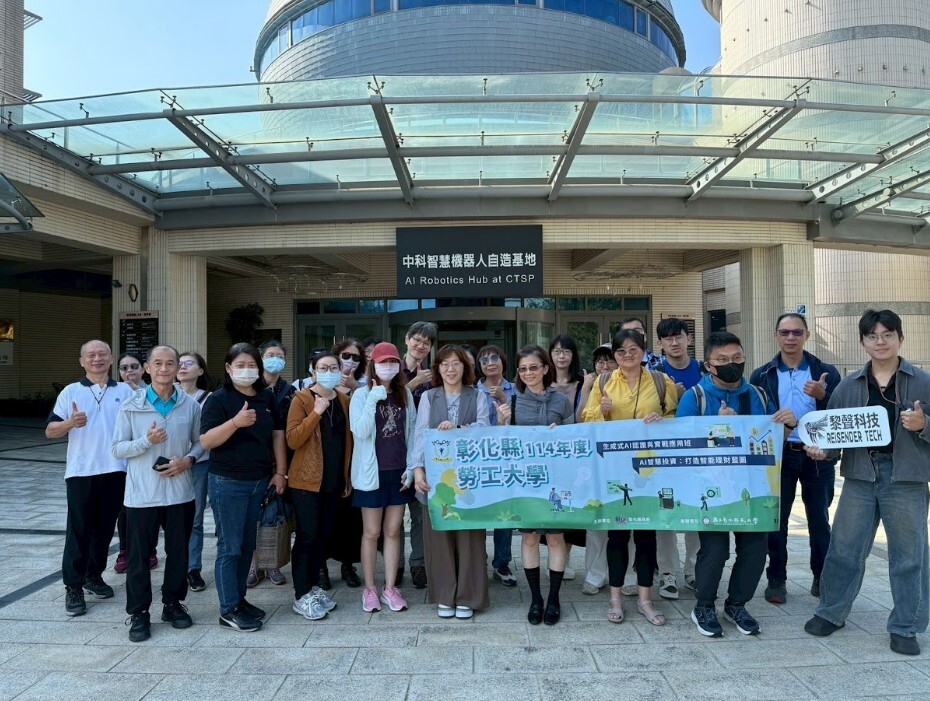
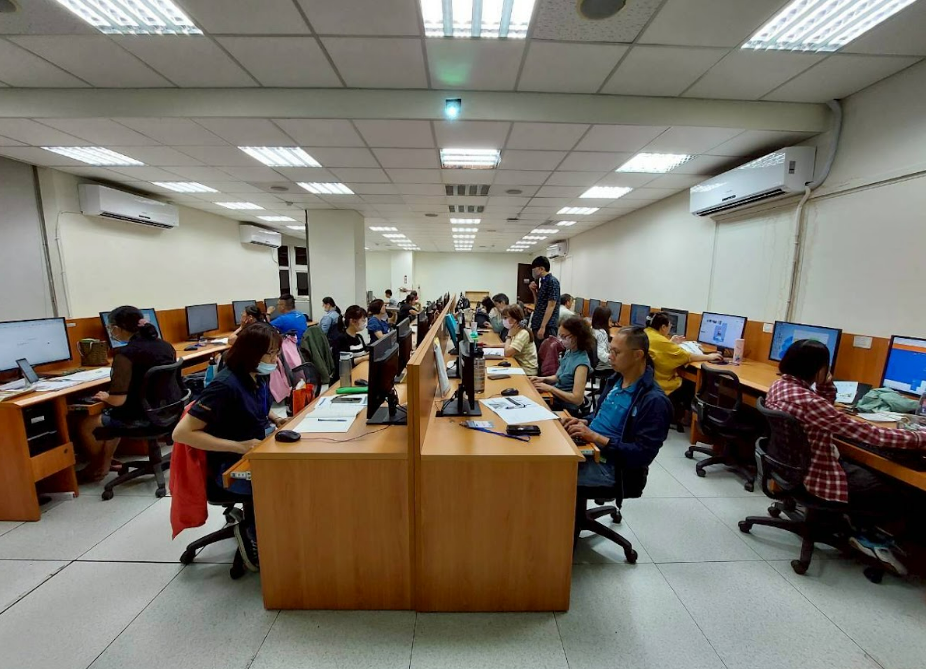
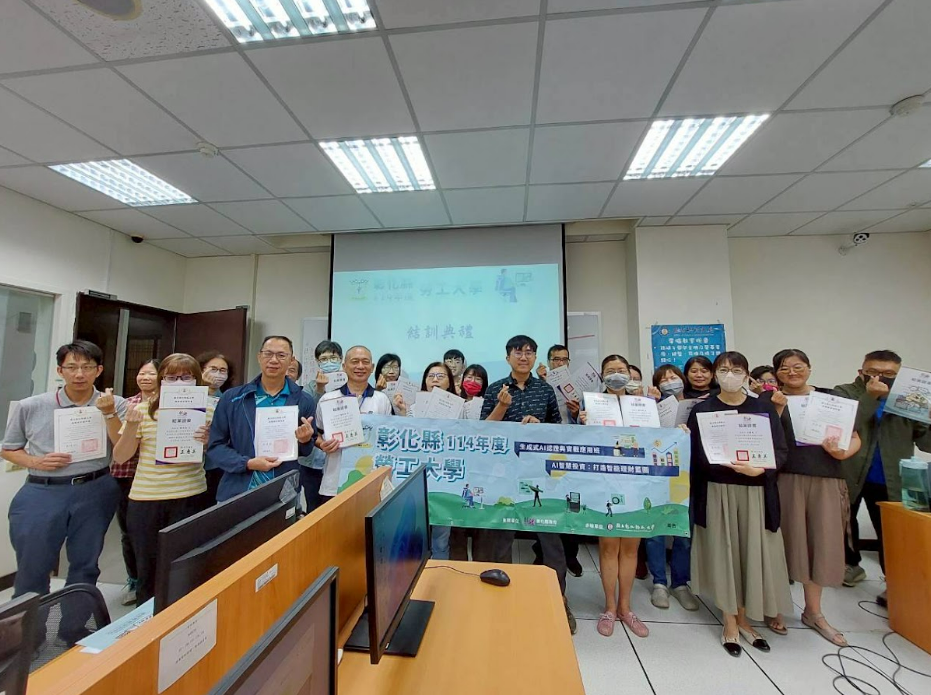
In 2025, NCUE held the first Changhua County Labor College, providing further study for working public and advancing the digital transformation of the local workforce with giving priority to unemployed workers and those on reduced hours. The labor college offered two courses were in 2025, including Generative AI Certification and Practical Applications, and AI-Enabled Investment. The content of both courses was closely aligned with international trends and practical operation, covering AI data governance, automated document processing, data analysis, and financial risk management. The teaching team made good use of shared cloud resources and real-time interaction to help participants internalise leading-edge techniques and address pain points in their own workplaces. Besides, participants were also encouraged to sit the Generative AI Competency Certification administered by the Institute for Information Industry (III) and those who pass receive an AI certificate issued by III. This helps the participants strengthen their employability and competitiveness at work that participants could apply what they learned in real settings. Besides, the courses combined a rich body of theoretical and practical knowledge with company visits that took participants into industry sites.
The first Labor College attracted workers from a range of industries. In total, 50 people took part in the training and 49 completed it successfully. Participants reported that they had improved their digital skills and became more familiar with AI tools, which helped them improve work efficiency, as well as optimize data analysis and application of generative AI, allowing them to complete more tasks in less time and raise their competitive advantages. Figure 37 is the open enrolment announcement for the courses on Facebook; Figure 38 is the course prospectus; Figures 39 to 42 show photographs taken during the classes.
(3) Training activities for gender equity
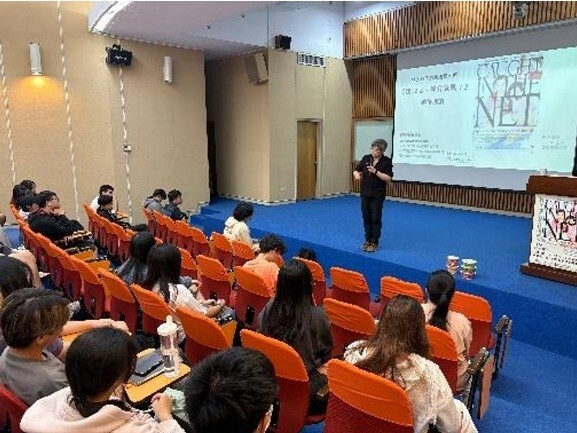
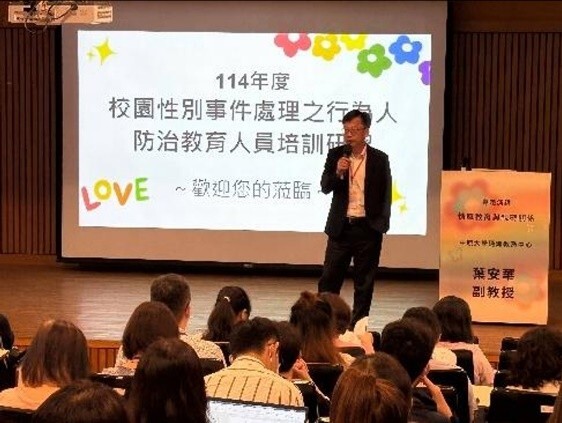
In 2025, NCUE held a total of 110 training activities for gender equity education which includes anti-discrimination and anti-harassment. Figures 1-6 demonstrate the photographs of the activities. Compared with 2024, the number of activities and participants in 2025 increased by 4.7% and 15.2% respectively. In 2024, NCUE held 105 sessions with a total of 6,038 participants, while in 2025, it held 110 sessions with a total of 6,954 participants. The activities aim to promote gender equity education and the key principles of anti-discrimination and anti-harassment as widely as possible. Figures 43 and 44 show photographs from these activities.
(4) Community mental health courses:
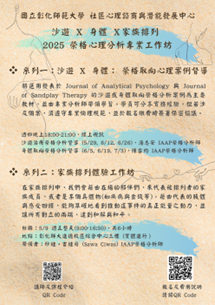
In 2025, NCUE's Community Counseling and Human Development Service Center held 1 workshop, and its theme was "Sandplay x Body x Family Constellation: 2025 Jungian Analysis Professional Workshop" (Figure 45), with 15 attendances in total.
(5) Counseling and guidance support courses for preschool educators:
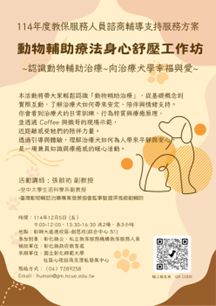
Since 2025, NCUE has assisted the Changhua County Government in delivering annual Counseling and Guidance Support Service for Preschool Educators. The program helped relieve preschool educators’ stress and take care for their physical and mental well-being. A restorative stress-relief activity was arranged for 5 December 2025, introducing participants to animal-assisted therapy in an accessible way. Moving from basic concepts to actual interaction, participants learned how therapy dogs provide reassurance, companionship and emotional support. The participant could also observe the daily training, behavioral characteristics, and therapeutic principles of therapy dogs (Figure 46).
(6) Eco-Homestead and Sustainable Communities Project:
Working with Providence University, Tainan National University of the Arts and Changhua Arts High School, NCUE conducted 6 professional capacity-building activities in horticultural therapy, ecological performance, and the creation of ecological gardens, with 253 attendances in total. These strengthened the ecological education, activity design, and outreach skills of teachers and other personnel both within and beyond NCUE. In addition, the university held 9 sessions of the Xiangshan Community Tour Guide Volunteer Training Series, training 23 local volunteers and improving their skills in guiding community tour, introducing local culture, and promoting events. Through opening university’s professional resources to the public, NCUE strengthened the professional knowledge and practical capabilities of teachers and community volunteers (Figures 47-48).

(7) Sustainable Changhua project:
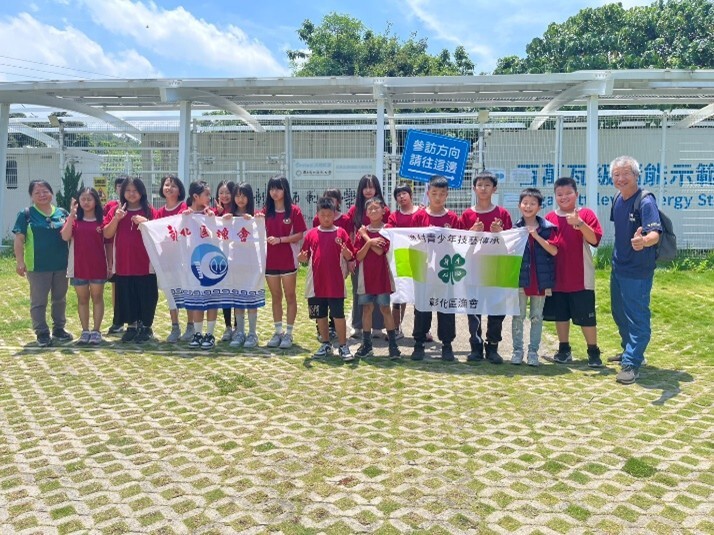
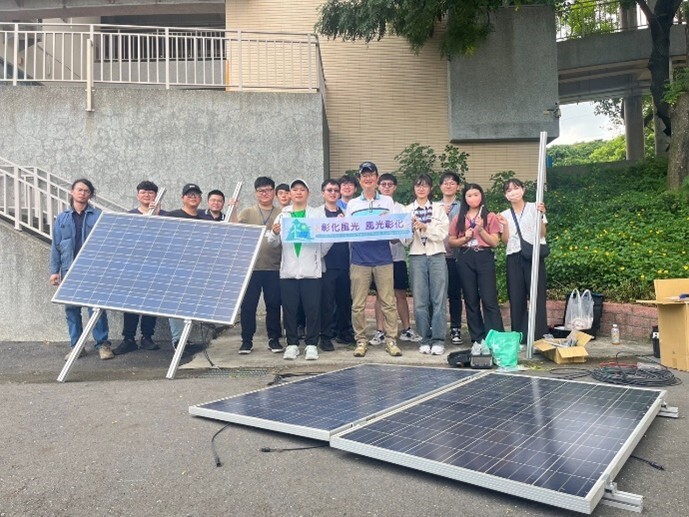
Through NCUE's energy education projects and its implementation of the Ministry of Education's fourth-phase (2025-2027) University Social Responsibility Implementation Project: Sustainable Changhua: Green Energy Perspective in Education, Technology, and Economy, NCUE makes full use of the extensive energy facilities on its Baoshan Campus to run visits to and hands-on courses at the NCUE smart microgrid. These give members of the public and teachers and students from other institutions direct exposure to and experience of green energy, and share the innovative technology of the smart microgrid. On campus, students receive training in the practical skills and knowledge of solar energy systems, with professors and professional engineers leading students in physically installing solar power generation systems (Figures 49-50). In 2025, NCUE held 6 visits to microgrid and energy storage system sites, with 74 participants in total.
(8) 2025 Summer Electromagnetic Education Seminar
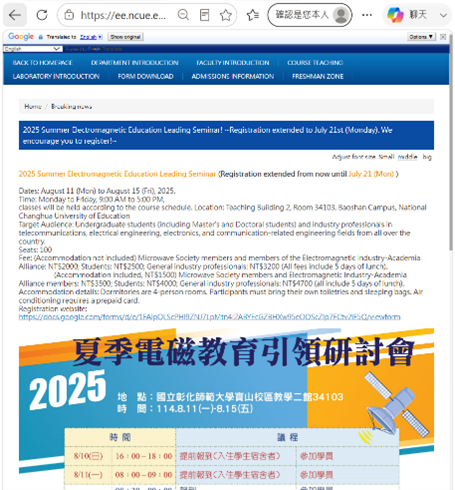
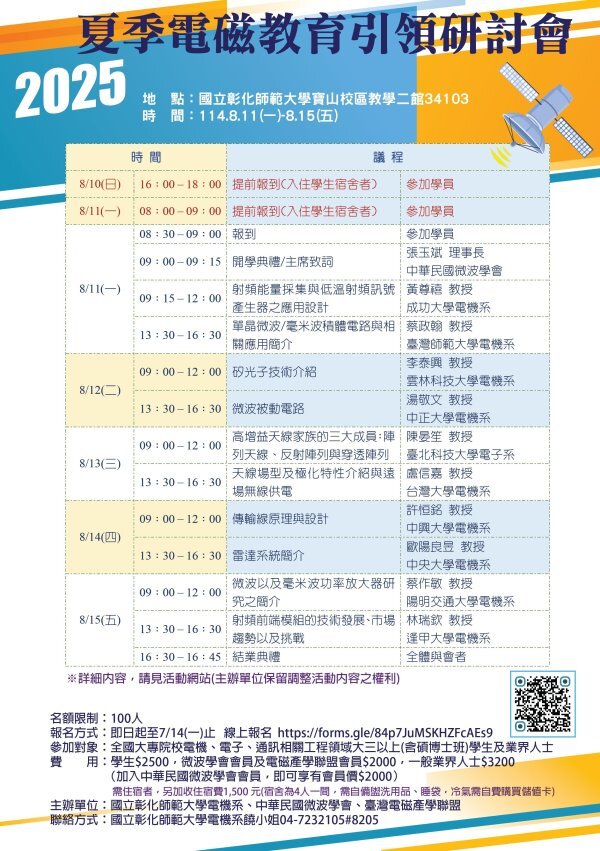
From August 11 to 15 in 2025, NCUE's Department of Electrical Engineering held the five-day 2025 Summer Electromagnetic Education Seminar, arranging six hours of lectures each day, with an average of more than 60 participants daily. Topics included monolithic microwave integrated circuits, an introduction to silicon photonics technology, microwave passive circuits, transmission line principles and design, and technological developments in radio frequency front-end modules, helping industry and academia keep abreast of advanced energy and communications technologies. Figure 51 shows the open enrolment information for the event, and Figure 52 demonstrates the event poster.
(9) The 34th Conference on Poetics: International Symposium on the Formation and Reflection of Classical Chinese Fiction
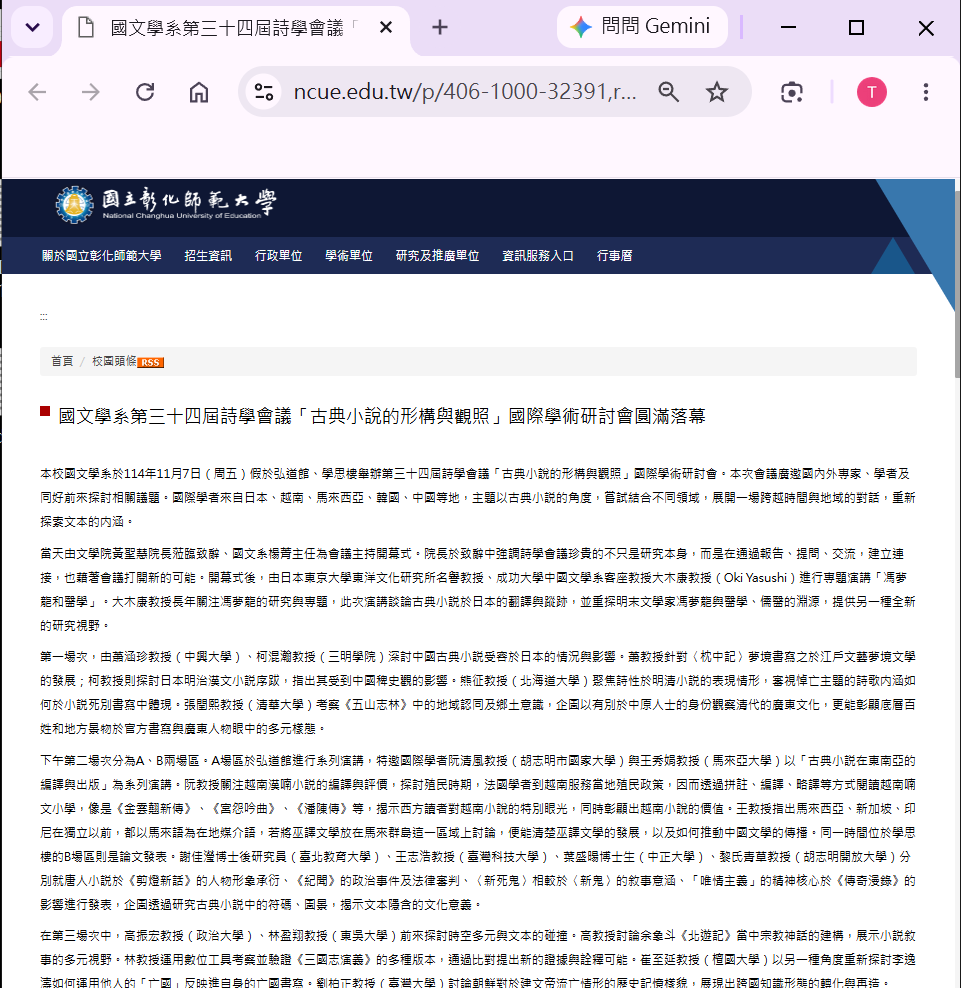
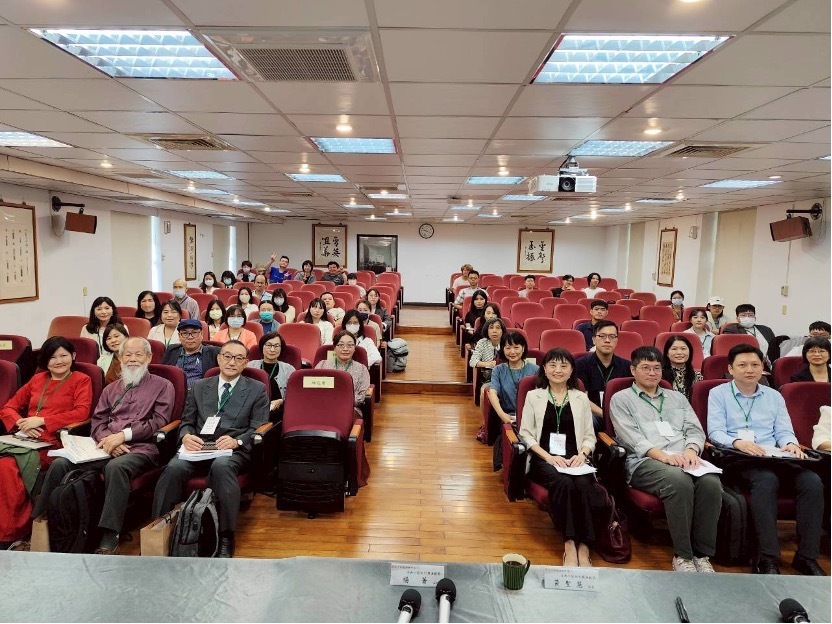
On November 7, 2025, NCUE held the 34th Conference on Poetics: International Symposium on the Formation and Reflection of Classical Chinese Fiction. The scholars from Taiwan, Japan, Vietnam, Malaysia, Korea and elsewhere attended the conference for examining the transnational translation and cultural of classical fiction, demonstrating transformation and reinvention of forms of knowledge. The conference not only fostered scholarly exchange across national and disciplinary boundaries but also, in the spirit of "using new tools to examine old questions", uncovered afresh the plural interpretations and contemporary value of classical literature. The event successfully brought together a substantial body of international scholarly energy. Figure 53 shows the NCUE News item on the event, and Figure 54 demonstrates the photographs from the conference.
NCUE News: https://www.ncue.edu.tw/p/406-1000-32391,r93.php?Lang=zh-tw
(10) Baisha Lecture: "Decision-making in Education Policy and the Planning of Talent Development"
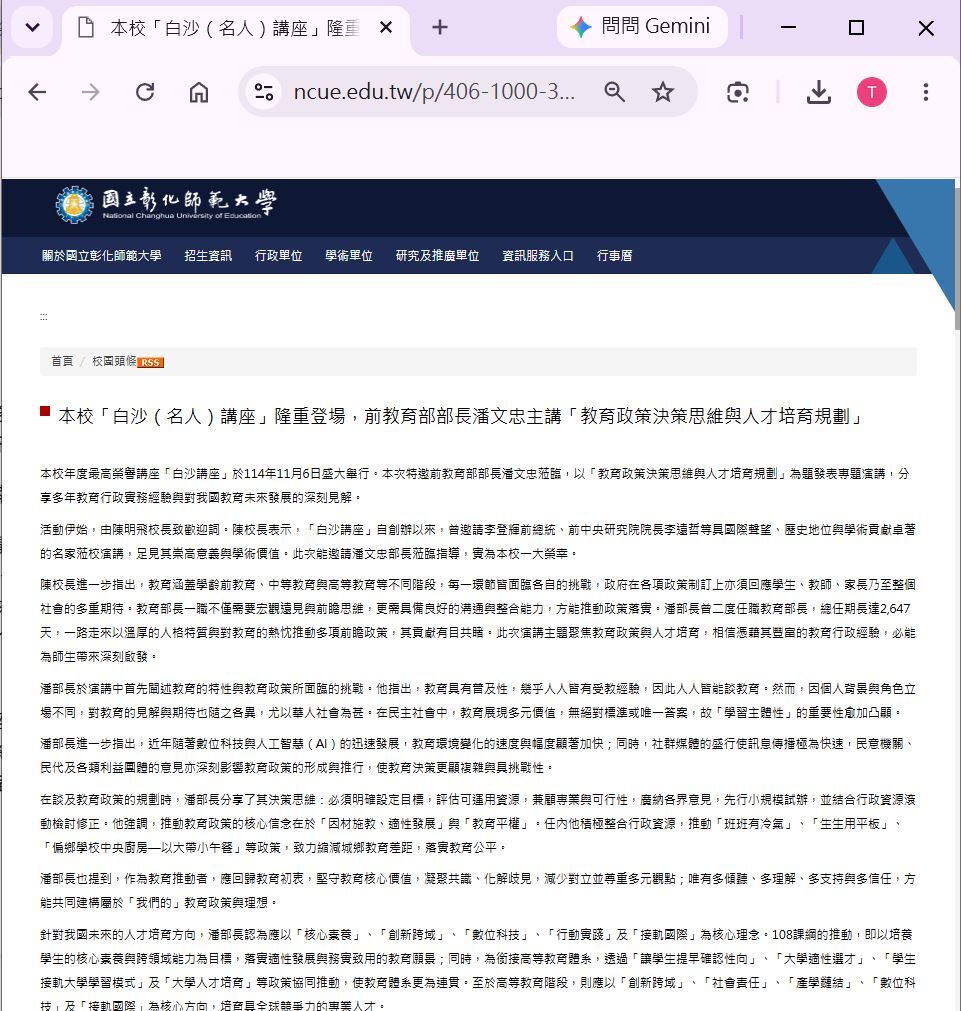
On November, 6, 2025, NCUE held the Baisha Lecture and invited Pan Wen-chung, former Minister of Education, to speak on "Decision-making in education policy and the planning of talent development." The lecture analyzed in depth the challenges of education policy in the age of digital technology and AI. It also stressed that educational equity as a core principle, guiding future talent development toward innovation, interdisciplinary collaboration, and international engagement.
To promote lifelong learning for the public, NCUE opened the lecture not only to faculty and students but also the local community and the public, inviting NCUE alumni, as well as principals and directors of schools at all levels in Changhua County to attend. It was also live-streamed, removing the constraints of physical location. By sharing the resources of a high-level lecture, NCUE successfully connected local educators with wider social networks, giving concrete effect to the SDG 4 goal of promoting lifelong learning for all. Figure 55 shows the NCUE News item on the event and Figure 56 demonstrates the photographs from the activity.
NCUE News: https://www.ncue.edu.tw/p/406-1000-32227,r93.php?Lang=zh-tw
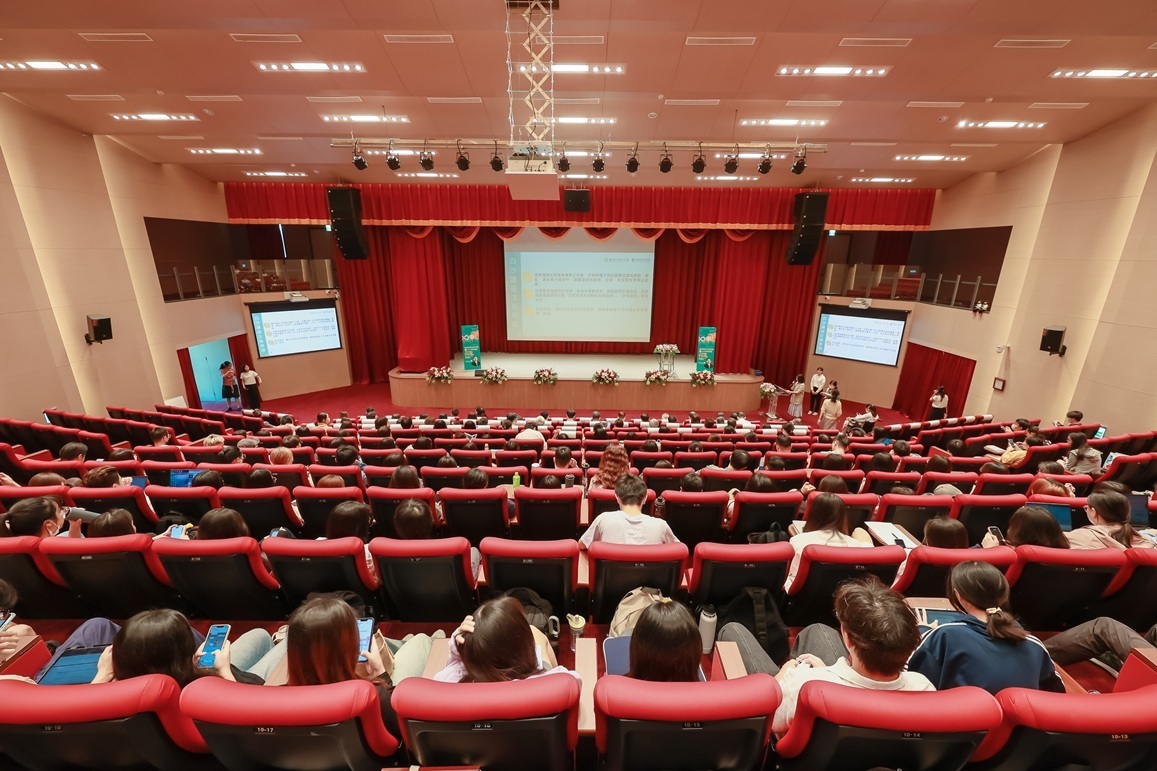
(11) Changhua-Yunlin-Chiayi University Alliance lecture on teaching expertise
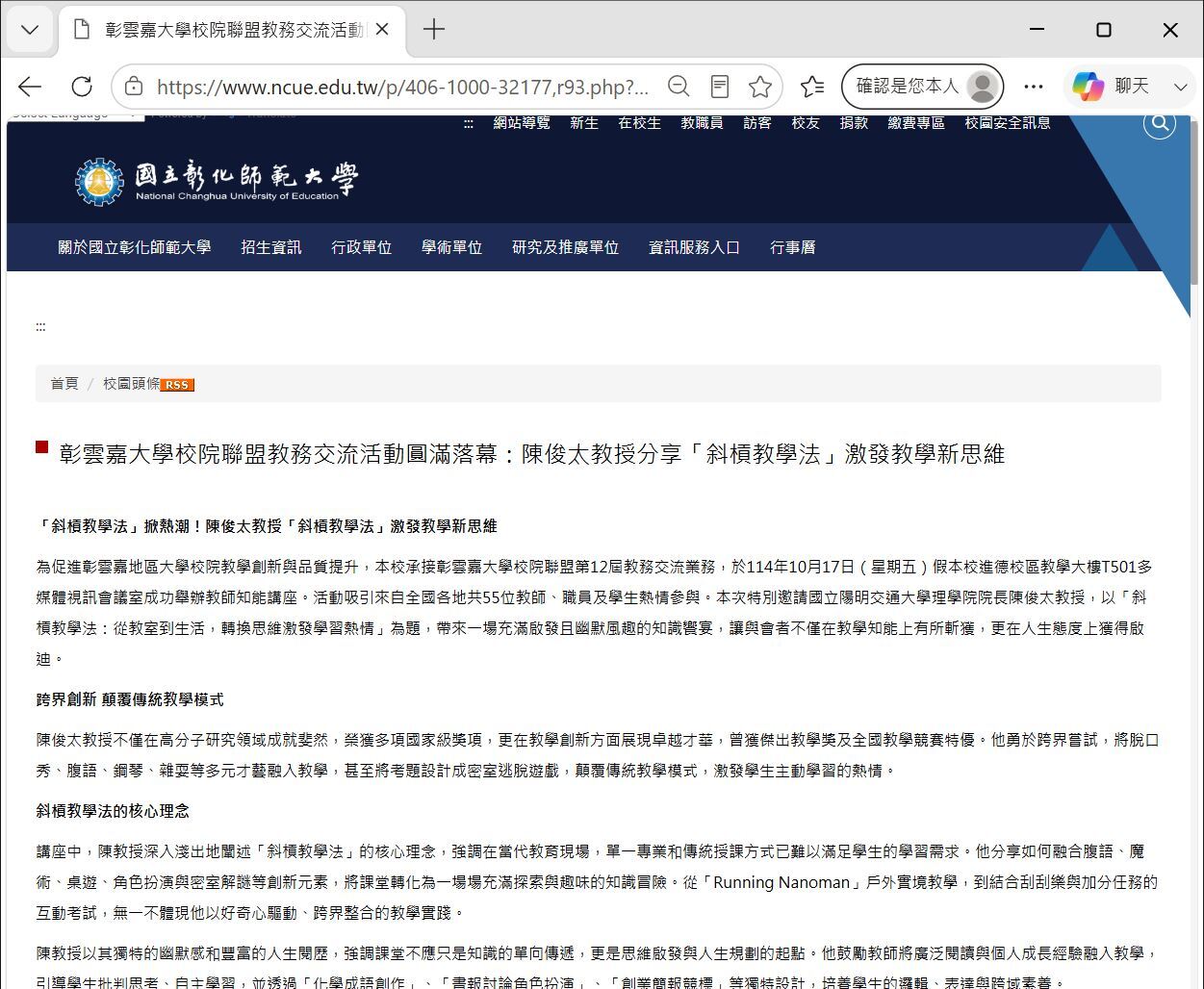
On October 17, 2025, NCUE held a Changhua-Yunlin-Chiayi University Alliance lecture on teaching expertise, inviting Professor Jiun-Tai Chen of National Yang Ming Chiao Tung University to speak on "slash pedagogy" and share how conventional one-way lecturing can be overturned by building cross-disciplinary elements such as magic, board games, role play, and escape-room puzzles into instructional design. Drawing on extensive practical experience, Professor Chen demonstrated how cross-boundary integration can stimulate students' active exploration and critical thinking, turning the classroom into an engaging adventure in knowledge.
The event attracted 55 educators and students from institutions across Taiwan. By holding open lectures on teaching expertise and sharing high-level teaching resources, NCUE not only promoted the professional growth and the exchange of experience of teachers across institutions in the region, but also fulfilled its university social responsibility, injecting innovative momentum into raising the overall quality of higher education in Taiwan and advancing lifelong learning. Figure 57 shows the NCUE News item on the event, and Figure 58 demonstrates photographs from it.
NCUE News: https://www.ncue.edu.tw/p/406-1000-32177,r93.php?Lang=zh-tw
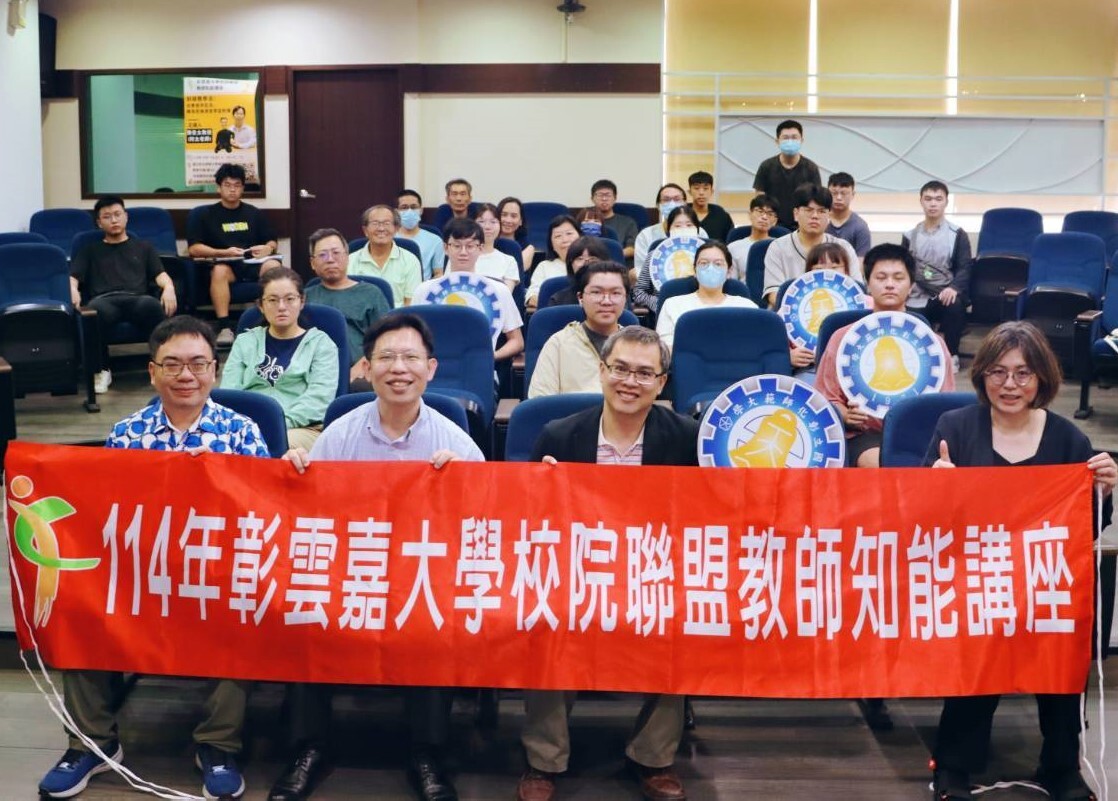
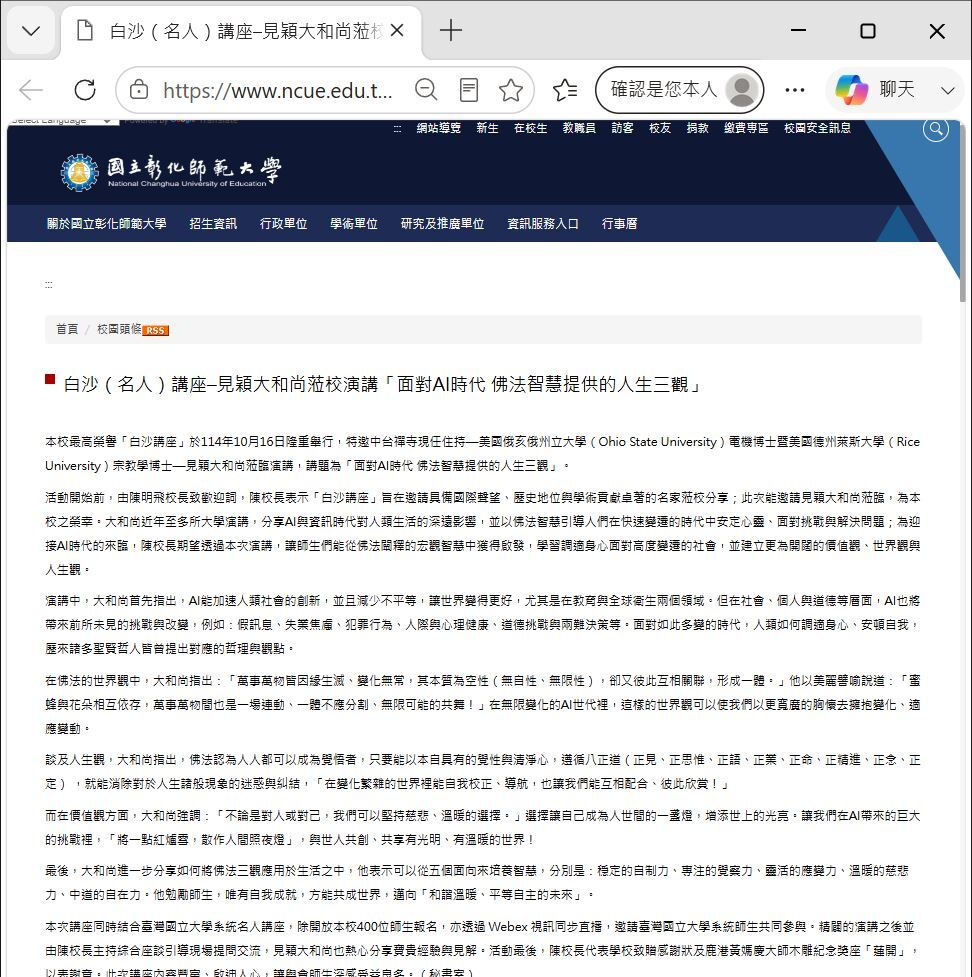
(12) Baisha Lecture - "Facing the age of AI: three worldviews offered by Buddhist wisdom"
On October 16, 2025, NCUE held the Baisha Lecture, inviting Venerable Jian-Ying, Abbot of Chung Tai Chan Monastery, to speak on "Facing the age of AI: three worldviews on life offered by Buddhist wisdom". The lecture examined in depth the impact AI technology brought to human society, ethics, and psychology. It drew on philosophical and Buddhist perspectives to help the audience find inner steadiness amid rapid technological changes and develop the core wisdom of awareness and adaptability.
To put the sharing of educational resources into practice and promote lifelong learning, the lecture was not only open to NCUE faculty and students in person but also, drawing on the resources of the National University System of Taiwan, live-streamed via Webex. Through technology, it removed the constraints of campus location, extending a high-level lecture rich in humanistic concern and philosophical reflection to a wider audience, and offering a high-quality distance learning channel to people at other institutions and beyond. Figure 59 shows the NCUE News item on the event and Figure 60 demonstrates photographs from it.
NCUE News: https://www.ncue.edu.tw/p/406-1000-31807,r93.php?Lang=zh-tw

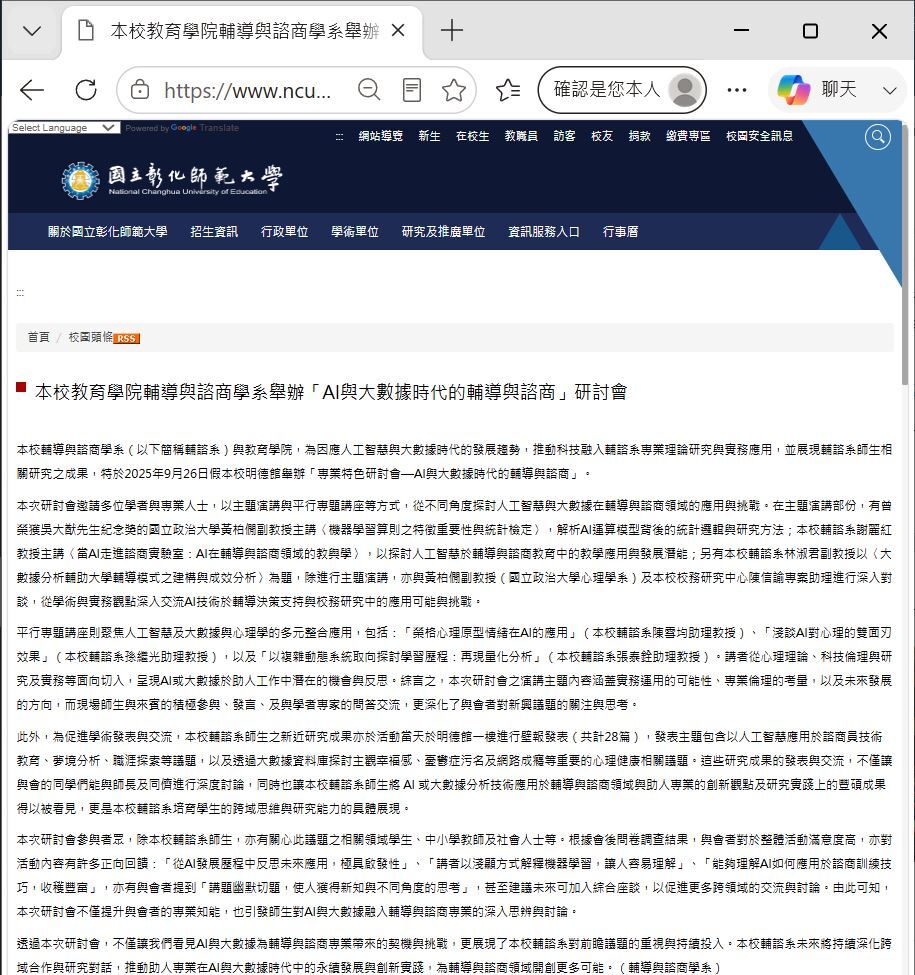
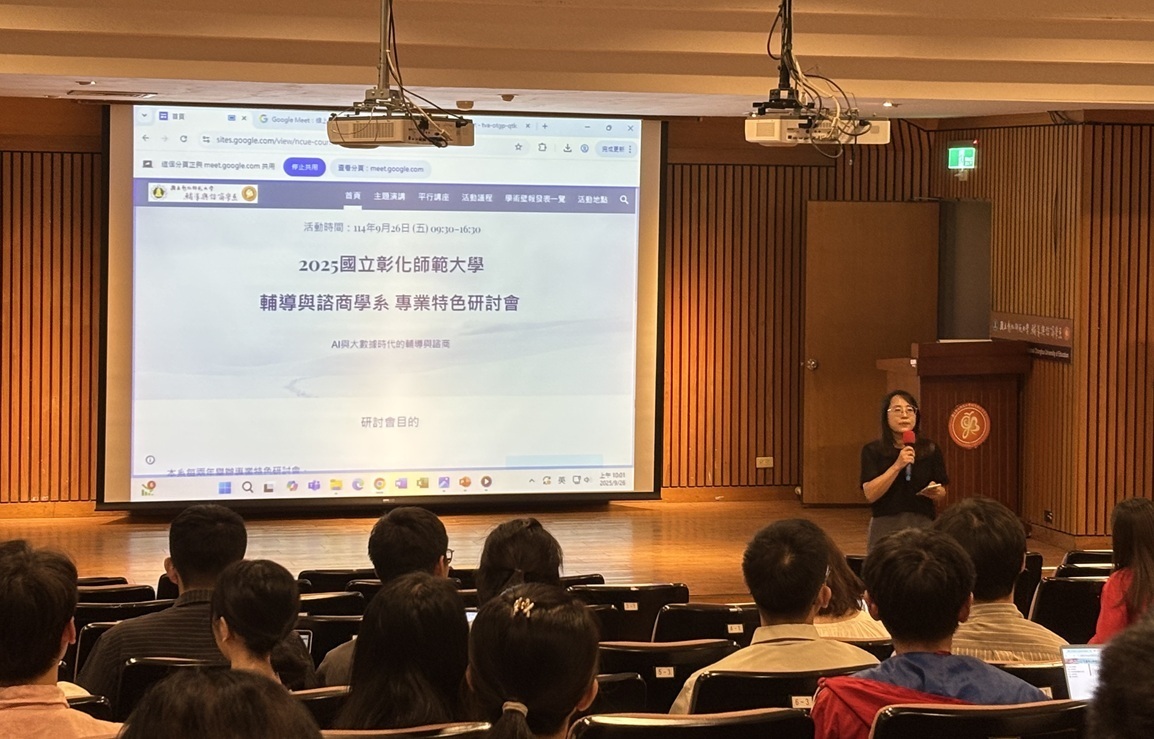
(13) Guidance and Counselling in the Age of AI and Big Data Conference
On September 26, 2025, NCUE's Department of Guidance and Counseling held a conference on "Guidance and counselling in the age of AI and big data", examining the applications and challenges of artificial intelligence and big data in the helping professions. The conference invited scholars and experts to give keynote talks on machine learning, AI-assisted counselling instruction, big data analysis, and technology ethics. A number of cross-disciplinary applied studies were presented.
To fulfill commitment to open educational resources, the conference served not only as a platform for scholarly exchange within NCUE, but was also fully open to the public, attracting students from other institutions, elementary and secondary school teachers, and the general public. By sharing forward-looking practical applications combining AI with psychological guidance, NCUE provided educators in the region and the community with a high-quality channel for professional development, deepened the connection between the university and society, and gave concrete effect to its goal of promoting lifelong learning among the public. Figure 61 shows the NCUE News item on the event and Figure 62 demonstrates photographs from it.
NCUE News: https://www.ncue.edu.tw/p/406-1000-31756,r93.php?Lang=zh-tw
(14) Academic conference on educational trends and school management
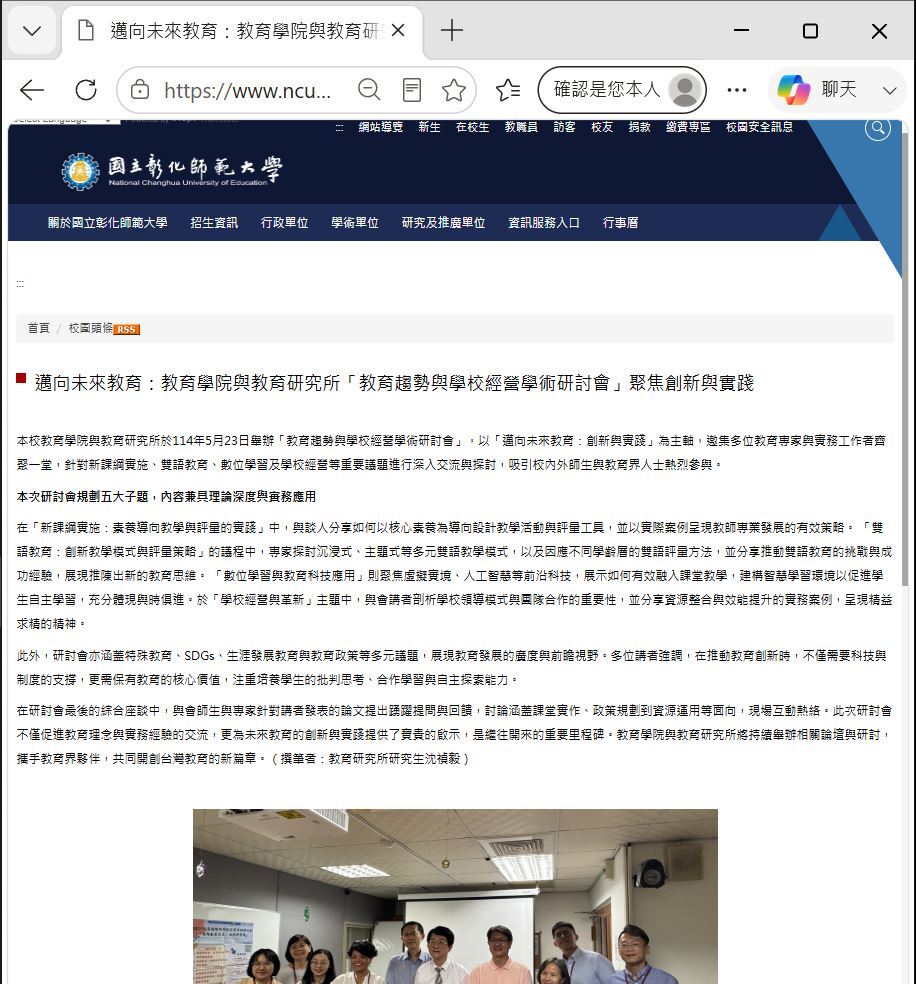
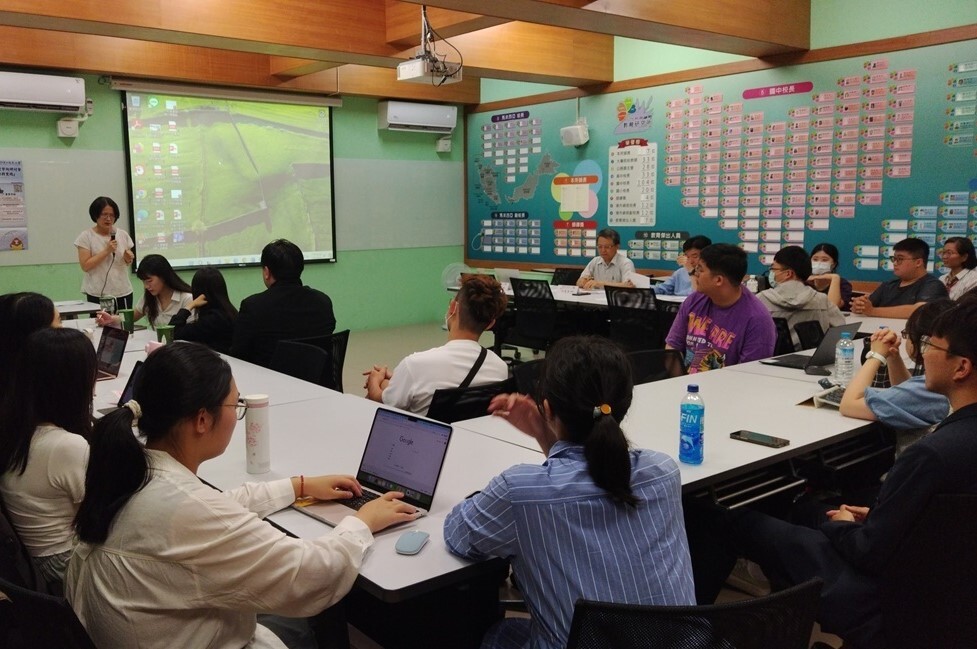
On May 23, 2025, NCUE's College of Education and Graduate Institute of Education held an academic conference on educational trends and school management under the theme "Towards the future education: innovation and practice", bringing together education specialists and practitioners for discussion and exchange. The event attracted many educators from outside NCUE as well as the general public.
The conference provided educators from outside the university with a high-quality channel for lifelong learning and professional development. It focused on five sub-themes covering competency-based instruction under the new curriculum guidelines, innovative models of bilingual education, the application of AI and digital educational technology, and innovation in school management. It also examined forward-looking topics such as special education and the SDGs. Through in-depth communication and the sharing of academic resources, NCUE helped local elementary and secondary school teachers as well as the public keep abreast of the latest developments in education and the application of technology, successfully linking the university with the wider education community and demonstrating significant impact in promoting lifelong learning and raising the quality of education in the region. Figure 63 shows the NCUE News item on the event and Figure 64 demonstrates photographs from it.
NCUE News: https://www.ncue.edu.tw/p/406-1000-31309,r93.php?Lang=zh-tw
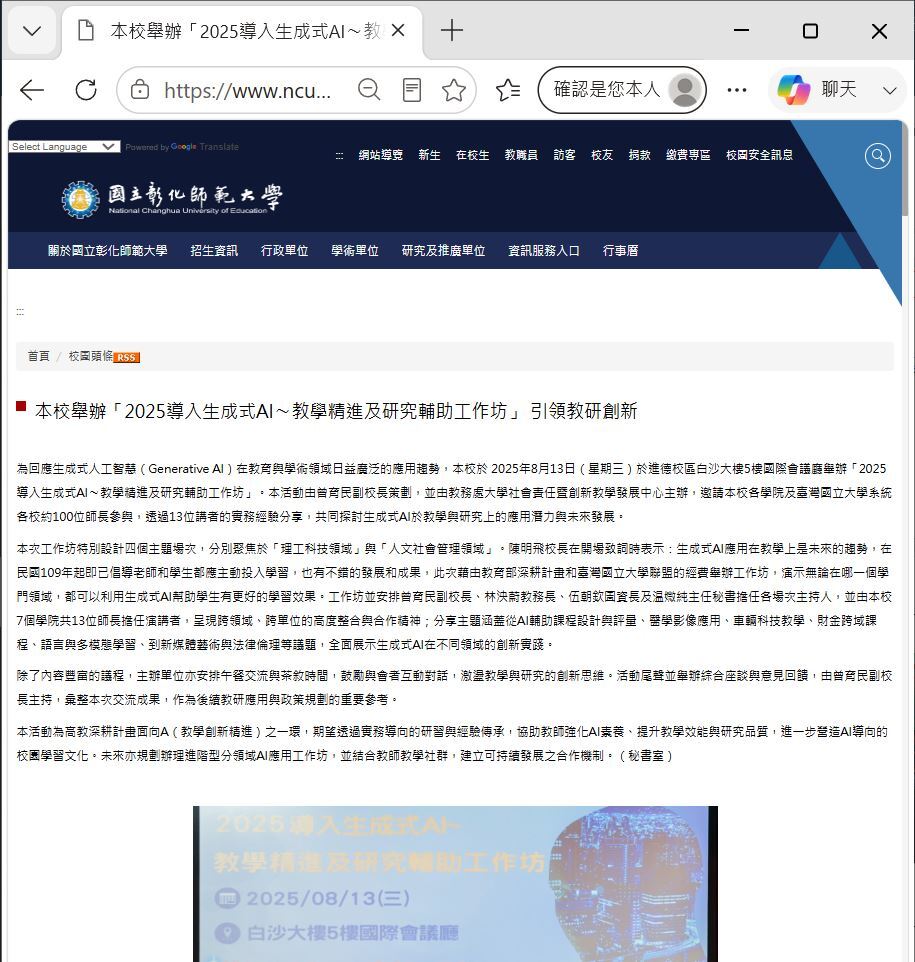
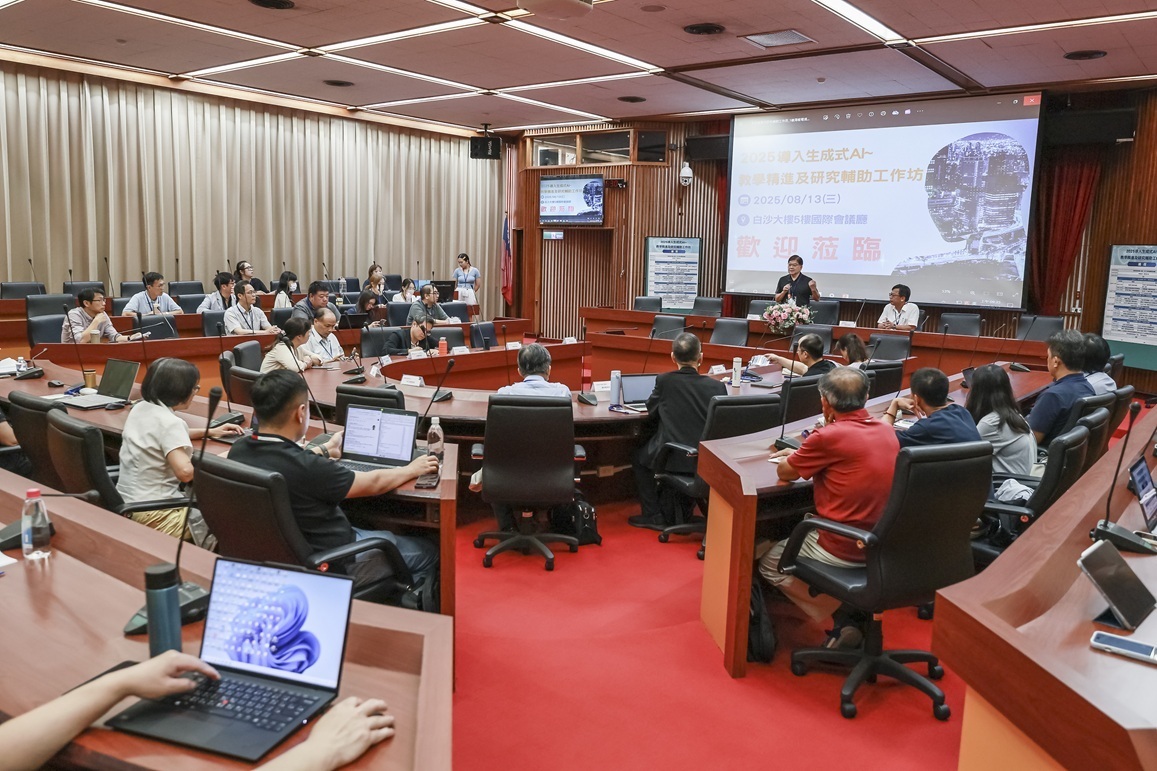
(15) 2025 Workshop on Introducing Generative AI: Enhancing Teaching and Supporting Research
On August 13, 2025, NCUE held “2025 Workshop on Introducing Generative AI: Enhancing Teaching and Supporting Research”, examining forward-looking applications of generative AI in education and scholarship. To put the sharing of educational resources into practice, the event provided professional development not only for NCUE faculty but also for faculty from all institutions in the National University System of Taiwan.
The workshop brought together 13 speakers from a range of disciplines across two main strands, including area of science and technology and area of humanities and social management, to share practical applications of AI in course design, medical imaging, cross-disciplinary work in finance, and new media art. Through opening the training event to a range of institutions, NCUE shared the results of its work on AI-enabled innovative teaching without reserve, helping educators from other institutions strengthen their AI literacy. This not only contributed to raising the quality of higher education in Taiwan but fulfilled the university's social responsibility in building an open and mutually beneficial professional network for lifelong learning. Figure 65 shows the NCUE News item on the event and Figure 66 demonstrates photographs from it.
NCUE News: https://www.ncue.edu.tw/p/406-1000-31244,r93.php?Lang=zh-tw
(16) The 25th IEEE International Conference on Advanced Learning Technologies
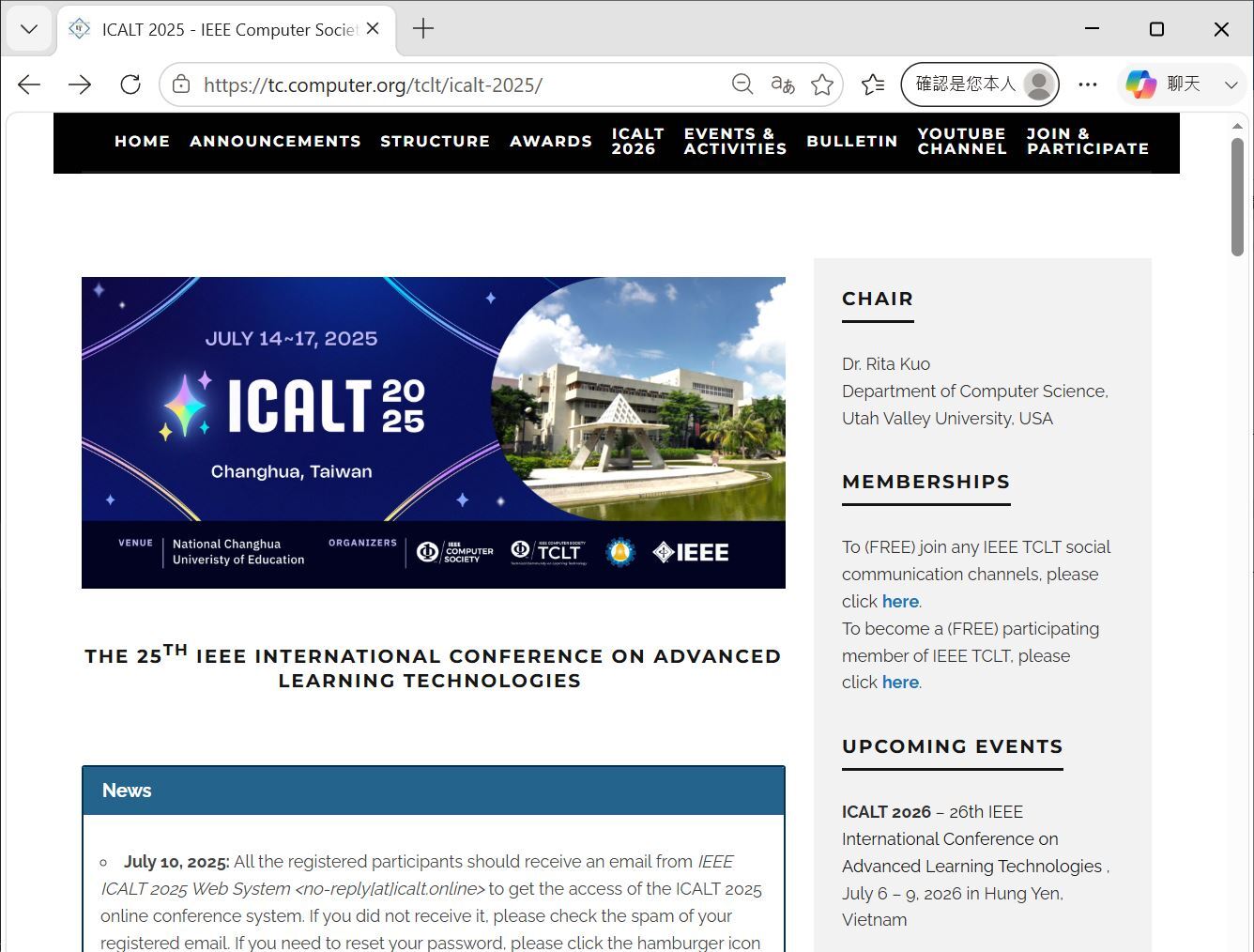
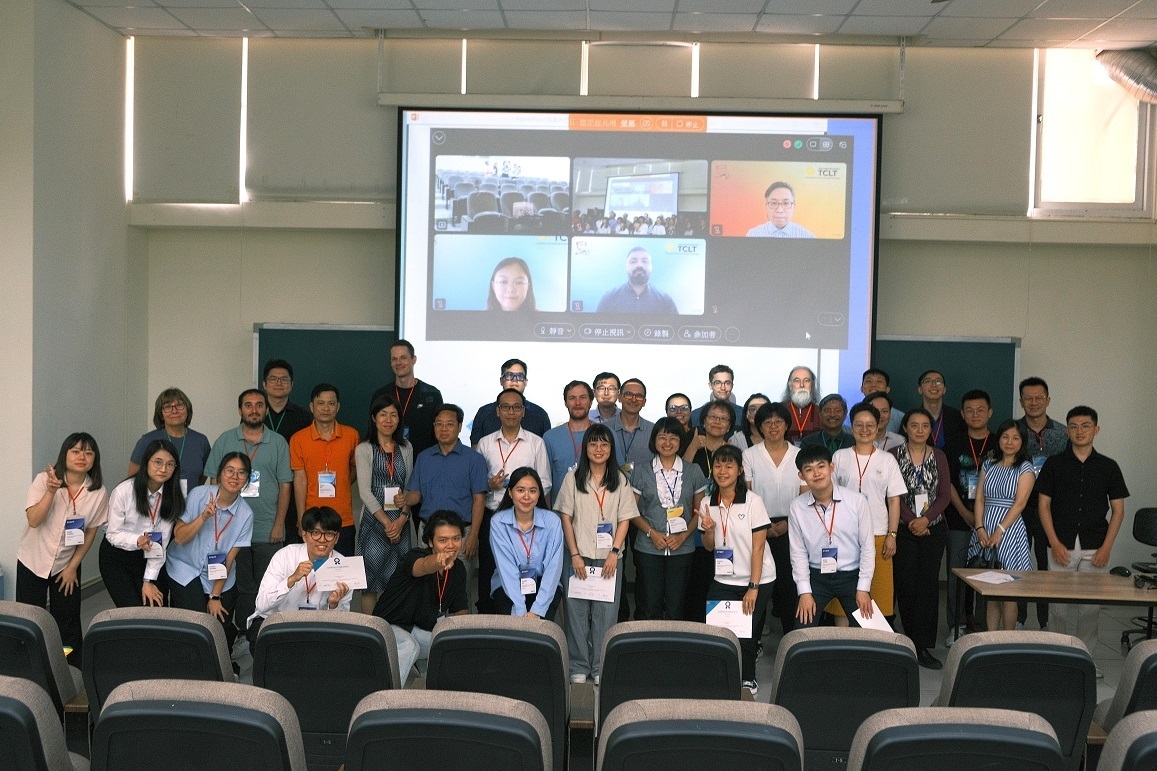
From July 14 to 17, 2025, NCUE hosted ICALT 2025, a landmark international conference in the field of learning technologies, focusing on applying emerging technologies, such as artificial intelligence, big data, and virtual reality, to education. To put opening educational resources into practice, the conference adopted a hybrid format combining in-person and simultaneous online participation, removing geographical constraints and providing a high-quality platform for lifelong learning and professional development for educators and professionals worldwide from outside NCUE.
The conference attracted more than a hundred specialists from around the world, covering 14 major themes together with cross-disciplinary forums such as "Women in Engineering" and "Emerging Educational Technologies". Through hosting an open international conference, NCUE shared the latest applied research on how technology is reshaping education, and helped educational practitioners worldwide strengthen their digital literacy. This not only promoted the exchange of knowledge across borders but also successfully built an internationalised professional network for lifelong learning, demonstrating NCUE's global impact in advancing sustainable development in education. Figure 67 shows the conference's official website and Figure 68 demonstrates photographs from the event.
ICALT official website: https://tc.computer.org/tclt/icalt-2025/
NCUE News: https://www.ncue.edu.tw/p/406-1000-31093,r93.php?Lang=zh-tw
(17) When Special Education Meets Artificial Intelligence: 2025 Special Education Conference
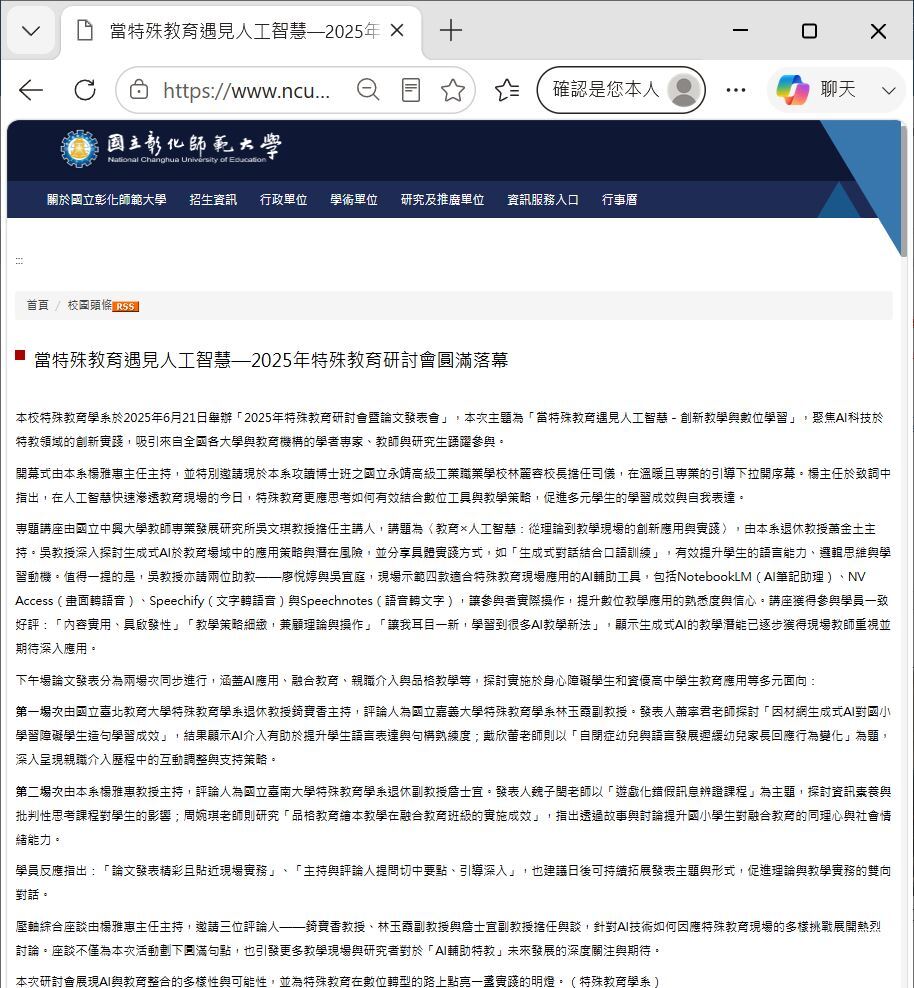
On June 21, 2025, NCUE's Department of Special Education held the 2025 Special Education Conference on the theme "When Special Education Meets Artificial Intelligence", examining innovative applications of AI technology in the field of special education. To put the sharing of educational resources into practice, the event was fully open to the public and attracted specialists and scholars from educational institutions as well as front-line elementary and secondary school teachers across Taiwan.
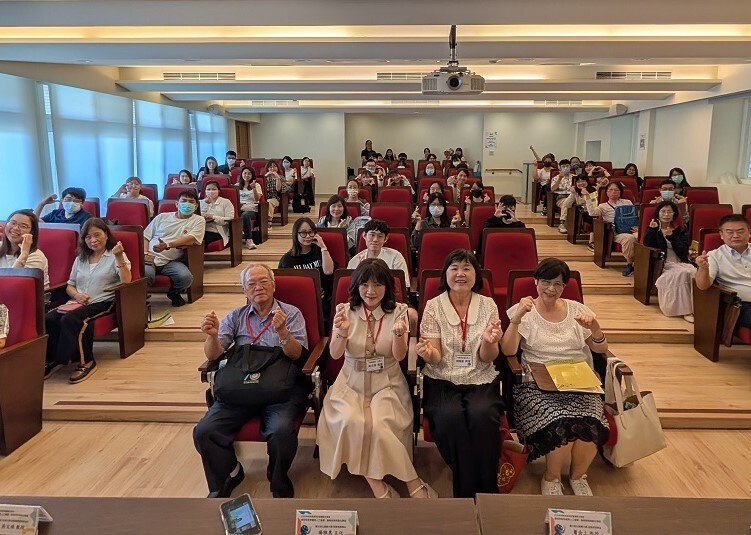
The conference not only invited specialists to examine the educational applications of generative AI, but also arranged hands-on sessions demonstrating a range of digital support tools, such as NotebookLM and speech transcription, to help special education practitioners from outside NCUE strengthen their digital teaching skills. A number of practice-based papers on inclusive education and AI applications were also presented. By holding an open academic conference and sharing forward-looking special education resources without reserve, NCUE provided front-line teachers nationwide with a high-quality channel for lifelong learning, demonstrating its social impact in driving digital transformation in special education. Figure 69 shows the NCUE News item on the event and Figure 70 demonstrates photographs from it.
NCUE News: https://www.ncue.edu.tw/p/406-1000-31011,r93.php?Lang=zh-tw