
SDG 8.2.4
SDG 8.2.4 Employment policy modern slavery
NCUE upholds the United Nations’ 2030 Agenda for Sustainable Development, particularly SDG 8, and vigorously promotes "Employment Policy and Prevention of Forced Labor and Human Trafficking Policy," firmly opposing forced labor, modern slavery, human trafficking, and child labor. NCUE's employment and procurement processes incorporate human rights protection and labor standards to ensure working conditions comply with legal requirements and international labor standards. Furthermore, NCUE strengthens the awareness and responsibility of faculty, students, and external partners regarding these issues through new employee education and training, supply chain review mechanisms, and regular advocacy, jointly creating a campus environment that respects human rights, labor justice, and sustainable development. NCUE has also established relevant regulations to implement the protection of workers' rights and obligations, as described below:
1. The government of the Republic of China has formulated the Human Trafficking Prevention Act to prevent human trafficking and protect the rights and interests of victims. In accordance with this law, NCUE is committed to preventing forced labor, modern slavery, or human trafficking.
2. NCUE strictly complies with the provisions of Article 44 of the Labor Standards Act and confirms that we do not employ any child laborers aged 15 or older but under 16 to work on campus.
3. The regulations stated below have been clearly formulated by NCUE, and their contents are regularly revised to keep up with the times. No illegal acts such as forced labor or slavery are permitted, and the rights and obligations of workers are guaranteed, as shown in Table 1.
| Regulation | Summary of key articles |
|---|---|
| Working Rules for Contracted Personnel in National Changhua University of Education |
Article 3, Paragraph 2: When NCUE recruits or dismisses appointed personnel, it must not be based on race, class, language, ideology, religion, political affiliation/party, place of origin, place of birth, gender, sexual orientation, age, marital status, appearance, facial features, physical or mental disabilities, or previous union membership. If express provisions are made under other laws, those provisions shall be complied with. |
|
Article 16, Paragraph 1: The normal working hours of appointed personnel shall not exceed eight hours per day and forty hours per week. |
|
|
Article 19, Paragraph 1: Extension of working hours due to operational necessities, employees are required to obtain prior approval from the University President or in accordance with NCUE’s overtime control guidelines by filling out an overtime performance record for approval after the fact. Overtime work shall be calculated on an hourly basis, with a maximum limit of 4 hours per person per day and 12 hours on holidays, with a monthly limit of 46 hours in general. When a unit supervisor assigns any appointed personnel in advance to continue working beyond normal working hours due to business needs (hereinafter referred to as ‘overtime’), it will be recorded on an hourly basis. For each personnel, the overtime limit is four hours daily, eight hours on a public holiday, and 46 hours monthly. |
|
|
Article 20, Paragraph 1: Appointed staff may extend their working hours or work on their rest days. Depending on the choice that they have agreed upon in advance, they may have compensatory days off in-lieu or receive overtime pay according to the standards stated below. |
|
| Key points for the protection of labor rights and grants for NCUE students who are part-time assistants |
Paragraph 12: NCUE has clearly stipulated the rights and obligations of both employees and employers to improve the management system for part-time assistants and to promote harmony and consensus on campus. Both parties shall comply with the Labor Standards Act and its rules for implementation, the key points stated here, and the related laws and regulations. |
|
Paragraph 17: The timing for work, number of working hours, and the working location of part-time assistants shall be negotiated and agreed upon by the employer and employee. … When an application for overtime is submitted, the employer and employee shall negotiate whether the latter shall have compensatory time off in-lieu or receive overtime pay. |
|
|
Paragraph 18: Part-time assistants are granted leave in accordance with the Labor Standards Act, Regulations on Leave-Taking of Workers, Act of Gender Equality in Employment, and the relevant regulations of NCUE. |
4. Relevant laws and regulations, as shown in Figure 1, 2, 3, and 4:
(1) Human Trafficking Prevention Act (Figure 1)
https://law.moj.gov.tw/ENG/LawClass/LawAll.aspx?pcode=D0080177
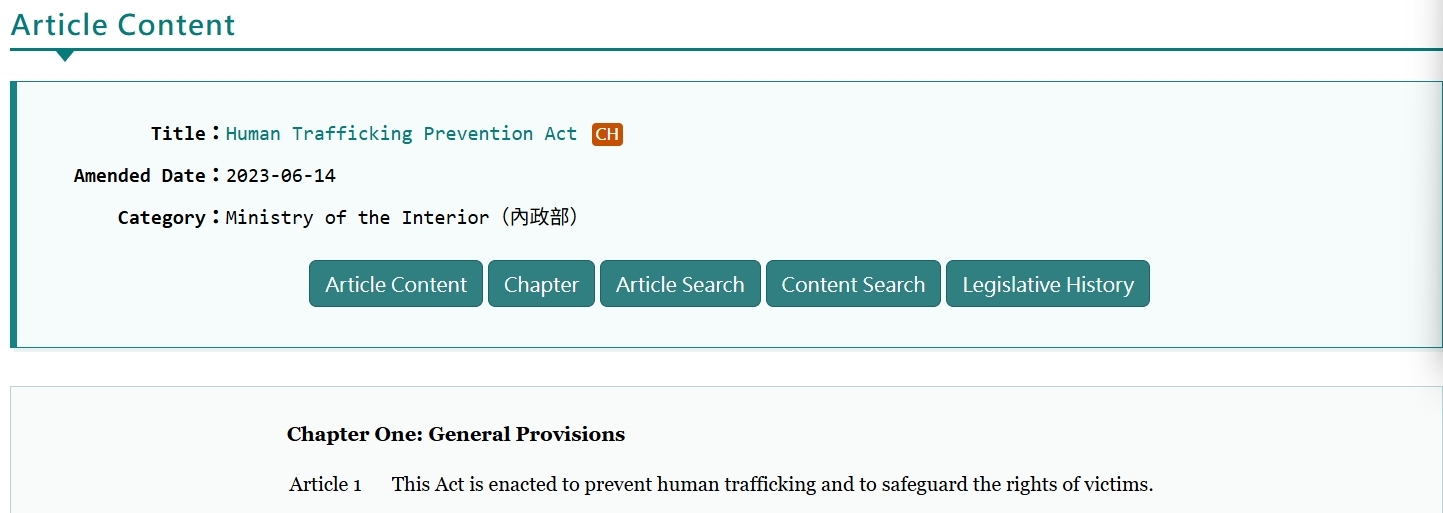
Figure 1. Human Trafficking Prevention Act
(2) Labor Standards Act (Figure 2)
https://law.moj.gov.tw/ENG/LawClass/LawAll.aspx?pcode=N0030001
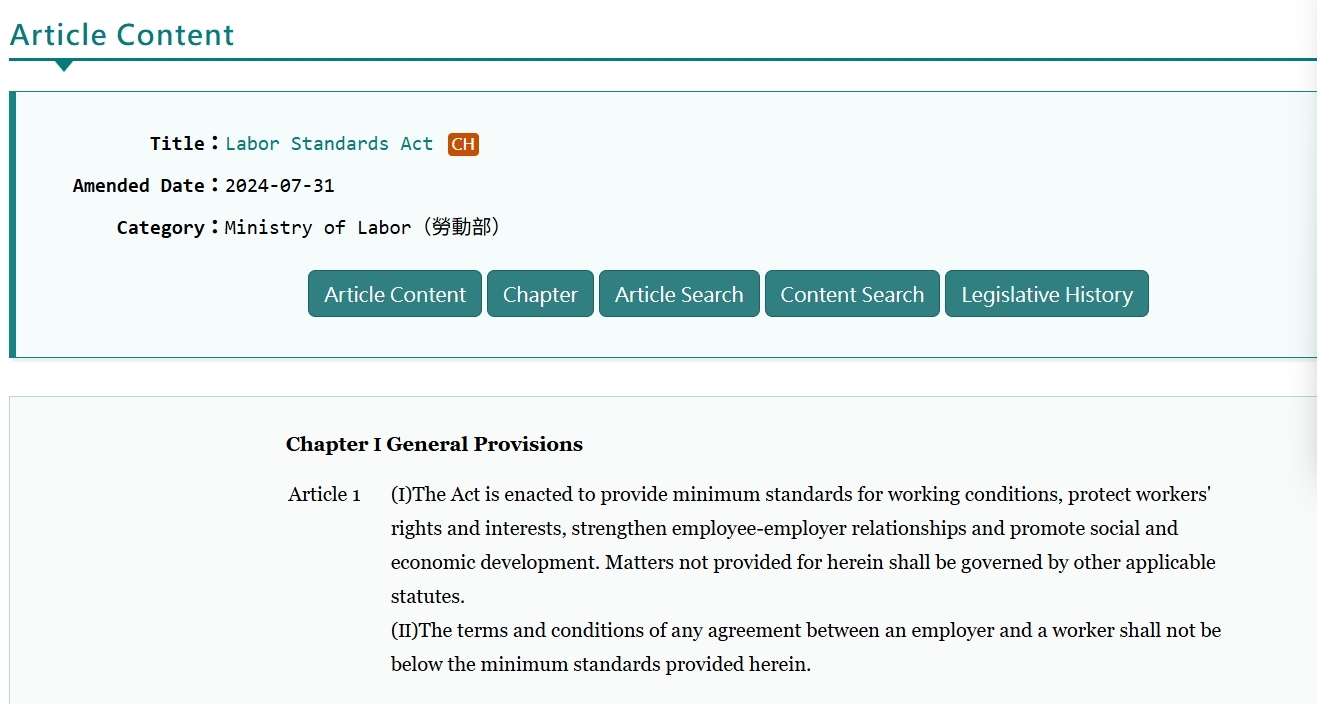
Figure 2. Labor Standards Act
(3) Working Rules for Contracted Personnel in National Changhua University of Education (Figure 3): https://personnelweb.ncue.edu.tw/var/file/1/1001/img/869/320050482.pdf
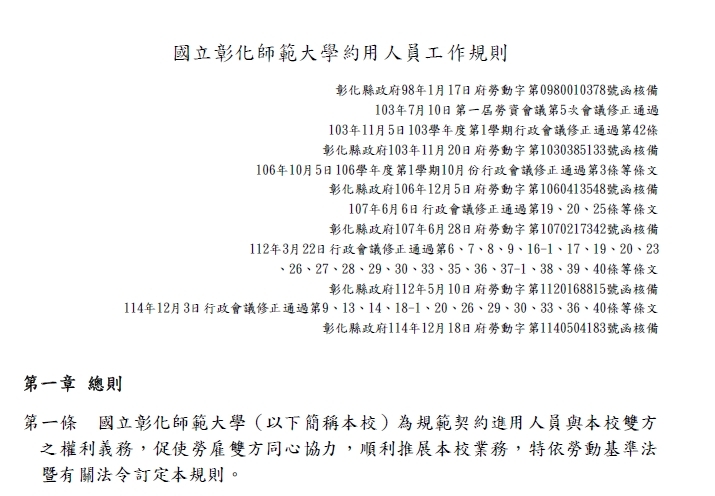
Figure 3. Working Rules for Contracted Personnel in National Changhua University of Education
(4) Key points for the protection of labor rights and grants for NCUE students who are part-time assistants (Figure 4)
https://personnelweb.ncue.edu.tw/var/file/1/1001/img/881/992835963.docx
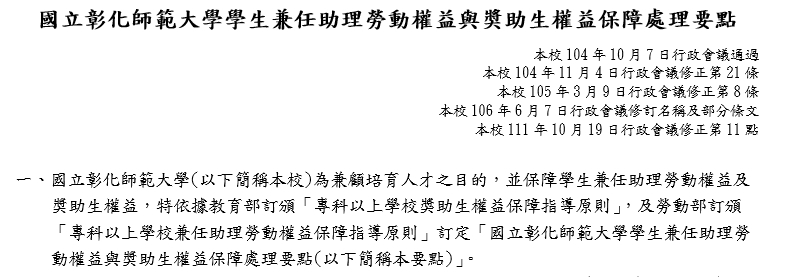
Figure 4. Key points for the protection of labor rights and grants for NCUE students who are part-time assistants