
SDG 1.3.3
SDG 1.3.3 Low-income student support
To support students from low-income households in finishing their studies, NCUE provides additional support to students to increase their income and respect their equal rights to education. The measures include the following:
1. NCUE integrates resources to provide support in areas such as finances, accommodations, food, education, and daily life.
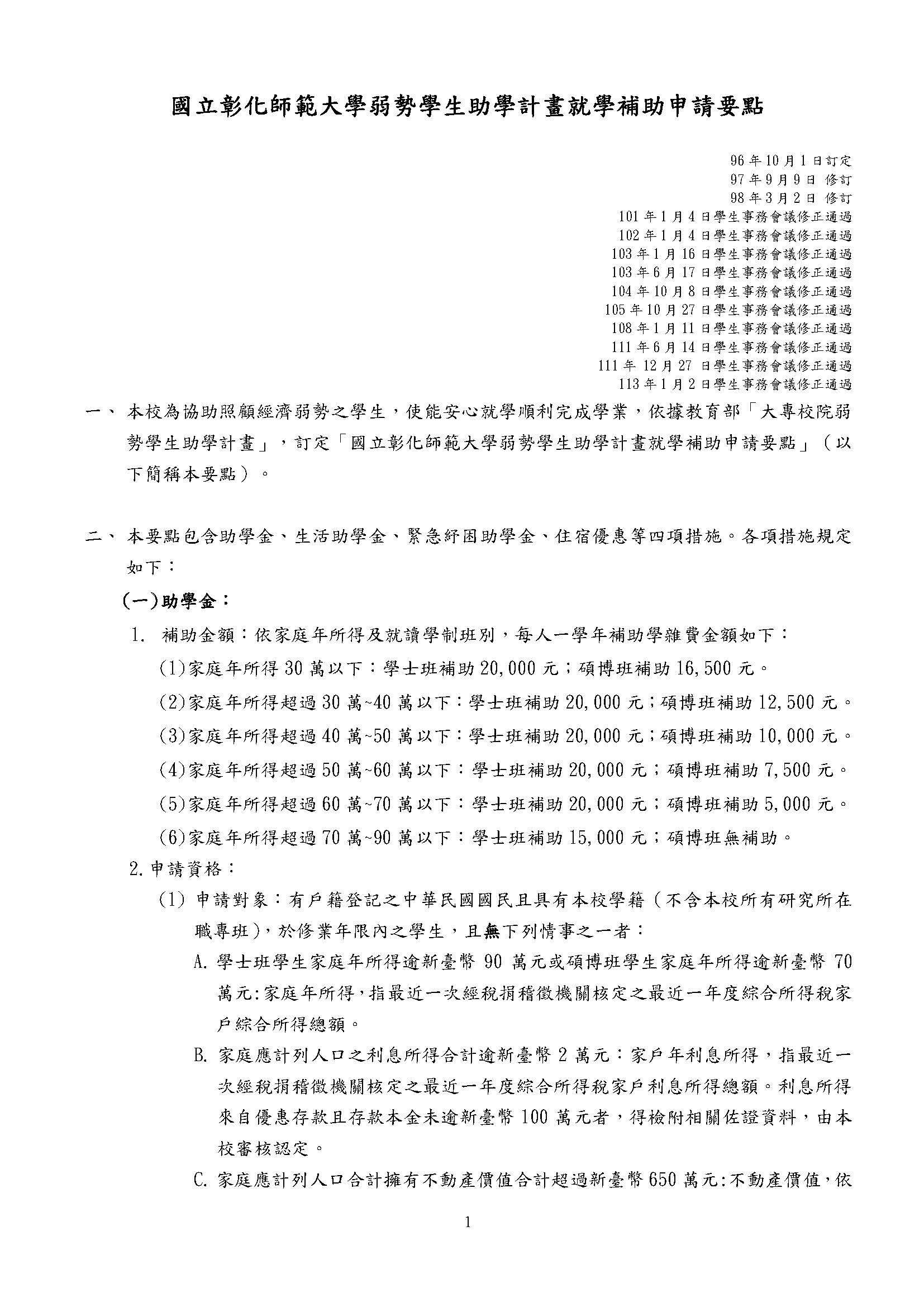
In compliance with the Ministry of Education's Assistance Program for Disadvantaged University and College Students, NCUE has formulated the "Guidelines for the National Changhua University of Education's Disadvantaged Student Assistance Program for Educational Subsidies" (Figure 1), implementing financial aid initiatives including tuition grants, living grants, emergency relief grants, and accommodation benefits, to actively provide support measures for low-income and economically disadvantaged students to assist them in successfully completing their university studies. The comprehensive plan is as follows:
(1) Economic and Accommodation Support (Table 1):
(a) Tuition Grants: Financial aid is provided at six different levels, based on annual household income and the student's enrolled program/level, ranging from NTD$5,000 to NTD$20,000 per student per academic year, to alleviate the financial burden of students.
(b) Living Grants: Students with an annual household income below NTD$300,000, whose academic performance ranks in the top 50% of their class, and whose conduct grade reaches 85 points or above are eligible to receive a monthly living grant of NTD$3,000, disbursed for four months per semester.
(c) Emergency Relief Grants: Students experiencing severe financial or personal distress that impacts their studies due to serious injury or illness, the loss of a family member, major family crises, or exceptional emergencies are eligible to apply. Assistance is evaluated based on the student's actual circumstances, capped at a maximum grant of NT$30,000.
(d) Accommodation Benefits: On-Campus Accommodation: Free on-campus accommodation is provided to students from low-income households, and priority is given to students from middle-to-low-income households for on-campus accommodation (including summer and winter breaks). Additionally, the Ministry of Education has implemented the "Subsidy Program for On-Campus Accommodation for University Students" since February 2024. In principle, subsidies of up to NTD$5,000 per semester are provided to each on-campus resident student, while students from low-income or middle-to-low-income households (referred to as economically disadvantaged students) and, starting from 2026, children of active-duty military personnel, are eligible for subsidies of up to NTD$7,000 per semester. On-campus resident students do not need to apply for subsidies separately. The university pre-deducts the corresponding subsidy amount based on student status (general/economically disadvantaged/children of active-duty military personnel) from the accommodation fee when dormitory residents apply for housing. Students only need to pay the remaining accommodation fee after the subsidy is applied. However, if the accommodation fee is lower than the maximum subsidy amount, the subsidy will cover the cost in full, exempting the students from paying the accommodation fee.
| Item | Number of Recipients | Amount (NTD) |
|---|---|---|
| Tuition Grants | 826 | 25,997,026 |
| Living Grants | 26 | 312,000 |
| Emergency Relief Grants | 15 | 746,000 |
| Housing Grants | 5,138 | 25,585,775 |
| Total | 6,005 | 52,640,801 |
(2) Food, Education, and Daily Life Support (Table 2):
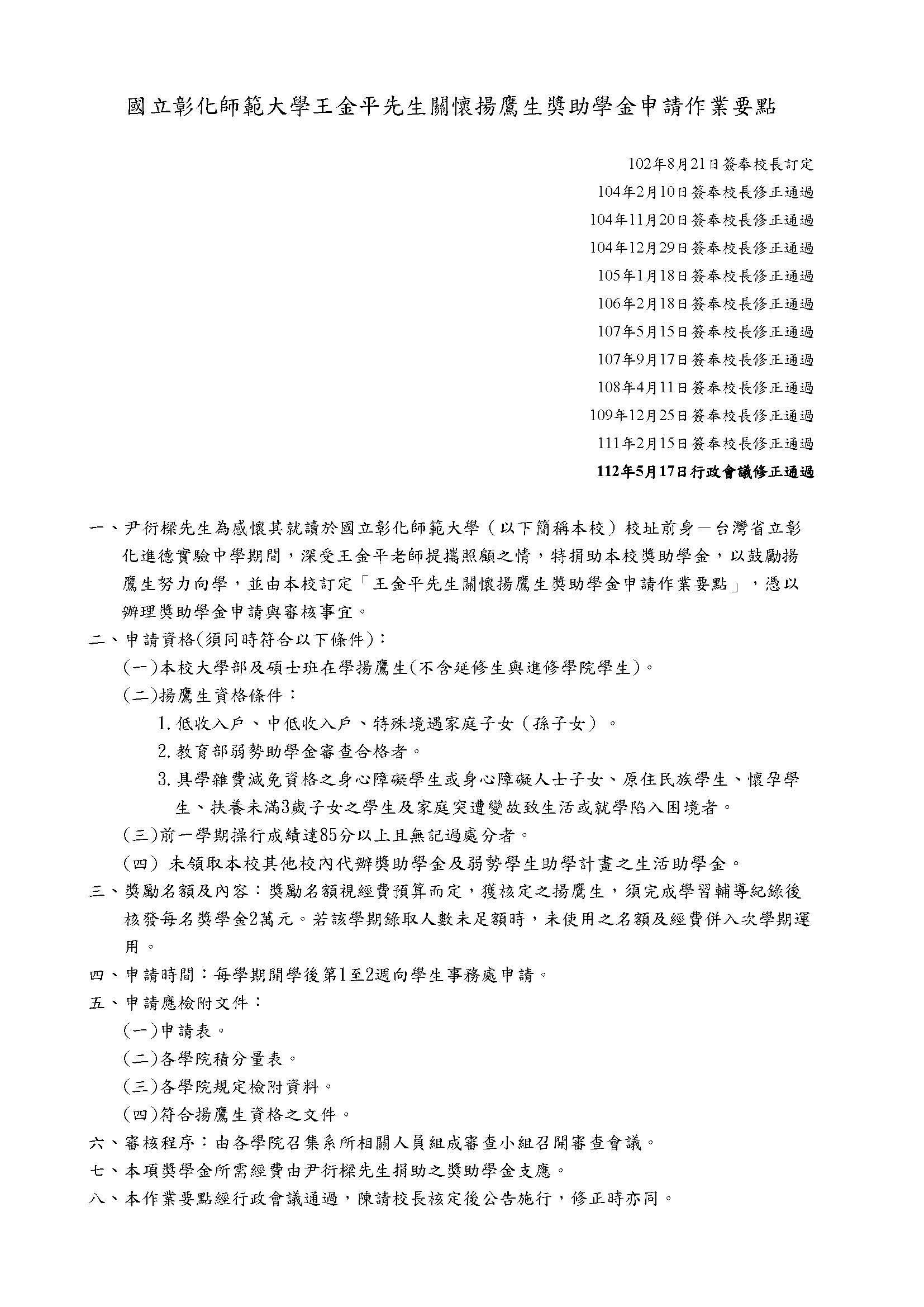
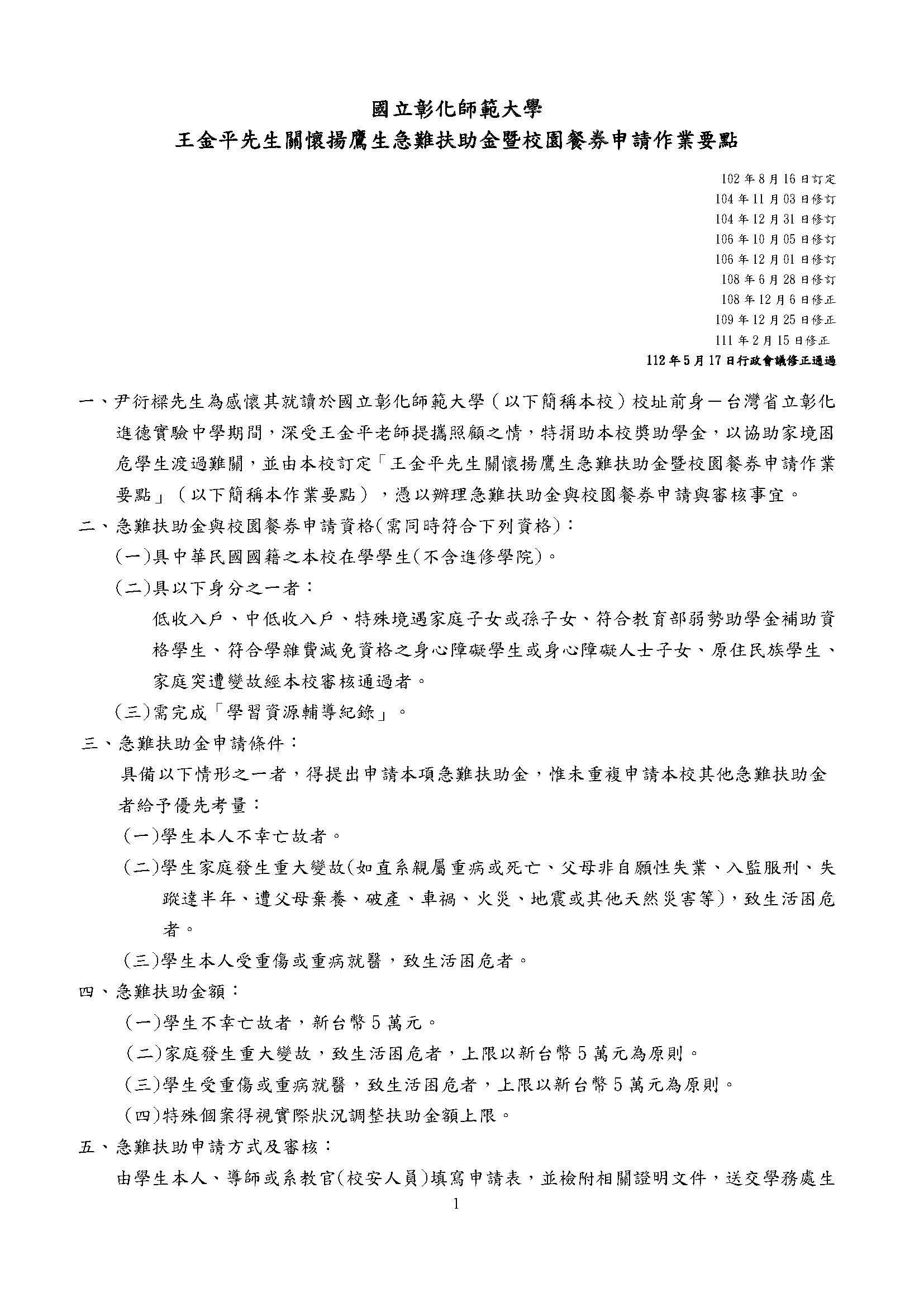
(a) The Soaring Eagles Mr. Jin-Pyng Wang Scholarship (Figure 2): In the first semester, 20 students will be awarded, and in the second semester, 25 students will be awarded. Approved Soaring Eagles students must complete the learning guidance records before receiving a scholarship of NTD$20,000.
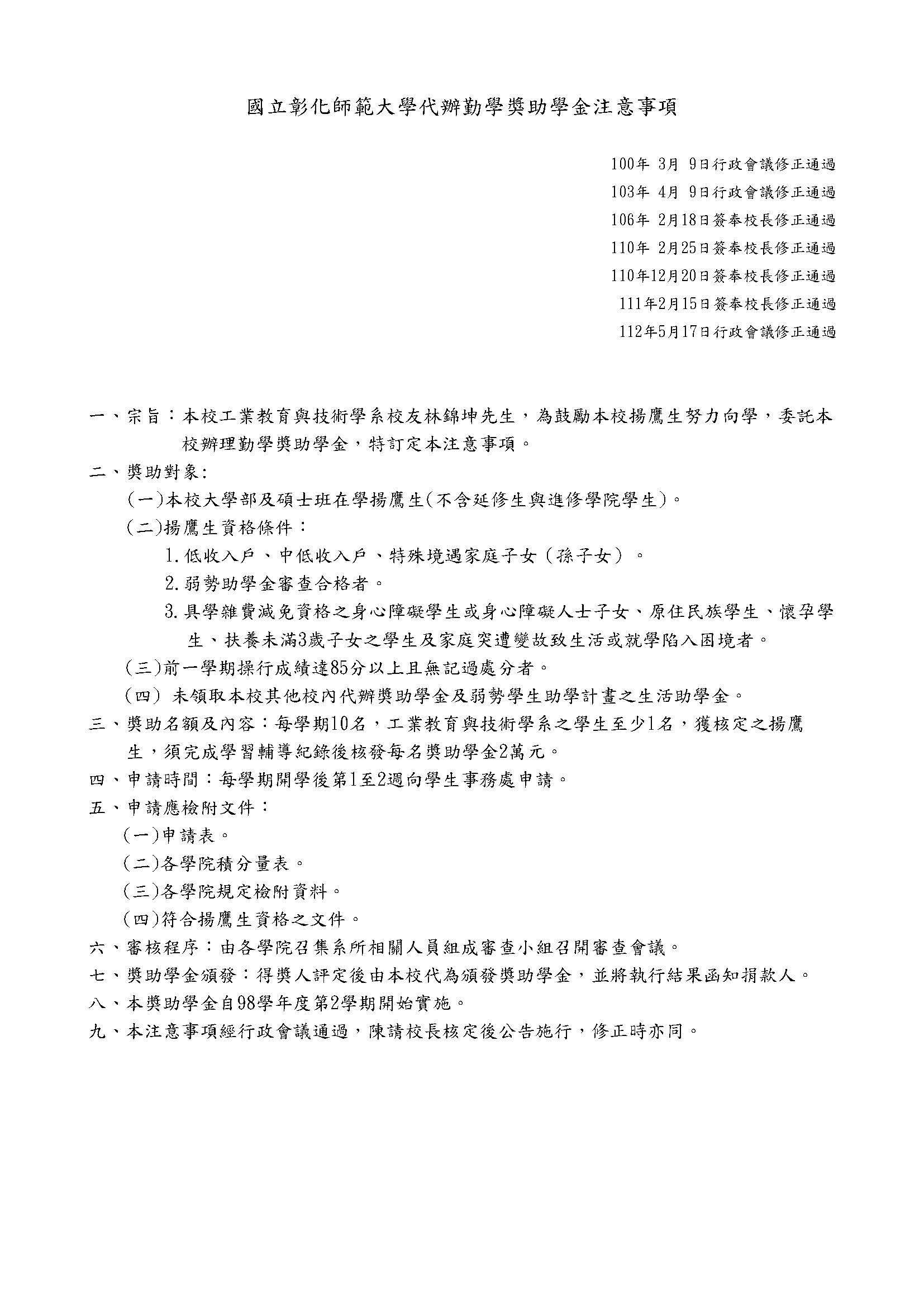
(b) Diligence Scholarship (Figure 3): Ten scholarships are awarded per semester, with at least one recipient from the Department of Industrial Education and Technology. Approved Soaring Eagles Students are required to complete learning guidance records before receiving a scholarship of NTD$20,000.
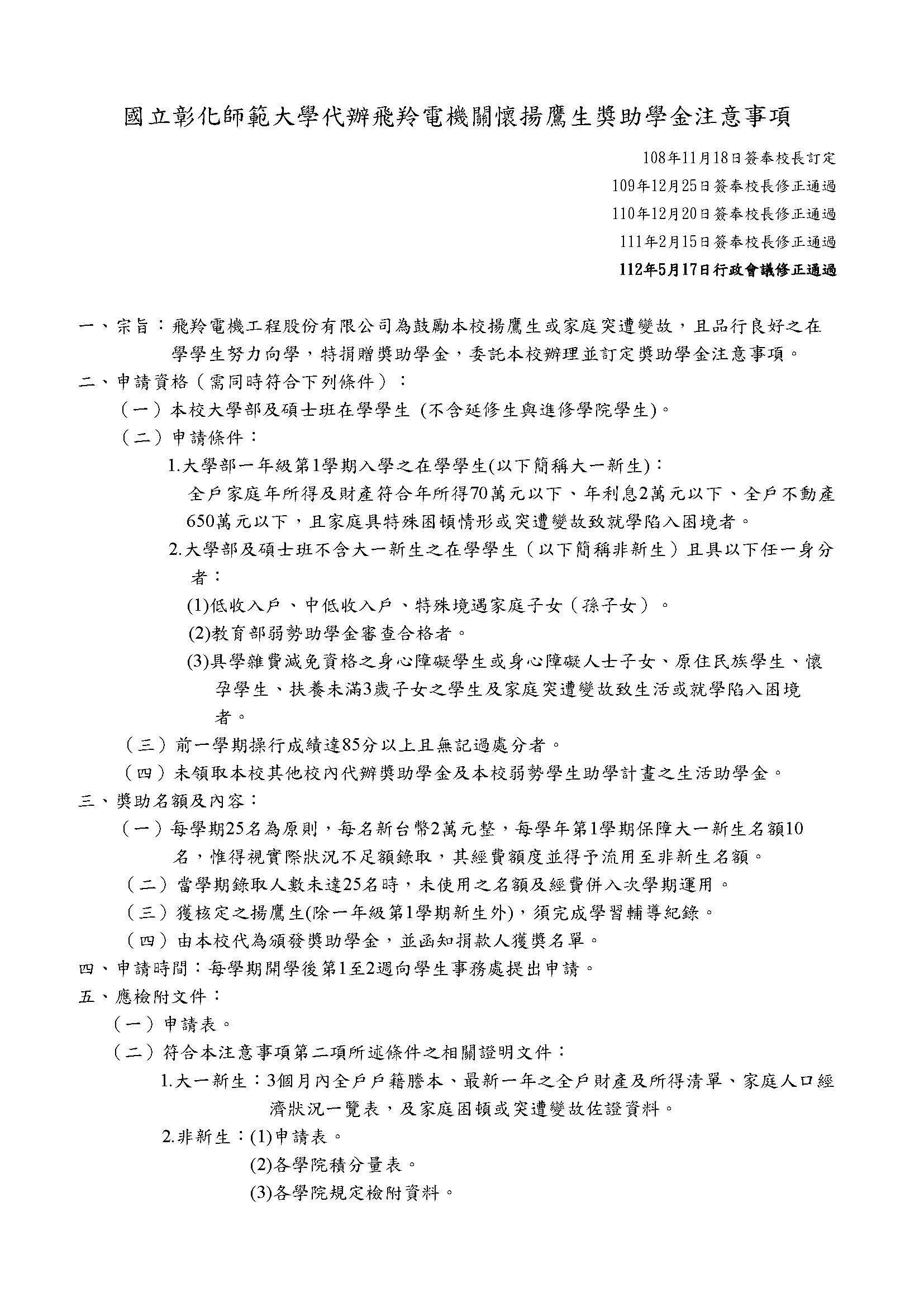
(c) Fei-Ling Electrical Engineering Company Scholarship and Bursary for The Soaring Eagles Students(Figure 4): In principle, up to 25 students will be awarded per semester, with each receiving NTD$20,000. In the first semester of each academic year, 10 quotas are reserved for freshmen.
(d) Mr. Jin-pyng Wang Emergency Aid and University Meal Coupons for The Soaring Eagles Students (Figure 5): Intended for students in unfavorable living conditions due to the unfortunate demise of a student, significant family crises, severe injuries, or critical illness requiring medical treatment. The maximum aid amount is set at NTD$50,000. The maximum aid amount may be adjusted for special cases. Students are eligible to apply for university meal coupons, with a maximum distribution of 40 coupons per application and up to 160 coupons per student per semester.
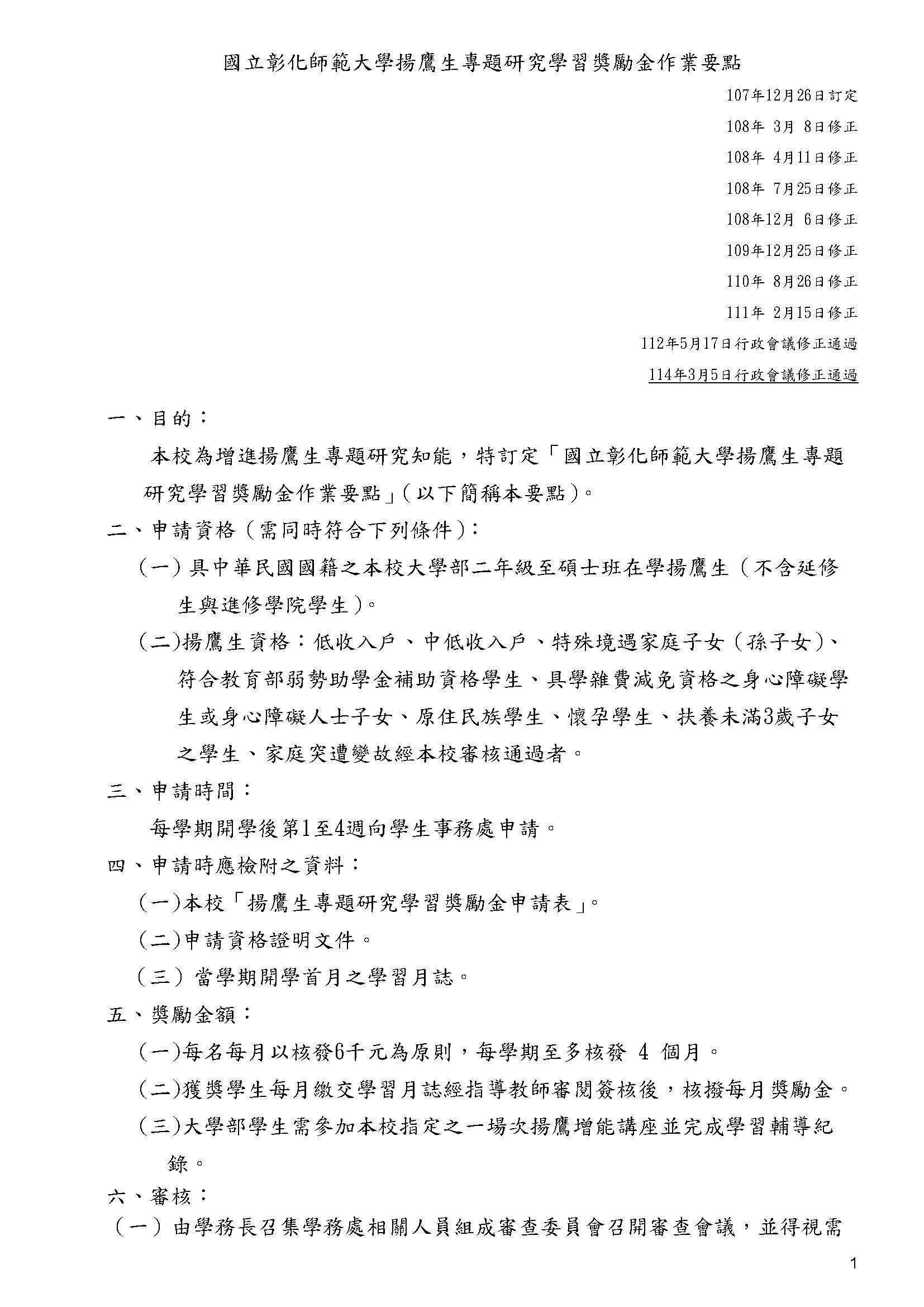
(e) The Soaring Eagles Students' Research Project Learning Incentive Grants (Figure 6): A monthly reward of NT$6,000 is disbursed, for a maximum of 4 months per semester. Approved Soaring Eagles students are required to complete learning journals, attend designated lectures, and complete guidance records.
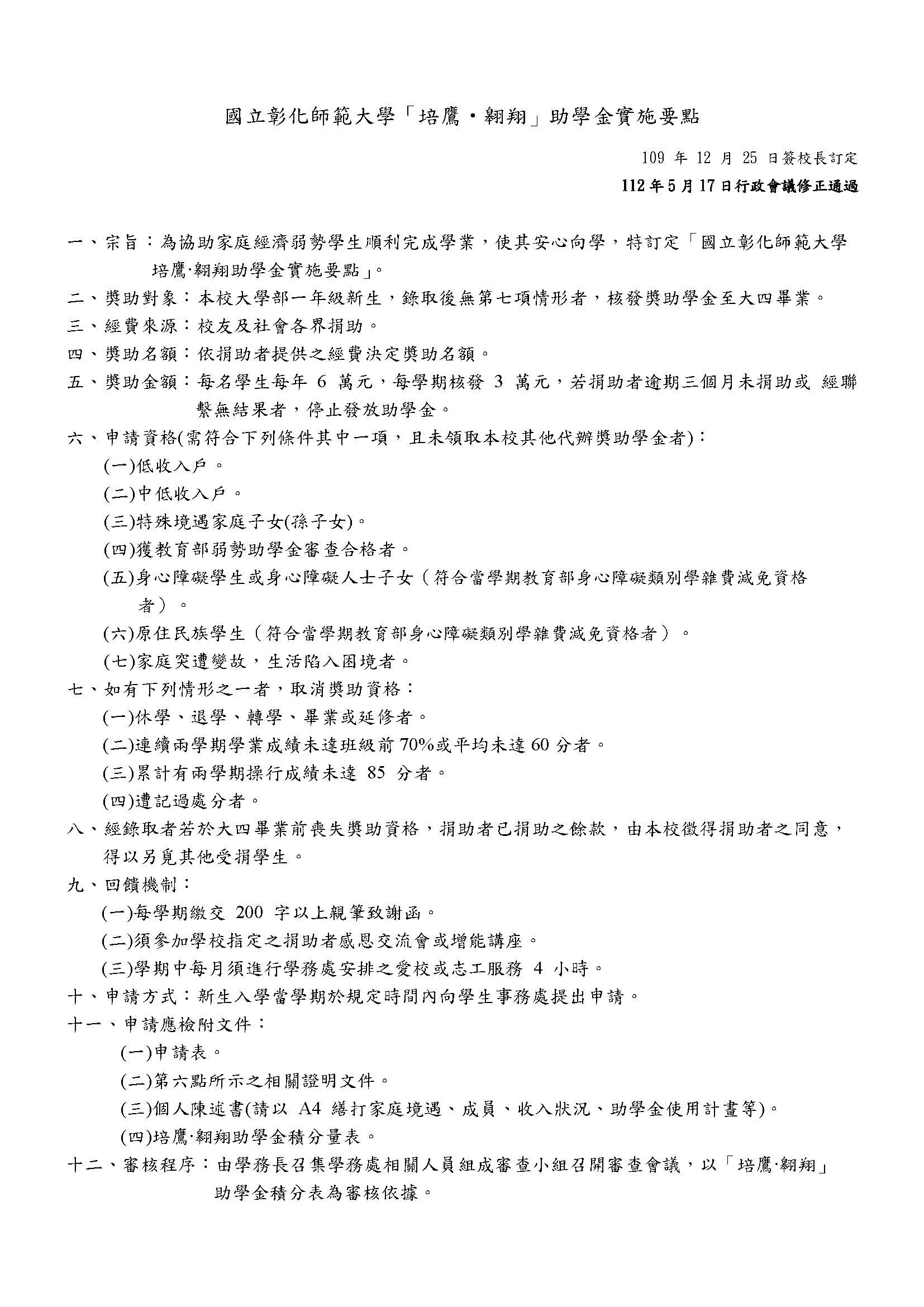
(f) The Soaring Eagles Grants (Figure 7): The grants are awarded to undergraduate freshmen and continue until their fourth year of study. Each student receives an annual grant of NTD$60,000, disbursed in two installments of NTD$30,000 per semester. If a donor fails to make the contribution within three months or cannot be contacted, the grant disbursement will be suspended.
| Item |
2024 Second semester of 2023 to First semester of 2024 |
2025 Second semester of 2024 to First semester of 2025 |
||
|---|---|---|---|---|
| Number of Students | Amount (NTD) | Number of Students | Amount (NTD) | |
| Notice for the Application of Mr. Jin-pyng Wang Scholarship for The Soaring Eagles Students of the National Changhua University of Education | 45 | 900,000 | 45 | 900,000 |
| Notice for the Scholarship and Subsidies for Diligent and Economically Disadvantaged Students Entrusted to the National Changhua University of Education | 20 | 400,000 | 20 | 400,000 |
| Notice for the Fei-Ling Electrical Engineering Company Scholarship and Bursary for The Soaring Eagles Students Entrusted to National Changhua University of Education | 50 | 1,0000,000 | 50 | 1,0000,000 |
| Notice for the Application of the National Changhua University of Education Mr. Jin-pyng Wang Emergency Aid and University Meal Vouchers for Eagle Rising Students | 108 | 1,054,000 | 178 | 1,160,800 |
| Guidelines for Soaring Eagles Student Research Project Learning Incentive Grants at National Changhua University of Education | - | - | 45 | 1,056,000 |
| The Soaring Eagles Grant Implementation Guidelines of the National Changhua University of Education | 12 | 360,000 | 16 | 480,000 |
| Total | 235 | 3,714,000 | 354 | 4,996,800 |
2. NCUE implements assistance measures from various units on the campus to help economically disadvantaged students move towards a better future.
All departments, the Office of Student Affairs, and the Student Counseling and Guidance Center provide other relevant assistance measures, including the following: project fund empowerment for Educational Security: Establishing Sustainable Special Funding for Education and Improving the Fundraising Management Mechanism; guidance and counselling—Provide Various Supports on Daily Life; psychological counselling—Provide Relevant Counselling Resources and Establish a Case Management Tracking System; academic support—Provide Various Learning Guidance Resources; and Career Orientation—assisting students in formulating personal future plans and developing customized counseling and support programs to help them gain an early understanding of various possible career development. NCUE hopes that students from low-income families and economically disadvantaged students will realize their potential at NCUE to create a better future with them and fulfil its social responsibilities.