
|
|
|
|
|
|
|
|
|
|
|
|
|
|
|
|
|
SDG 16.3.3 Participation in government research
NCUE comprises seven colleges: Arts, Science, Engineering, Education, Management, Technology and Vocational Education, and Social Sciences and Physical Education. All colleges actively participate in government policy research projects to develop key policies or assist government departments in formulating policies and implementing strategies.
In 2023, NCUE implemented projects funded by the National Science and Technology Council (NSTC), with a budget of NT$137,504,710. Additionally, there were NSTC Industry-Academia Collaboration projects totaling NT$4,988,342. NCUE also handled Industry-Academia Collaboration carried out 97 projects with a combined budget of NT$48,218,584. In 2024, NCUE executed 136 projects funded by the National Science and Technology Council (NSTC), with a budget of NT$145,769,277. Additionally, there were 7 NSTC Industry-Academia Collaboration projects with a combined budget of NT$5,911,060. NCUE also handled 264 non-NSTC projects with a combined budget of NT$437,504,874. Furthermore, 117 Industry-Academia Collaboration projects were undertaken, with a budget of NT$63,898,403. The amounts for types of programs in 2023 and 2024 are shown in Figure 1. Furthermore, NCUE has established incentive measures for faculty members with outstanding research achievements and project performance, including Distinguished Professorships, Outstanding Teacher Awards, Special Talent Awards, and Industry-Academia Collaboration Excellence Awards, to encourage independent research and collaboration with industry partners.
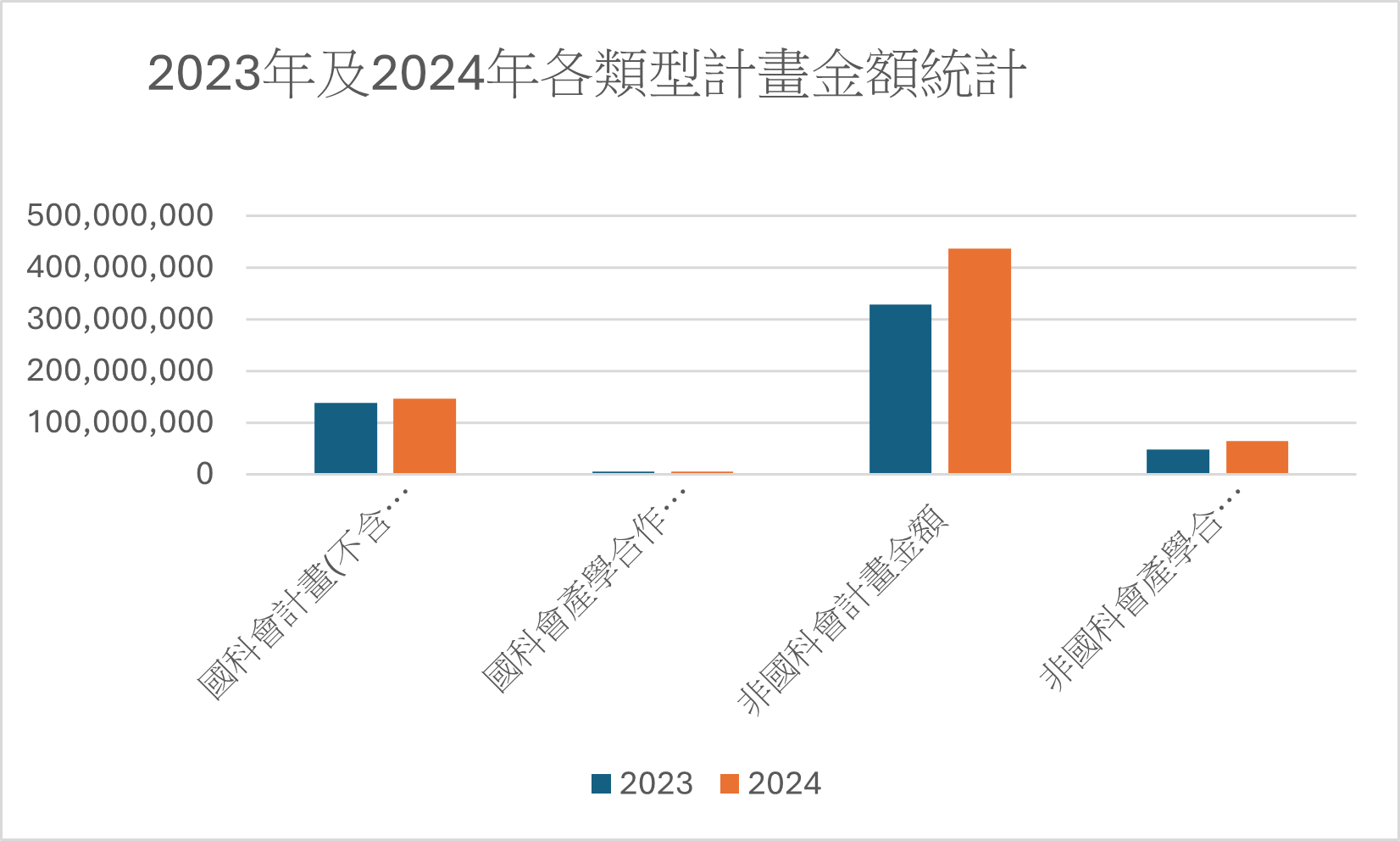
Figure 1. Statistics of Program Amounts by Type for 2023 and 2024
In 2023, 16 faculty members from NCUE implemented a total of 16 projects for government departments. Additionally. This increased in 2024 to 27 faculty members executing a total of 28 government-funded research projects, detailed as follows:
1. Five faculty members Executed five government projects of examining “Reducing Inequality” policies:
(1) Professor Chi-Wei Peng from the Department of Accounting is executing a National Science and Technology Council project (2024/08/01~2026/07/31) titled "An Integrative Study on ESG Disclosure Dilemmas." With the implementation of Corporate Governance 3.0 in Taiwan aimed at enhancing the quality of ESG sustainability report disclosure among listed companies, there remains considerable divergence in views regarding ESG performance and ESG disclosure in both academic literature and practical sectors, creating ESG disclosure dilemmas. This project attempts to examine how these issues affect ESG disclosure dilemmas from organizational behavior and sustainability governance perspectives. The project also seeks to analyze the economic consequences of ESG disclosure dilemmas, hoping to bridge gaps in the literature while providing research findings to regulatory authorities for industry policy formulation reference (Figure 2).

Figure 2. An Integrative Study on ESG Disclosure Dilemmas
(2) Assistant Professor Shu-Hua Lin from the Department of Guidance and Counseling is executing a National Science and Technology Council project (2024/08/01~2025/07/31) titled "Constructing an Advocacy Competency Model for School Counselors and Integrating It into Pre-service Teacher Education Specialized Courses: Action Research on Social Justice Ethics Practice (II)." This research contributes to understanding Taiwan school counselors' advocacy action processes and advocacy competency models, accumulating insights into indigenous cultural advocacy themes. Through integrating research findings into teacher education curricula, the project develops a training framework combining DFC (Design for Change) pedagogy with advocacy competency models, along with developing relevant teaching materials suitable for classroom use, thereby enhancing pre-service counselors' social justice advocacy competencies. Future applications can be extended to other departments or related courses as reference (Figure 3).

Figure 3. Constructing an Advocacy Competency Model for School Counselors and Integrating It into Pre-service Teacher Education Specialized Courses: Action Research on Social Justice Ethics Practice (II)
(3) Professor Yu-Ling Sung from the Department of Geography is executing a Ministry of Education project (2023/08/01~2024/07/31) titled "Ministry of Education 2023 Teaching Practice Research Project - Local Practice in Human Geography: From Topographical Writing of the Coastal Agricultural and Fishing Communities in Fangyuan Township to Place-Making." Building upon previous teaching practice research experience, this study explores how to utilize community practice methods with lower technical barriers that better integrate with geographical theoretical knowledge in demographic geography courses, enabling research participants to enhance knowledge capabilities and transform others' understanding or attention toward communities. The study first uses development association directors as contact points and implementation venues, employing "topographical writing" as an action service-learning strategy, returning to the essence of human geography. The aim is to enable students to integrate demographic geography theory with practical field knowledge, becoming a small but important force in promoting local development. Using action service-learning as practical guidance and topographical writing as implementation strategy, this research adopts Participatory Action Research (PAR) as the research method, supplemented by Action Service Learning as the course's practical implementation strategy, with Fangyuan Township in Changhua County—a coastal semi-agricultural, semi-fishing township—as the implementation venue. Within the historical development context, residents were found to have many unique migration experiences. Through topographical writing emphasizing place and landscape data characteristics, guided by local industry mentors and issue orientation, and based on discussions with community development associations, 8 residents with rich migration experiences who have returned to settle locally were recruited for semi-structured qualitative interviews. After collecting life experience data, students conducted biographical writing, embodying unique sense of place, integrating human geography's "geographic imagination," representing through students' "other" perspectives as an interpretive approach to place, reconstructing place meaning, and making topographical writing texts into local studies materials. Such returnee population biographies enable residents to better understand local character stories, creating teaching materials with local value while allowing the place meanings they construct to be disseminated through community activities or school exchanges, thereby enhancing local value. In teaching effectiveness, the teaching evaluation was 4.78, and pre-post questionnaire analysis showed that students were satisfied with the overall course content and materials regarding [Demographic Geography] course content and materials perspectives and satisfaction levels. In the community aspect, the topographical writing content from this course provided important materials for local cultural performances (intertidal theater troupe performances) (Figure 4).

Figure 4. Local Practice in Human Geography: From Topographical Writing of the Coastal Agricultural and Fishing Communities in Fangyuan Township to Place-Making
(4) Professor Hsien-Chang Wu from the Department of Physics is executing a National Science and Technology Council project (2024/08/01~2025/07/31) titled "Science Popularization Activity: Inquiry and Practice Natural Science Camp for Visually and Hearing Impaired Students." Continuing years of effort, this project aims to create new pathways for visually and hearing impaired students to engage in hands-on science and mathematics learning, while providing a model for Taiwan's inclusive education system. To achieve this goal, the team has invited experts from the fields of pure sciences, special education, and science education to collaborate with various institutions in planning and executing the project. The project also recruits undergraduate students with backgrounds in pure science and science education as counselors, thereby cultivating future teachers with dual expertise. Additionally, we will collaborate with international organizations for knowledge exchange and experience sharing, thereby enhancing the project's global impact. Through this project's implementation, visually and hearing impaired students will directly benefit, not only enhancing their learning abilities and positive life attitudes but also opening new possibilities for their future career choices. The project's implementation not only helps improve society's understanding and acceptance of students with disabilities, further promoting these students' workplace opportunities, but also strengthens support for educational equity for disadvantaged groups. By gathering expertise from different fields, this project focuses on enhancing educational quality for disadvantaged groups, bringing more comprehensive and inclusive development prospects to our society while strengthening Taiwan's international reputation in the education of disadvantaged groups (Figure 5).

Figure 5. Science Popularization Activity: Inquiry and Practice Natural Science Camp for Visually and Hearing Impaired Students
(5) Professor Pei-Wen Lu from the Department of Geography is executing a National Science and Technology Council project (2023/08/01~2026/07/31) titled "Climate Resilient Development and Disaster Prevention and Adaptation Governance: A Just Transition Participatory Approach." This project centers on a just transition participatory approach to construct methods for pursuing climate-resilient development within the scope of disaster prevention and adaptation governance. In academic research, it aims to conduct a systematic analysis of just transition, establishing practical frameworks for integrating just transition into climate decision-making services through international research collaborations and Taiwan-based case studies. In national development, through interdisciplinary alliances between sub-projects, it seeks to identify adaptation governance gaps and explore Nature-Based Solutions (NBS) to enhance climate resilience, responding to climate emergency conditions (Figure 6).

Figure 6. Climate Resilient Development and Disaster Prevention and Adaptation Governance: A Just Transition Participatory Approach
2. Four faculty members assisted the government in executing four research projects focused on "Health and Well-being" policies:
(1) Associate Professor Pei-Fen Wu from the Department of Information Management is executing a National Science and Technology Council project (2024/08/01~2026/07/31) titled "Enhancing Senior Citizens' Technology Experience through XR Applications: Exploring the Impact of Expressive Arts Creation on Creativity and Well-being." This research aims to deepen artistic empowerment for senior citizens through XR-based expressive arts creation activities that integrate digital and artistic elements, while simultaneously achieving digital empowerment in senior technology to further promote their psychological health. To achieve this goal, the study will explore learning motivation in applying XR technology to art education for seniors to understand its potential effects in teaching. Through arts creation activities, the research expects to awaken seniors' latent creativity and gain in-depth understanding of whether arts creation has positive impacts on seniors' psychological well-being. Overall, this study hopes to assist seniors in enhancing creativity and well-being through digital arts experiences, thereby cultivating positive emotions. The anticipated research outcomes will provide new theoretical foundations and empirical experiences for combining senior technology and arts creation, serving as a reference for senior technology and arts education while promoting practical solutions to address aging issues (Figure 7).

Figure 7. Enhancing Senior Citizens' Technology Experience through XR Applications: Exploring the Impact of Expressive Arts Creation on Creativity and Well-being
(2) Assistant Professor Chun-I Chou from the Graduate Institute of Human Resource Management is executing a National Science and Technology Council project (2024/08/01~2026/07/31) titled "Establishing the Dynamic Process of Forgiveness in the Workplace: An Integrated Perspective of Emotion Regulation and Self-Determination." Study 1 of this project attempts to combine self-determination theory and emotion regulation theory, responding to and extending Brady et al.'s (2023) dynamic process of forgiveness, and proposes an emotion regulation motivation-based forgiveness model that emphasizes the role of personal motivation in the emotion regulation process. Emotion identification, regulation tendencies, and regulation strategies are all influenced by individuals' degree of self-determination, resulting in different forms of forgiveness states. Therefore, combining motivational and emotional aspects to explore the dynamic process of forgiveness can more comprehensively capture the forgiveness process and how different processes affect physical and mental health outcomes as well as work outcomes differently. Given that the forgiveness process is a dynamic process where the degree of self-determination plays an important role, Study 2 of this project will continue from Study 1's theoretical model and attempt to use low-interference mindfulness self-training to enhance the degree of self-determination in emotion regulation, thereby improving the level of integrative emotion regulation (Figure 8).

Figure 8. Establishing the Dynamic Process of Forgiveness in the Workplace: An Integrated Perspective of Emotion Regulation and Self-Determination
(3) Associate Professor Chi-Tai Shen from the Graduate Institute of Human Resource Management is executing a National Science and Technology Council project (2024/08/01~2025/07/31) titled "Perceived Supervisor Emotional Blackmail and Harmonious Passion: The Dual Mediating Effects of Rumination and Psychological Capital." Emotional blackmail and passion for work have consistently received considerable attention. Particularly due to the unequal relationship between supervisors and subordinates, supervisors' emotional blackmail can easily impact subordinates' passion for work. However, past research has limited exploration of the process underlying this relationship. Therefore, this research project attempts to integrate a dual mediation model to explore how perceived supervisor emotional blackmail triggers subordinates' ruminative cognitive thinking, thereby reducing psychological capital and ultimately affecting subordinates' harmonious passion. We hope this will bridge the research gap. We believe this will have considerable contribution and value in both academic knowledge accumulation and practical operations (Figure 9).

Figure 9. Perceived Supervisor Emotional Blackmail and Harmonious Passion: The Dual Mediating Effects of Rumination and Psychological Capital
(4) Project Associate Professor Jen-De Chen from the Department of Physical Education is executing a National Science and Technology Council project (2024/08/01~2025/07/31) titled "Are College Student-Athletes Mentally Healthy? - Exploring the Relationships between Training Load, Athletic Burnout, and Depression and Anxiety Symptoms." Social aspect: College student athletes suffering from depression and anxiety symptoms constitute a vulnerable group. This research reveals the status of college athletes' mental health issues, which can improve sports development policies, enhance athletes' physical and mental well-being, and advocate to government, schools, and society at large to strengthen commitments to implementing athletes' mental health. From academic aspect, this project's exploration of factors related to depression and anxiety symptoms can inspire academic thinking, initiate domestic scholars' attention to athlete mental health issues, expand perspectives and stimulate research investment, deepen understanding of Taiwanese college student-athletes' mental health-related problems, accumulate research capacity, and establish a comprehensive knowledge system. From practical aspect, the results of this project will benefit higher education talent development institutions, mental health promotion units, and coaching training practices, serving as a reference for optimizing talent development performance and as a basis for government policy-making to strengthen counseling for athletes and cultivate physically and mentally healthy talents for the nation (Figure 10).

Figure 10. Are College Student Athletes Mentally Healthy? - Exploring the Relationships between Training Load, Athletic Burnout, and Depression and Anxiety Symptoms
3. Fifteen faculty members assisted the government in executing fifteen research projects focused on "Quality Education" policies:
(1) Professor Shu-Hsuan Chang from the Department of Electrical Engineering and Mechanical Technology is executing an NSTC project (2023/08/01-2026/07/31) titled "University Students' Technological Imagination: Scale Development, Measurement Invariance Testing, and Applications in Business and Management Education (Key Code: 403.1)". This research aims to develop a "Technological Imagination Scale" suitable for undergraduate students and explore the cultivation of technological imagination among business and management major students. Theoretically, the research outcomes will contribute to imagination cultivation by proposing a new construction called "technological imagination" (which can serve as a key antecedent for exploring the cultivation of the three innovations: "creativity, innovation, and entrepreneurship"), developing a measurement tool for "technological imagination," and conducting research on interdisciplinary innovative entrepreneurial talent cultivation. Practically, the courses, teaching materials, assessment tools, and research results developed in this project can be applied and promoted across educational institutions at all levels, making concrete contributions to imagination cultivation and interdisciplinary innovative entrepreneurial talent development. Additionally, this imagination cultivation curriculum can be internationalized for educational export, demonstrating Taiwan's international influence as a competitive advantage in international education. Therefore, this research possesses synergy between theoretical innovation and practical application (Figure 11).

Figure 11. Undergraduate Students' Technological Imagination: Scale Development, Measurement Invariance Testing, and Applications in Business and Management Education (Key Code: 403.1)
(2) Professor Su-Ching Lin from the Graduate Institute of Education is executing an NSTC project (2023/08/01-2025/07/31) titled "Exploring the Relationship between Teacher Professional Development Programs and Student Learning—Applications of Relational Systems Evaluation Model, Developmental Evaluation, and Five-Level Model". This two-year project aims to explore the relationship between teacher professional development programs and student learning. The first year focuses on teacher professional development. Using Process-Oriented Guided Inquiry Learning (POGIL) and Evaluative Capacity Building (ECB) as the main components of the teacher professional development program (T-Pogil-RseP1). The project explores POGIL-related theories and practices through cross-school professional learning communities and applies the learning to develop experimental teaching programs for students in the second year (S-POGILP); through the evaluative capacity building process, enhancing participants' knowledge and skills in program evaluation and applies this learning to plan evaluation proposals for S-POGILP. During T-Pogil-RseP1 implementation, Developmental Evaluation (DE) and Five-Level Model (FLM) will be applied through the online platform "T-Pogil-RsePed" mechanism to provide timely feedback, continuously adjusting program content and activity formats, and evaluating participants' professional growth in stages, including reactions to the program, learning, application of learning in program development, and evaluation design. The second year implements S-POGILP experimental teaching and applies the developed evaluation proposals to assess the program's impact on students' physical and chemical science achievement and 5C capabilities. DE and FLM models will also be applied to evaluate the second-year teacher professional development program (T-Pogil-RseP2), assessing teachers' professional growth gained through teaching practice and evaluation processes, including organizational support, application (teaching and evaluation practice), and student learning outcomes stages (Figure 12).

Figure 12. Exploring the Relationship between Teacher Professional Development Programs and Student Learning—Applications of Relational Systems Evaluation Model, Developmental Evaluation, and Five-Level Model
(3) Professor Mei-Chun Wen from the Graduate Institute of Science Education is executing an NSTC project (2023/08/01-2025/07/31) titled "Research on Teacher Identity, Teaching Efficacy, and Curriculum Development of Secondary School STEM Teaching Practice Community Teachers". This project centers on teacher communities, starting from the problems, difficulties, or current situations encountered by each community, and implementing action research to promote STEM curriculum development and teacher teaching efficacy. It is expected to provide participating teachers with systematic teacher professional development, including teacher identity, STEM teaching efficacy, and even professional knowledge and design assessment capabilities for curriculum development. For students participating in STEM curriculum implementation, it is also expected that they can learn integrated knowledge and skills different from single-subject teaching This can be served as preparation for cross-domain capabilities needed for future citizenship. Simultaneously, this research expects to propose successful examples of STEM teaching professional growth for reference by all sectors. For the challenges that the 2019 Curriculum Guidelines bring to various STEM fields, it can also assist in providing feasible curriculum directions. After professional growth, STEM teachers can also serve as leaders in STEM education, spreading teaching enthusiasm across broader educational settings (Figure 13).

Figure 13. Research on Teacher Identity, Teaching Efficacy, and Curriculum Development of Secondary School STEM Teaching Practice Community Teachers
(4) Professor Cheng Meng-Fei from the Department of Physics is executing an NSTC project (2023/08/01-2025/07/31) titled "Developing Portable Green Energy Device STEM Curricula for High Schools and Universities—Exploring Interdisciplinary Learning". From a theoretical perspective, this research contributes to exploring how students engage in interdisciplinary reasoning and learning processes in STEM curricula, the impact of different interdisciplinary teaching methods on students' reasoning and learning, and how to conduct STEM teaching across different natural sciences and assess interdisciplinary capabilities. Students' interdisciplinary learning processes are rarely studied because interdisciplinary learning processes and assessment are difficult. This research not only provides a framework for curriculum design and different interdisciplinary pedagogies, which make science, engineering, technology, and mathematics more closely integrated, but will also develop new assessment methods to evaluate students' interdisciplinary learning processes and outcomes. From a teaching perspective, this research will serve as guidelines for incorporating green energy technology into curriculum design. These curricula can be further promoted and applied to other green energy STEM curricula, enhancing green energy literacy among university students and K-12 education (Figure 14).

Figure 14. Developing Portable Green Energy Device STEM Curricula for High Schools and Universities—Exploring Interdisciplinary Learning
(5) Assistant Professor Chang-Hua Cheng from the Graduate Institute of Science Education is implementing the National Science and Technology Council (NSTC) project (2023/08/01-2025/07/31) "Development, Implementation, and Effectiveness Analysis of Self-Directed Learning Competency-Oriented Mathematics Teaching Modules Based on Integrated Learning Models." This project aims to refine self-directed learning competency-oriented mathematics teaching modules (referred to as modules) and examine the effectiveness of these modules in enhancing teachers' self-directed learning instruction and students' self-directed learning development. The 12-Year Basic Education promotes self-directed learning as a prerequisite for achieving the curriculum ideals of lifelong learning and holistic education. However, academic understanding of how teachers can guide self-directed learning in classrooms remains limited, with related research still in its nascent stage. Based on this, the researcher utilizes integrated learning models to construct modules and develops teacher empowerment training programs to enhance teachers' ability to implement module-based instruction in classrooms. Simultaneously, this project develops relevant assessment tools to analyze and examine teachers' self-directed learning instruction and students' co-regulation occurring during classroom interactions. The research outcomes will contribute to the transformation and implementation of the self-directed learning cultivation ideals in 12-Year Basic Education, as well as academically advance understanding of teachers' self-directed learning instruction, students' co-regulation, and module implementation effectiveness (Figure 15).

Figure 15. Development, Implementation, and Effectiveness Analysis of Self-Directed Learning Competency-Oriented Mathematics Teaching Modules Based on Integrated Learning Models
(6) Professor Wen-Ji Chou from the Department of Biology is executing an NSTC project (2024/08/01~2026/07/31) titled "HimmuSTORY: The Impact of Historical Science Argumentation Live-Action Role-Playing Board Games on Nature of Science". This project develops the historical science live-action role-playing board game "HimmuSTORY" to deepen students' understanding of the nature of science. Students can enhance argumentation abilities through the gaming process and gain deeper understanding of immunology scientific knowledge and science history. Additionally, "HimmuSTORY" can be combined with the junior and senior high school biology curriculum unit "The Body's Defense System" for practical application in teaching settings. The academic impact lies in integrating science education theory into practice products and developing curricula jointly with in-service teachers, enabling effective combination of theory and practical teaching settings. The social impact is that the practice products and teaching activity curricula developed by this integrated project are based on twelve-year basic education competency orientation, cultivating students with scientific literacy required for modern and future needs. The economic impact is that through commercialization of science education practice products, it may drive cross-domain industries such as science education and cultural creativity (Figure 16).

Figure 16. HimmuSTORY: The Impact of Historical Science Argumentation Live-Action Role-Playing Board Games on Nature of Science
(7) Professor Jin-Wen Liao from the Department of Electrical Engineering and Mechanical Technology is executing an NSTC project (2024/08/01~2025/07/31) titled "Task Inquiry and Virtual-Physical Integration: Learning Effectiveness Assessment and Promotion of Micro-Teaching Integrated Industry-Connected Electrical and Electronic Group Educational Practice Curricula". This research project focuses on industrial technology expansion into network information applications, remote video monitoring, artificial intelligence applications, and responding to corporate social responsibility, environmental protection, social responsibility, and corporate governance sustainability, ultimately achieving the vision of "creating shared value". Therefore, during teacher education stages in nurturing technical high school professional group subject teachers, especially in teaching materials and methods and teaching practicum, there is an urgent need to significantly enhance industry connections. Through rigorous cultivation processes such as task inquiry, virtual-physical integration, micro-teaching, and teaching demonstrations, ensuring the quality of vocational subject teachers' professional development and practical teaching capabilities is a goal that is of this project’s concern. This project can bring three expected benefits for pre-service teachers: (1) When choosing employment, they can meet the talent recruitment needs of enterprises. (2) When serving as vocational subject teachers, they will possess practical teaching skills. (3) They can provide feedback to their teacher education programs, supporting teaching resources needed for educational practice courses (Figure 17).

Figure 17. Task Inquiry and Virtual-Physical Integration: Learning Effectiveness Assessment and Promotion of Micro-Teaching Integrated Industry-Connected Electrical and Electronic Group Educational Practice Curricula
(8) Professor Ai-En Lin from the Graduate Institute of Technology and Adolescent English is executing an NSTC project (2024/08/01~2026/07/31) titled "Effectiveness and Task-Technology Fit of AI Teaching Agents Guiding Sixth Graders to Explain Scientific Concepts in English within Virtual Reality Games". This project responds to the current national promotion of people's bilingual competency, expecting to contribute to bilingual capability cultivation for adolescents and children. In the aspect of using information technology integration in teaching, including how to conduct gamified teaching guidance through virtual reality technology combined with generative artificial intelligence, the empirical research results will help researchers and teachers in related fields understand how to more effectively use generative artificial intelligence and virtual reality technology to guide adolescents or elementary students in explaining scientific concepts in English (Figure 18).

Figure 18. Effectiveness and Task-Technology Fit of AI Teaching Agents Guiding Sixth Graders to Explain Scientific Concepts in English within Virtual Reality Games
(9) Professors from the Department of Biology are executing an NSTC project (2024/08/01~2025/07/31) titled "Genetics and Ecology Experimental Teaching Module: Junior and Senior High School Inquiry and Practice Science Experiment Design". This project focuses on the designed and developed "Genetics and Ecology" experimental teaching module for junior and senior high school inquiry and practice experimental equipment design, based on basic concepts or principles in the biology field. The project develops experimental teaching equipment suitable for junior and senior high school students' inquiry and practice science experiments, based on biology curriculum educational content, covering genetics, evolution, and ecology fields. Through modular experimental equipment kits, students can understand concepts, phenomena, logic, and theories through hands-on operation, experimental recording, group discussion, and logical reasoning processes in classrooms, making difficult-to-understand biological theories such as genetic and evolutionary concepts occurring within organisms, and ecological phenomena and theories requiring longer observation and research time in macro-environments concrete through specific examples. This project will design hands-on experimental equipment for students, using appropriate explanations and worksheets for teachers and students to understand, operate hands-on, and commercialize (Figure 19).

Figure 19. Genetics and Ecology Experimental Teaching Module: Junior and Senior High School Inquiry and Practice Science Experiment Design
(10) Professor Shu-Li Lin from the Graduate Institute of Science Education is executing an NSTC project (2024/08/01~2026/07/31) titled "Science Creativity-Oriented General Education Curricula and Initial Exploration of Integrating Generative AI: Effects on Problem-Solving Thinking, Science Creative Product Performance, and Creative Self-Efficacy". This project intends to transform previously successful inquiry general education curricula to develop general education curricula that cultivate students' scientific creativity. The first semester will develop and validate two research tools: "Scientific Problem-Solving Thinking Test" and "Science Content Knowledge Test", then implement two rounds of curricula to examine students' scientific problem-solving thinking, science creative product performance, and creative self-efficacy as curriculum effectiveness measures. The fourth semester will integrate generative AI use into the curriculum to verify generative AI's impact on students' scientific creativity and other items. Additionally, expert consensus assessment techniques and direct ranking hierarchical analysis methods will be used to evaluate science creative products produced by groups. The quality of creative products from students in this sub-project and the main project will also be compared to contrast science creative products produced by science creativity general education curricula and STEM teacher education curricula as a basis for curriculum improvement. This project has reference value for developing science creativity curricula (Figure 20).

Figure 20. Science Creativity-Oriented General Education Curricula and Initial Exploration of Integrating Generative AI: Effects on Problem-Solving Thinking, Science Creative Product Performance, and Creative Self-Efficacy
(11) Professor Hsien-Chang Wu from the Department of Physics is executing a National Science and Technology Council project (2024/08/01~2025/07/31) titled "Science Popularization Activities: Inquiry and Hands-on Natural Science Camps for Visually Impaired and Hearing-Impaired Students." This project continues years of dedicated efforts, aiming to create new pathways for hands-on science and mathematics learning for visually and hearing-impaired students, and through the practice of inclusive education, to provide a model for the broader inclusive education system in Taiwan. To achieve this goal, our team invites experts from pure sciences, special education, and science education fields to collaborate with various institutions in planning and implementing the project. The project will also recruit university students with backgrounds in pure sciences and science education to serve as counselors, thereby cultivating a future teaching workforce with dual expertise. Furthermore, we will collaborate with international organizations for knowledge exchange and experience sharing, thus enhancing the project's impact. Through the implementation of this project, visually and hearing-impaired students will directly benefit, not only enhancing their learning abilities and positive attitudes towards life but also opening new possibilities for their future career choices. The implementation not only helps increase the society's understanding and acceptance of students with disabilities, further promoting workplace opportunities for these students, but also strengthens support for educational equity for disadvantaged groups. By bringing together experts from different fields, this project focuses on improving educational quality for disadvantaged groups, not only bringing more comprehensive and inclusive development prospects to our society but also enhancing Taiwan's international image in education for vulnerable populations (Figure 21).

Figure 21. Science Popularization Activities: Inquiry and Hands-on Natural Science Camps for Visually Impaired and Hearing-Impaired Students
(12) Professor Shu-Hua Lin from the Department of Guidance and Counseling is executing a National Science and Technology Council project (2024/08/01~2025/07/31) titled "Construction of School Counseling Teachers' Advocacy Competency Model and Integration into Pre-service Teacher Education Professional Courses: Action Research on Social Justice Ethics Practice (II)." This research contributes to understanding the advocacy action processes and advocacy competency models of counseling teachers in Taiwan, accumulating understanding of local cultural advocacy themes. By integrating research results into teacher education curricula, the project develops a training framework combining DFC teaching methods with advocacy competency models, as well as compiling relevant teaching materials and handouts suitable for classroom use. This helps enhance pre-service counseling teachers' social justice advocacy competencies and can be extended to other departments or related courses for reference in the future (Figure 22).

Figure 22. Construction of School Counseling Teachers' Advocacy Competency Model and Integration into Pre-service Teacher Education Professional Courses: Action Research on Social Justice Ethics Practice (II)
(13) Professor Pei-Shu Tsai from the Graduate Institute of Translation and Interpreting is executing a National Science and Technology Council project (2024/11/01~2025/10/31) titled "Exploring Cognitive Load Changes in Students Learning English-Medium Instruction Materials through Behavioral and EEG Data." In response to current changes in higher education, many domestic universities have begun implementing bilingual or English-medium instruction. This research utilizes objective EEG data and students' subjective cognitive load questionnaires to propose research from the user perspective. The research findings can provide reflection on the currently implemented bilingual education in society. In terms of academic development, this research differs from past studies focusing on English for Specific Purposes (ESP) by adopting interdisciplinary cognitive science EEG research methods, revealing real-time brain activity information during the learning process. This also provides positive assistance for promoting Chinese-English bilingual teaching research based on Taiwan's experience (Figure 23).

Figure 23. Exploring Cognitive Load Changes in Students Learning English-Medium Instruction Materials through Behavioral and EEG Data
(14) Professor Yung-Ling Lai from the Department of Mechatronic Engineering is executing a National Science and Technology Council project (2024/08/01~2025/07/31) titled "Science Popularization Activities: Net Zero Sustainability—Solar Energy Science Popularization Education Project." The project aligns with the educational development of the 12-year national education system, transforming complex and abstract net zero technology knowledge into scientific knowledge that is relevant to citizens' lives and easy to understand. Through three major promotions—net zero technology science camps, net zero technology tours, and filming popular science= videos—the project disseminates net zero technology science knowledge to stimulate students' curiosity about net zero technology, inspire learning interest, enhance learning motivation and confidence, and cultivate young students with knowledge and capabilities in net zero technology. Through the implementation of net zero technology science popularization activities, this project popularizes net zero technology science knowledge among public, enhances citizens' understanding of net zero technology, and improves citizens' scientific literacy, thereby establishing the foundation for Taiwan's net zero technology industry development (Figure 24).

Figure 24. Science Popularization Activities: Net Zero Sustainability—Solar Energy Popular Science Education Project
4. Four faculty members are assisting the government in implementing five research projects focused on "affordable and clean energy" policies.
(1) Professor Wei-Ze Huang of the Department of Electrical and Mechanical Technology executed the NSTC project (2023/08/01-2025/07/31) titled "Research on Enhancing Regional Distribution Network Operational Performance and Resilience Using Reconfigurable Networked Microgrids." In response to domestic and international power supply instability caused by high renewable energy penetration, this study applies the concept of reconfigurable networked microgrid operations to improve distribution network operational performance and enhance operational resilience. Each microgrid not only possesses self-sufficient autonomous capabilities but can also support power regulation within distribution network through the public grid. Additionally, the established optimal models and strategies for normal operation and contingency scenarios of networked microgrids can provide relevant applications and research for industry, government, and academia, contributing to government promotion of private microgrid deployment and distribution network operations with networked microgrids, creating a win-win situation for both power supply and demand sides (Figure 25).

Figure 25. Research on Enhancing Regional Distribution Network Operational Performance and Resilience Using Reconfigurable Networked Microgrids
(2) Assistant Professor Chi-Hua Hsu of the Department of Mechanical and Electro-Mechanical Engineering executed the NSTC project (2024/01/01~2025/03/31) titled "Intelligent Quality Prediction Analysis and Optimization Design for Assembly Tolerances in Non-Rigid Machine Tool Manufacturing Processes." With rising global energy prices and severe climate change, people have begun to emphasize energy development, conservation, and environmental protection issues. Machine tools, acclaimed as the core equipment of industrial manufacturing, occupy a significant portion of overall industrial energy consumption, with their carbon dioxide emissions being a considerable concern. Therefore, based on the global trends of energy saving and carbon reduction, this project expects to digitally model machine tool assembly processes and conduct subsequent assembly quality analysis and optimization, thereby reducing energy consumption during the machine tool assembly stage and improving assembly quality. The project objective is to establish a non-rigid five-axis machine tool assembly quality prediction analysis system to analyze the effects of non-rigid material characteristics and component tolerances on overall machining accuracy, and to identify optimal tolerance configurations through optimization theory. In view of this, completing this project is expected to help domestic machine tool manufacturers enhance their assembly process capabilities (Figure 26).

Figure 26. Intelligent Quality Prediction Analysis and Optimization Design for Assembly Tolerances in Non-Rigid Machine Tool Manufacturing Processes
(3) Assistant Professor Feng-Yi Tsao of the Department of Chemistry executed the NSTC project (2024/08/01~2027/07/31) titled "Design and Synthesis of Functional Conjugated Polymers for Application in Thin-Film Photocatalytic Hydrogen Production Technology." This project will focus on synthesizing various D-A type conjugated polymers and hydrophilic conjugated polyelectrolyte materials, utilizing thin-film processes to prepare organic conjugated polymer thin-film photocatalysts for application in photocatalytic hydrogen production technology. This project not only deepens domestic organic photocatalytic hydrogen production technology but also responds to global green energy and carbon reduction policies. Furthermore, it can integrate with technologies from other optoelectronic-related fields for interdisciplinary collaboration, thereby expanding the application scope of organic photocatalytic hydrogen production (Figure 27).

Figure 27. Design and Synthesis of Functional Conjugated Polymers for Application in Thin-Film Photocatalytic Hydrogen Production Technology
(4) Professor Wei-Ze Huang of the Department of Electrical and Mechanical Technology executed the NSTC project (2024/08/01~2026/07/31) titled "Research on Zero-Energy Building Microgrid Energy Management Using Machine Learning and Swarm Optimization Algorithms." In response to the continuously rising global building energy consumption and COP28's ongoing commitment to achieving global net-zero emissions by 2050, developing zero-energy building microgrid operational concepts has become imperative. This project aims to establish algorithms for optimal renewable energy and energy storage system configurations required for zero-energy buildings. By applying machine learning and swarm optimization algorithms for building energy management system prediction, the project seeks to achieve building power balance within specific periods with energy saving and CO2 emission reduction as indicators, providing references for industry, government, and academia. Additionally, introducing zero-energy building microgrid operational concepts, considering on-site renewable energy, energy storage systems, and load control operation methods, can not only achieve energy autonomy and energy saving with carbon reduction but also assist public distribution networks in power regulation, contributing to promoting high-voltage user energy autonomy and increasing renewable energy self-consumption ratios and regional power supply stability (Figure 28).

Figure 28. Research on Zero-Energy Building Microgrid Energy Management Using Machine Learning and Swarm Optimization Algorithms
(5) Professor Chih-Cheng Lo of the Department of Electrical and Mechanical Technology executed the NSTC project (2024/08/01~2026/07/31) titled "Establishment and Effectiveness Evaluation of Teaching Modules Using Living Laboratories in Climate Change Education - Taking Smart Home Microgrid Green Behavior as an Example." This project's aims to explore the relationship between smart home design of renewable energy microgrid system and the eco-friendly behavior from the perspective of energy users, further developing climate change interdisciplinary teaching material modules for microgrid system smart home living laboratories, and thoroughly investigating the impact of smart home microgrid future living laboratory teaching modules on student learning effectiveness. Living laboratory teaching modules can be applied in climate change education and related policy measures for enhancing social sustainability awareness. Living laboratories provide better understanding of environmental and social sustainability issues. This educational and awareness enhancement can promote environmental literacy and sustainability concepts among users in daily life, inspire energy-saving and pro-environmental behaviors, and improve climate change literacy (Figure 29).

Figure 29. Establishment and Effectiveness Evaluation of Teaching Modules Using Living Laboratories in Climate Change Education - Taking Smart Home Eco-friendly Behavior as an Example
5. NCUE is implementing the University Social Responsibility (USR) Implementation Project organized by the Ministry of Education.
(1) Projects: The third phase (2023-2024) of the University Social Responsibility Implementation Project includes:
"NCUE x Common Good: Deep Cultivation and Advancement of Local Communities ", " Beautiful and Treasured Clams in Fangyuan and Dacheng: Sustainable Industry and Environment Project of Changhua’s Two Townships Amid Climate Change", "Ecological Homelands and Urban-Rural Sustainability: A Changhua Ecological Art Project", "Sustainable Changhua: Green Energy Perspective in Education, Technology, and Economy."
(2) Empirical evidence and results: NCUE’s USR projects have unique characteristics. The Teaching Excellence Centre continues to strengthen the support system and encourage faculty members and students to study and propose USR-related research plans on teaching practices and participate in project-based practical courses that can solve local problems. The projects integrate the concepts of corporate social responsibility (CSR) and environmental, social, and corporate governance (ESG) to realize the United Nations’ SDGs, effectively driving faculty members and students to solve local issues for the win–win situations in sustainable development and the circular economy.
This achievement report has been made public, please refer to the USR EXPO website:
(a) NCUE x Common Good: Deep Cultivation and Advancement of Local Communities (Figure 30): https://drive.google.com/file/d/1RAjWp2VrKm8W0VLtgpFQ5Rs6UWwB1CM7/view
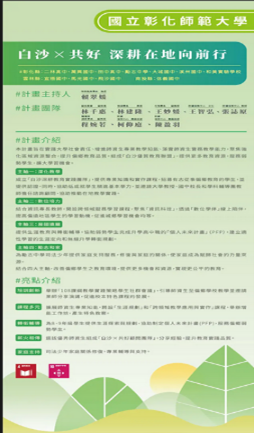
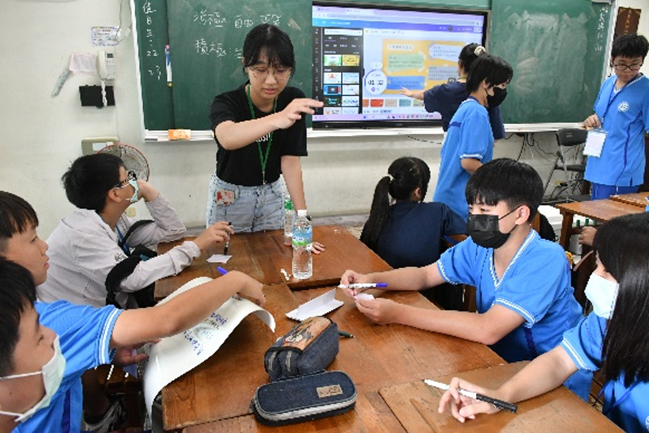
Figure 30. NCUE x Common Good: Summer Camp for Junior High Schools in Remote Areas
(b) Beautiful and Treasured Clams in Fangyuan and Dacheng: Sustainable Industry and Environment Project of Changhua’s Two Townships Amid Climate Change (Figure 31): https://drive.google.com/file/d/1TNv2y3bqe4WNXR9_p_BOd09c7t0MUvAJ/view
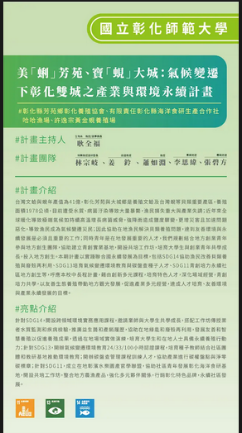
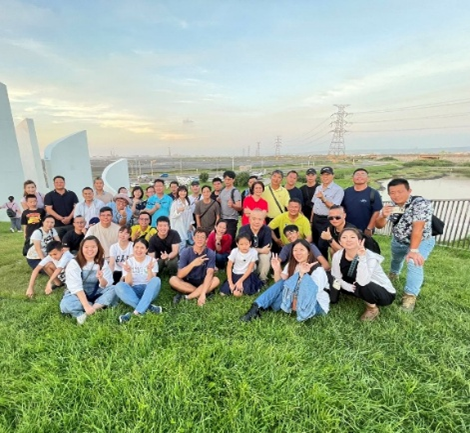
Figure 31. Beautiful and Treasured Clams in Fangyuan and Dacheng: Trip to Changhua Coastal Industrial Park
(c) Ecological Homelands and Urban-Rural Sustainability: A Changhua Ecological Art Project (Figure 32): https://drive.google.com/file/d/1qMTrN4_jgyMyjzX4jPIzrgo1oZp_x0UI/view
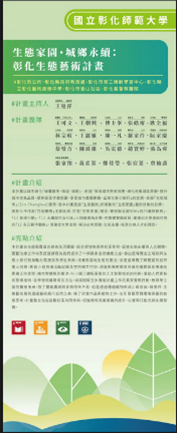
Figure 32. Ecological Homelands and Urban-Rural Sustainability: A Changhua Ecological Art Project